
How to Get Earthquake Early Warning: ShakeAlert, WEA, and Phone Alerts 2026
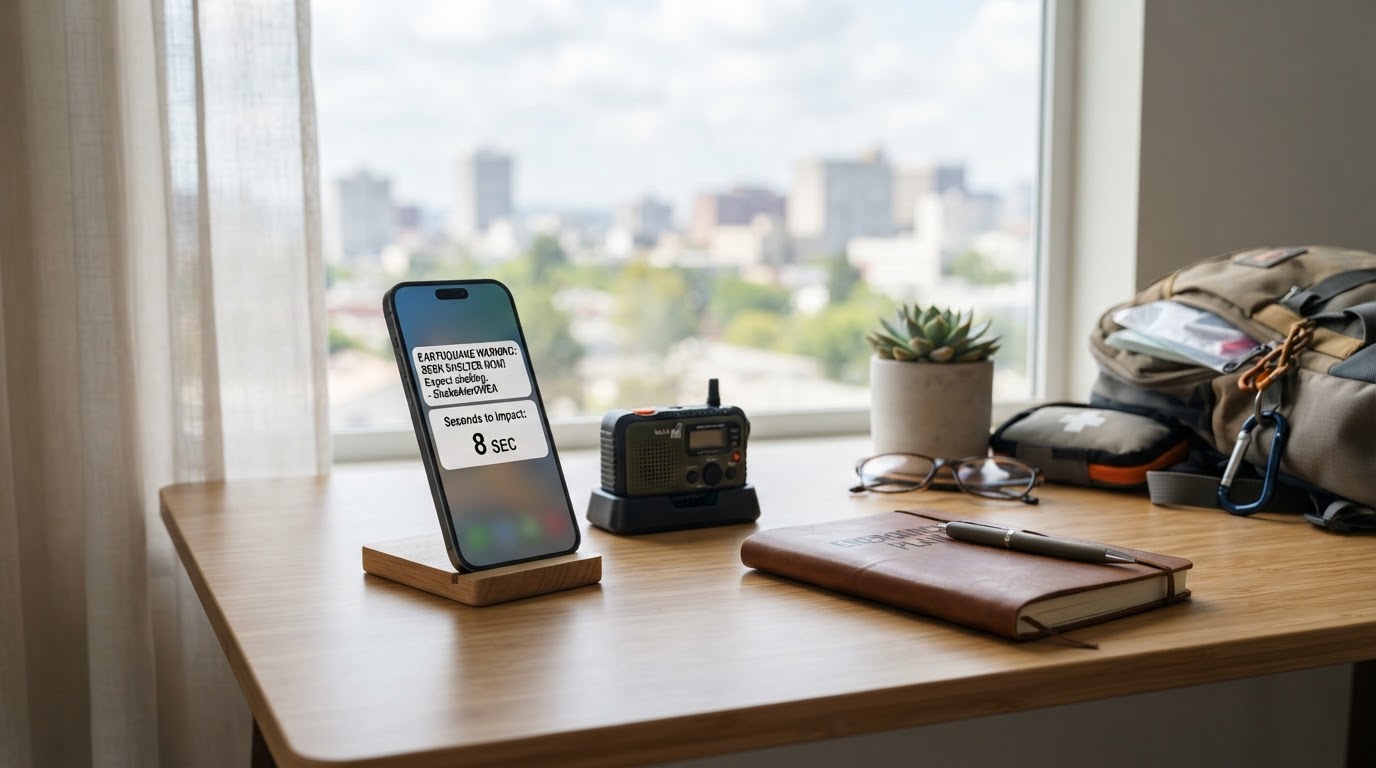
How to get earthquake early warning: enable ShakeAlert, WEA, and phone alerts, know how many seconds of warning each buys, and what to do when it fires.
This article contains affiliate links. If you buy through these links, we may earn a small commission at no extra cost to you.
Earthquake early warning is real, and you probably already carry it. In California, Oregon, and Washington, the USGS ShakeAlert system detects the first fast wave of a quake and fires a phone alert a few seconds to a minute before the strong shaking arrives. The direct answer: keep Wireless Emergency Alerts on, add one low-latency app for your region, rehearse the drop-cover-hold drill once a year, and treat every alert as the real thing. The warning buys you seconds; spend them under a table, not in a doorway. The what to do during and after an earthquake guide covers drop, cover, and hold on; this piece is about the head start.
Key takeaways:
- Early warning detects a quake that has already started; it never predicts one.
- WEA is free and mostly on by default; a purpose-built app is the fast lane.
- The closer you are to the epicenter, the less warning you get. Near it, the alert can arrive as the ground moves.
- Warning only helps if the drill and gear are ready before it fires.
What Earthquake Early Warning Actually Is
An earthquake releases two seismic waves: a fast, weak P-wave and a slower, destructive S-wave. ShakeAlert runs a network of seismometers that catches the P-wave, estimates location and magnitude within about a second, and broadcasts an alert that outraces the S-wave. It is not prediction; the quake has already happened, and the system is racing its own slowest wave.
The system is run by the USGS with university and state partners and is live in California, Oregon, and Washington. Set up every layer your region offers.
Distance is the limit. Far from the epicenter you can get tens of seconds to a minute of warning. A few miles out you get almost none. Plan for the best case, but never wait for the alert: if the ground moves, you drop, cover, and hold on.
The Four Ways Alerts Reach You
All four channels use the same kind of trigger; they differ in speed and set-up.
| Channel | How it reaches you | Cost | Best for |
|---|---|---|---|
| Wireless Emergency Alerts (WEA) | Cell broadcast from your carrier, same as weather and AMBER alerts | Free, mostly on by default | The baseline. No app, no sign-up, no battery trade-off |
| Android Earthquake Alerts | Built into Android settings; Google's detection network | Free | Most Android users once enabled |
| iPhone earthquake alerts | Built into iOS using other iPhones' accelerometers in supported regions | Free | iPhone users on current iOS |
| MyShake (UC Berkeley) | App from the Berkeley Seismological Laboratory | Free | A second, low-latency layer plus a research contribution |
WEA is the floor: it reaches nearly every phone with no app. A purpose-built layer like MyShake or your region's official app is the fast lane. Run WEA as the floor, one app as the backup.
Set It Up Today (a Five-Minute Check)
- Wireless Emergency Alerts. Settings, then Notifications or Safety, then Wireless Emergency Alerts. Keep the toggles on; people turn them off and forget.
- Android. Settings, then Safety and emergency, then Earthquake alerts. Flip it on.
- iPhone. Update to a recent iOS. Built-in alerts are automatic in supported regions, so there is usually no toggle.
- Add one app. Install MyShake or your state's official alert app for a low-latency layer where cell broadcast is slow.
- Run the drill. The Great ShakeOut happens every October and takes about a minute. Practice drop, cover, and hold on once a year so the motion is automatic when the alert fires.
What to Do With the Seconds You Get
The warning does not change the drill; it lets you do it calmly and from a better position.
- Indoors: get under a sturdy table, away from windows and tall furniture, and hold on. Do not head outside; falling glass and facades are the danger out there.
- In bed: stay put, roll over, and cover your head and neck with a pillow. Most quake injuries happen to people who stand up and step on glass.
- Driving: pull over clear of bridges, overpasses, and power lines, set the brake, and stay in the vehicle. The alert may be your first sign.
- With real seconds to spare: get kids and pets low and grab shoes. Everything else waits.
The Gear That Backs Up a Warning
A warning you cannot receive is just trivia. Three things keep it working for you, and they are the same kit you want for the outage that follows.
Keep your phone charged. The EcoFlow RIVER 3 Portable Power Station is the honest way: 245Wh, wall, car, or solar recharge, safe indoors, enough to top up the household's phones and radios for days. It is a battery station, not a generator, and that is the point.
WEA depends on a cell broadcast, and a major quake can disrupt towers. A NOAA radio does not depend on that network: the Midland ER310 Emergency Radio receives NOAA weather and emergency broadcasts and runs for more than 72 hours per charge. Use it for local instructions after the shaking; use USGS event pages for aftershock forecasts when internet service is available.
The seconds the warning buys lead into the aftermath. Broken glass and falls can cause serious injuries, so keep a kit within arm's reach: the First Aid Only 298-Piece All-Purpose Kit covers minor cuts, burns, and sprains for about $16.
What Early Warning Won't Do
- It does not predict. A quiet phone is not an all-clear; it just means no quake has been detected yet.
- Coverage is uneven. ShakeAlert is live on the West Coast; elsewhere, check what your region offers. If nothing, run a NOAA radio and a stocked kit.
- It can be wrong. False alerts are rare but possible, and misses happen too. Neither is a reason to disable the system.
Quick Recommendations
- Keep your Wireless Emergency Alert toggles on.
- Enable Android Earthquake alerts or confirm iOS coverage.
- Add MyShake or your region's official app as the low-latency layer.
- Practice drop, cover, and hold on at least once a year.
- Power for the phone that warns you: EcoFlow RIVER 3 Portable Power Station.
- The alert layer that ignores dead towers: Midland ER310 Emergency Radio.
- The kit for the minutes after: First Aid Only 298-Piece All-Purpose Kit.
A big quake in the West is a when, not an if. The good news: for the first time you get advance notice. Turn the alerts on this weekend, run the October drill, and keep the phone charged. That is the whole system.