
Earthquake Gas Shutoff: When to Turn Off Gas and How to Do It
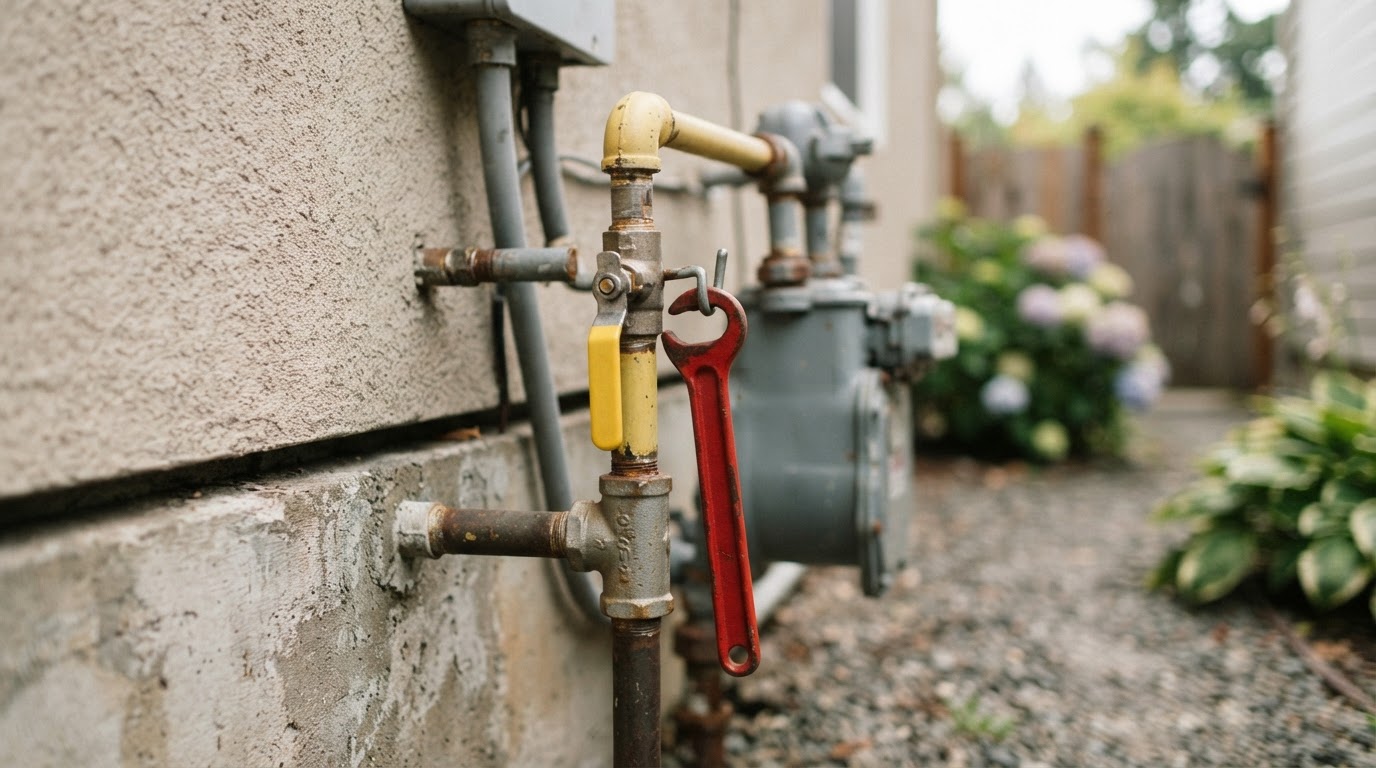
Smell gas after an earthquake? When to shut off your gas (and when not to), the quarter-turn wrench method, and what seismic auto-valves already cover.
This article contains affiliate links. If you buy through these links, we may earn a small commission at no extra cost to you.
The fire that follows an earthquake can do more damage than the shaking itself. San Francisco 1906, Kobe 1995, and the Marina District fire after Loma Prieta all started the same way: a broken gas line met a spark. The fix is ten seconds with the right wrench, but only when the evidence tells you to.
The short answer: shut off the gas only on evidence of a leak — rotten-egg odor, a hiss near the meter or an appliance, or visible damage to a line — and only if you can reach the valve safely. Otherwise leave it on; restoring a needlessly shut-off line takes a utility crew and can leave you without heat for days. When you do shut it off, make one 90-degree quarter-turn of the meter valve so the bar sits crosswise to the pipe. Don't turn it back on yourself — only the utility or its licensed contractor restores gas.
This is the same walk-through as general home prep; the full setup is in how to prepare your home for an earthquake.
When to shut it off, and when NOT to
SoCalGas, PG&E, FEMA, and USGS guidance agree: shut off on evidence, not on shaking alone. Tape this list inside the meter box.
Shut it off — only if you can reach the valve safely — when you notice:
- Sulfur/rotten-egg odor at the meter, a gas appliance, or a gas line.
- Hissing near the gas meter, a stove, or the water heater.
- Dead houseplants, white dust, or dust blowing from a line.
- The house has shifted, the foundation is cracked, or a gas appliance has toppled.
Leave it ON if:
- You feel a quake but smell and hear nothing, and the building looks intact. Shaking alone is not a reason to shut off; a needless one means days without gas.
- A neighbor says "just turn it off to be safe." Utility guidance is explicit: only the affected building's valve, and only on evidence.
- You can't safely reach the meter because of debris, a leaning wall, or a downed line. Evacuate and call from outside instead.
Get out instead when: the odor is strong throughout the house, the meter sits in a space you'd have to re-enter, or you feel lightheaded. Call from outside; never go back into an evacuated building to reach the valve.
Once you shut the main valve, don't restore it yourself. Gas crews purge air, relight pilots, and check for leaks. Same for appliance connectors: if a heater or stove toppled or its connector is kinked, a licensed gas contractor must inspect and reconnect it.
For an indoor leak at any time, the full leave-the-house playbook is in what to do if you smell gas.
Find the valve before the quake
In single-family homes the meter sits on an exterior wall near the street; in apartments, a utility closet or basement. Look for a raised cast-iron or brass valve with a flat rectangular bar on the pipe before the meter dial, plus a valve at each indoor appliance.
Put the wrench where you can reach it in the dark:
- A Prime-Line PH 17106 Gas Shut-Off Wrench (~$6, single-piece steel, fits the standard 1/4-turn bar) zip-tied to the meter pipe or hung on a nail at eye height — not buried in a toolbox.
- A backup near the water heater, since a toppled heater is the most common leak source. If you strapped it per our home-prep checklist, you're already ahead.
How to turn it off in 10 seconds
Practice once, with gas on and no leak, so the motion lives in your hands. Then leave the valve alone.
- Smell and listen. Crouch low near the meter. If you detect odor or hiss, proceed.
- Fit the wrench square on the bar. The Prime-Line PH 17106 Gas Shut-Off Wrench seats on all four flats, no adjustable jaw to slip when your hands shake.
- Quarter-turn clockwise until the bar sits perpendicular (crosswise) to the pipe. Along the pipe is on; across is off. One firm turn, don't force past 90 degrees.
- Leave it there. Hang the wrench back on the pipe and get outside.
- No spark sources. No switches, no unplugging, no phone until you're outside. Report from upwind or a neighbor's line.
Apartments often share a manifold: the building main cuts gas to every unit. If only your unit smells, shut the appliance valve first; if the odor persists or is at the manifold, use the main and alert the manager.
What about automatic shut-off valves?
Seismic excess-flow valves (EFVs) trip on a big flow surge — useful, but not a substitute: they can trip on a strong aftershock with no leak (a false shut-off a tech still has to reset), and they can miss a slow crack that fills a crawl space over hours. Think of an EFV as a seatbelt and the wrench as the steering wheel.
The first 10 minutes after any shake
- Drop, cover, and hold on until shaking fully stops (full drill in what to do during and after an earthquake).
- Shoes on, radio on; a Midland ER310 Emergency Radio tells you whether to stay or evacuate before cell service becomes congested.
- Smell for gas, listen for hiss, glance at the water heater. Shut off only on evidence.
- If you shut off, kill small fires with what you have, but get out if smoke is beyond a wastebasket.
- Text family (texts queue better than calls when networks congest); check on neighbors who may not smell mercaptan.
Power, light, and water when gas stays off
A shut-off means no stove, no furnace, and often no hot water until the utility clears you.
- Light: A solar lantern like BioLite Luci Emergency Lantern charges by day and runs all night without fuel.
- Power: The EcoFlow RIVER 3 Portable Power Station (245 Wh) keeps phones and radio going for days.
- Water: A Reliance Aqua-Tainer 7 Gallon Water Container… (7 gal) covers the days when the water utility also runs slow after a quake.
Common mistakes
- Shutting off "just in case" after every felt quake, then waiting days for a tech.
- Storing the wrench indoors; the meter is outside, and so is the tool.
- Using pliers or an adjustable wrench that rounds the bar; a fitted wrench costs ~$6.
- Trying to relight pilots yourself. Leave restoration to the crew.
Quick recommendations
- First buy: Prime-Line PH 17106 Gas Shut-Off Wrench, ~$6, lives on the meter
- Stay informed: Midland ER310 Emergency Radio, NOAA alerts when phones fail
- See at night: BioLite Luci Emergency Lantern, solar light, no fuel
- Backup power: EcoFlow RIVER 3 Portable Power Station, phones and radio for days
Walk out tonight, find the meter, fit the wrench, picture the quarter-turn. That 60-second rehearsal is the whole skill.
If the quake escalates into a federal disaster declaration, FEMA's Individuals and Households Program can cover temporary housing and repair costs. The apply-and-document walkthrough is in our FEMA disaster assistance guide.
Sources: FEMA Ready.gov and PHMSA utility-shutoff guidance, USGS earthquake safety handbooks, SoCalGas and PG&E shut-off instructions (2024–2026); valve cost ranges from contractor cost guides (2024–2025). Confirm your valve type with your local gas utility; shapes vary by region.
Frequently asked questions
When should I shut off my gas after an earthquake?
Only on evidence of a leak: rotten-egg odor, hissing at the meter, or a meter dial spinning with every appliance off — and only if you can reach the valve safely. A needless shutoff can leave your home without gas for days while crews work through the queue.
How do I turn off the gas after an earthquake?
Find the shutoff valve at the meter, a vertical bar in line with the pipe. Use a wrench (zip-tie one to the meter so it's always there) and turn a quarter turn until the bar crosses the pipe. Only the utility should turn it back on.
What is an automatic seismic gas shutoff valve?
A valve that closes automatically when shaking exceeds a threshold, solving the nobody-home problem. Quotes typically run $300–$700 installed depending on the valve, meter, and local permit fees (contractor cost guides, 2024–2025). It needs a manual reset, and like the manual valve, only the utility restores service afterward.