
How to Use FRS/GMRS Two-Way Radios for Family Coordination (2026)
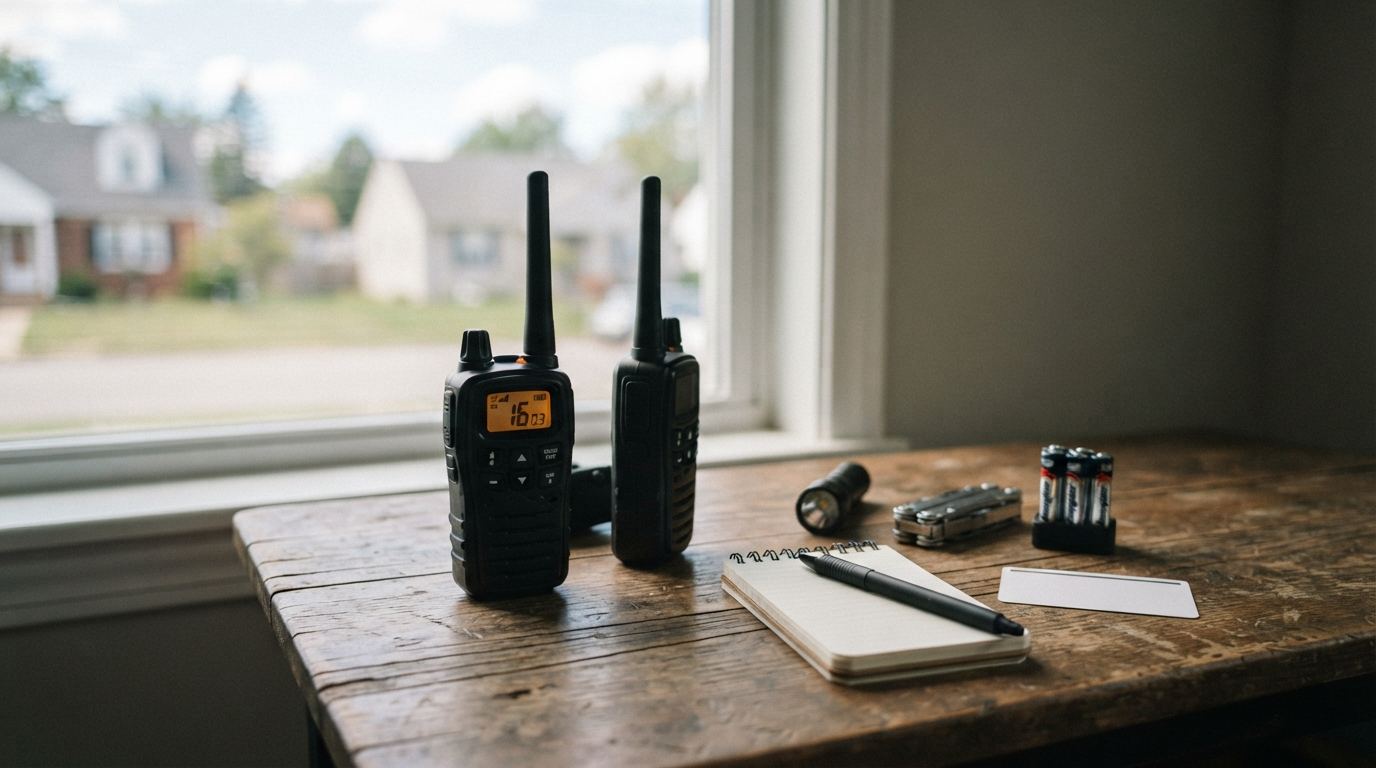
FRS and GMRS two-way radios keep families in touch when cell service is disrupted, with channels, CTCSS privacy codes, range limits, and a battery plan.
This article contains affiliate links. If you buy through these links, we may earn a small commission at no extra cost to you.
Cell networks can become congested or unavailable during a major storm. Your family still needs to talk across the neighborhood, between cars in a convoy, or from the house to the shelter down the street. Two handheld radios can keep your family in contact without relying on local cell service. The job is not buying a pair. It is putting both on the same channel, setting a tone so you hear each other and not the whole block, and keeping them charged when the grid is down.
This is the practical companion to our family emergency communication plan. That plan covers the out-of-area contact, two meeting points, and NOAA on 162.550 MHz. This guide is the radio skill: channels, privacy codes, honest range, and the battery setup that keeps the shelf alive for days.
FRS vs GMRS, plain
FRS and GMRS share the same 22 channels around 462 and 467 MHz. Any hardware-store blister pack speaks both. The difference is power and paperwork.
FRS is license-free, capped at 2 watts, fixed antenna. Turn it on and talk.
GMRS allows up to 50 watts on some channels, detachable antennas, and repeaters. It needs an FCC license: $35 for ten years, no test, one license covers your immediate family. The Midland GXT1000VP4 GMRS Two-Way Radio Pair is a 50-channel GMRS pair built for that power, with 142 CTCSS and DCS codes, NOAA weather, and a 36-mile advertised range.
Buy a GMRS-capable pair. You can use it on FRS channels today with no license and add the $35 license later for repeater range.
The 22 channels
Channels 1 through 22 are the working set. Channels 1 to 7 and 15 to 22 are shared high-power slots where GMRS allows 50W and FRS stays at 2W. Channels 8 to 14 are FRS-only at 0.5W. Most handhelds also list the repeater inputs 15R to 22R, which you can ignore until you have the license.
Agree on one channel and leave every radio there. Channel 16 or 20 is usually quieter than 1 or 9, where everyone defaults.
Write the channel on the family card. "Ch 16" beats memory under stress.
Privacy codes filter noise, not eavesdropping
Every radio advertises "142 privacy codes." Those are tone squelch, CTCSS and DCS. Your radio sends a sub-audible tone with your voice, and the other radio only opens when it hears that tone. You still share the channel, you just do not hear everyone else unless they happen to use your code.
Without a code you hear every kid and parking crew. With one you hear only family. The GXT1000VP4 gives you 38 CTCSS plus 104 DCS slots. Pick one, for example CTCSS 21, and set the same code on every handset. Write "Ch 16 / Code 21" on the card. If a neighbor parks on your pair, bump both radios one code up.
This is not encryption. Anyone can hear you if they set no code or scan tones. Keep messages short and give locations as meeting points, like "heading to Point B," rather than street numbers.
Honest range: think blocks
The box says 36 miles. What matters is what sits between you.
In flat open country with line of sight, a farm road or a lake, a 2-watt handheld carries 2 to 4 miles. Add houses, trees, and a small rise and it drops to half a mile to a mile. House to someone two blocks away, you will get through. Across a whole town, not without a repeater.
GMRS at higher power and a better antenna can stretch that, but UHF is line-of-sight and elevation wins. An upstairs window or a porch may help more than any wattage bump. Buildings, trees, and terrain can make the advertised range much shorter, so plan around blocks rather than miles.
Think blocks. Two cars in a convoy, house to car, shelter to house. For weather voice itself, use NOAA mode on the same pair or the dedicated Midland ER310 Emergency Radio. Our best emergency radios guide summarizes published battery and alert information.
Set it up once
- Charge both. The GXT1000VP4 includes rechargeable packs plus an AA tray. Keep both ready.
- Same channel and code on every handset. Channel 16, CTCSS 21. Confirm you hear each other, then lock the keypad.
- Turn on NOAA if the radio has it. The pair receives NOAA on 162.400 to 162.550 MHz. Program your county or leave it on scan. Our family plan notes 162.550 MHz as the most common default.
- Write it down. Channel, code, and who has which radio on the family card.
- Walk two blocks. One person walks out, one stays home, exchange three messages. Note where it got choppy. That is tomorrow's range map for free.
Keep them alive without wall power
Radios sip power, far less than a phone, but they still die if wall chargers are your only option. A small portable station covers the whole comms shelf.
The EcoFlow RIVER 3 Portable Power Station holds 245Wh and recharges from wall, car, or solar. That capacity recharges a radio pair several times, keeps a weather radio topped, and still has phone charges left. It is the shared battery, not a radio accessory. One box for radios, weather radio, and phones. Between charges, turn off scan, keep volume moderate, use short transmissions, and power off when you are side by side. Keep the AA tray loaded with lithium AAs as the backup that never needs a wall. The Energizer Ultimate Lithium AA Batteries, 24 Count is a 24-pack that holds power for up to 20 years and still works at -40°F, where alkalines fade.
How to talk
Press the mic, pause half a second, then talk. The first syllable clips if you speak instantly. Keep messages under 10 seconds: "Mike to Lin, at Point B, all clear, over." Say "over" when you finish and "out" when done. Call, confirm, clear. Call "Lin, Mike," wait for "Go ahead," get a read-back, then "out." Practice once with kids so no one freezes on the mic when it counts.
Checklist (tape to the radio)
- One GMRS-capable pair per household (Midland GXT1000VP4 GMRS Two-Way Radio Pair: 50 channels, 142 codes, NOAA)
- Same channel and code on every handset (e.g., Ch 16 / Code 21), on the family card
- NOAA alerts on and confirmed (162.550 MHz default)
- Both battery options ready: rechargeable pack + AA tray with lithium AAs
- Portable power set aside for the comms shelf (EcoFlow RIVER 3 or 200Wh+)
- Range drill done: best spots noted (porch, upstairs window)
Two radios do not make you a hobbyist. They make you reachable when the towers are not. Set the channel, set the code, write it down, and walk two blocks before the storm is on radar. That is the whole skill.