
Hurricane Windows & Doors: Boarding Up and Impact Protection (2026)
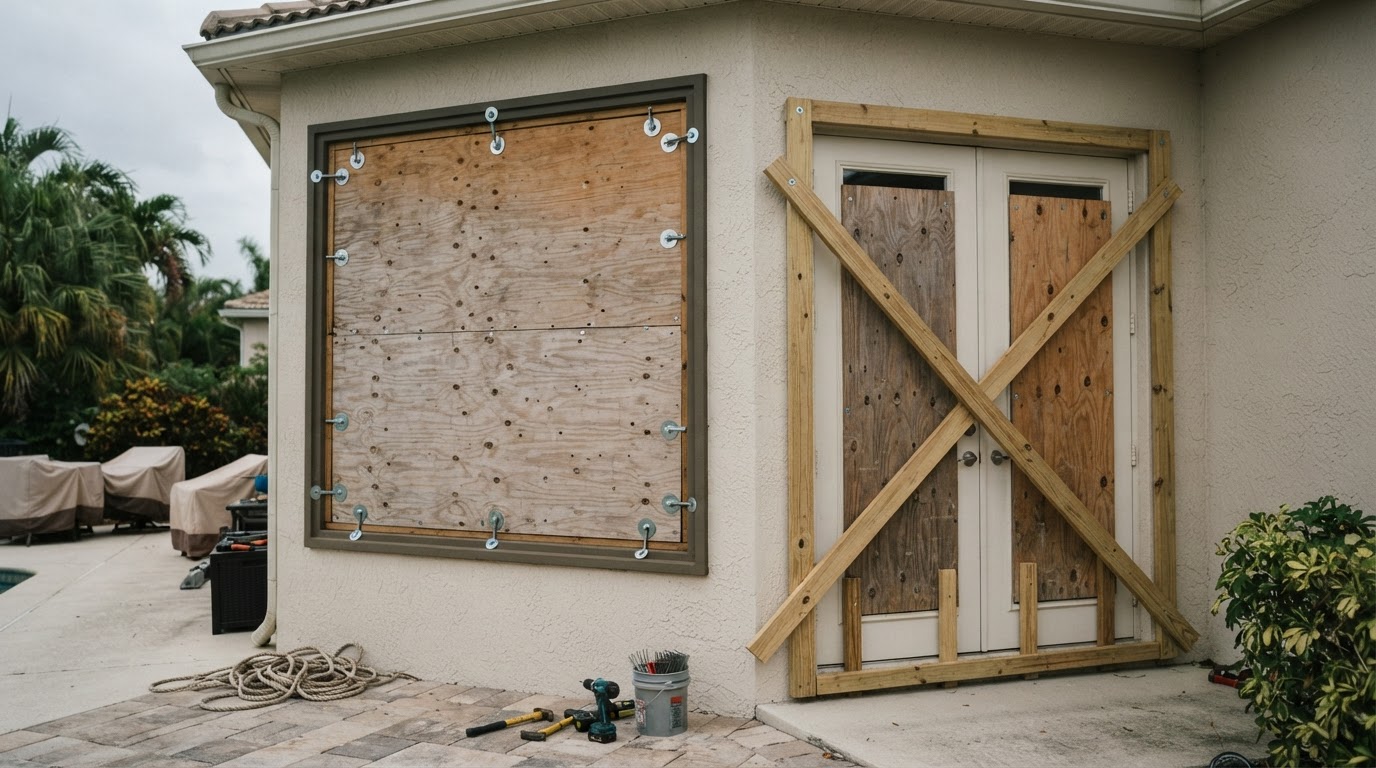
Hurricane windows and doors boarding guide: plywood sizing and anchor spacing, French-door and slider bracing, shutter options, and why tape fails in wind.
This article contains affiliate links. If you buy through these links, we may earn a small commission at no extra cost to you.
5/8-inch plywood screwed into studs keeps wind out. Impact shutters do the same job faster if they are already mounted. Tape does nothing except make bigger shards. Measure, cut, and label every panel in July. When the watch goes up you just hang them.
This is the window and door companion to our hurricane safety before, during, and after guide. That playbook covers evacuation, surge, and the kit. This one is the hardening method: how to board a house so a broken window does not take the roof with it.
Why windows fail first
One broken window lets pressure inside jump. That pressure pushes up on the ceiling and outward on the walls while outside suction is pulling the other way. Roof loss often starts at the opening, not at a weak rafter.
Debris does the breaking. At 100 mph small branches hit like lumber. At 130 mph gravel and fence boards punch through standard glass. The old advice to crack a window leeward to equalize pressure is wrong. Open windows feed pressure inside and add the uplift that takes the roof.
Plywood that actually holds
5/8-inch exterior plywood is the minimum for this guide. 7/16-inch oriented strand board is thinner and should not be treated as an equivalent substitute for storm protection.
Size each panel to overlap the frame by 4 inches on every side where trim allows. That puts fasteners into framing, not just trim. Mark every panel on the face with a lumber crayon: NW BED 1, S KIT SLIDER. Number the hardware bag to match.
Screws and anchors, not nails
Nails pull. Install anchors now, hang panels later.
- Wood frame: 1/4 inch by 2 1/2 inch lag screws with washers into studs. Predrill. Space fasteners every 12 to 16 inches, within 4 inches of each corner.
- Masonry: Tapcon style concrete screws or 1/4 inch expansion anchors into block or brick, not mortar. Tapcon's own Tapcon Storm Guard Hurricane Concrete Anchoring Kit… puts 25 anchors, wing nuts, caps, a drill bit, and a nut driver in one box for about $30, and the anchors stay in the wall between storms. Pull test one before you buy fifty.
- Vinyl and fiber cement: Go through to solid framing or use barrel bolts with backing plates. Foam or siding alone will rip out.
Barrel bolts and hanger bolts let one person hang a panel: set the bottom bolts, tilt up, drop the top. Keep a cordless driver with a spare battery in the anchor bucket. A 20V drill/driver kit like the BLACK+DECKER 20V MAX Cordless Drill/Driver Kit…, about $50, covers the predrilling and the panel screws, with a 30-piece bit set for both jobs.
No drill, no ladder, no holes in the wall: stamped board-up clips grip the panel and the window frame from inside. A 20-pack like the Prime-Line S 5100 Hurricane Board-Up Clips (20 Pack) covers three or four 5/8-inch panels, which makes them the renter answer. They are not as strong as lags into studs, so treat them as the fallback for windows.
Drill pilot holes one morning, cut and label the next. Hanging later takes 30 to 60 minutes for a small house with two people when the holes already exist. That is why September is too late to start.
Shutters that beat plywood
Permanent shutters cost more up front and close in minutes.
- Accordion: Fold from the sides and lock in the middle. One person closes a house in 15 minutes. Good for sliders.
- Roll down: Motor or hand crank, strongest coverage. Needs a header box above each opening.
- Bahama and colonial: Hinged and architectural, still need wind rated anchors.
- Clear polycarbonate: Lets light in, lighter than plywood, but pricey and scratches.
If plywood is the plan, consider a permanent shutter for the two hardest openings: the big picture window and the sliding door. Those panels are the heaviest and most awkward on a ladder.
French doors, sliders, and the X brace
Doors fail before windows because they are larger and flex more.
Sliding glass doors need full coverage. One horizontal brace across the middle is not enough. Cover the whole frame with plywood anchored on all four sides. If shutters exist, close them and still block the track so the door cannot lift off. A cut dowel or security bar handles that.
French doors are worse. The two leaves meet in the middle with only a latch and deadbolt on the seam. Wind bows both leaves inward and pops the meeting stile. Fix it with a vertical 2 by 4 or steel flat bar on the interior spanning header to sill, plus exterior plywood or shutter. Then add an X inside: two diagonals tied into trim or wall cleats, so flex and racking both load the brace.
A single wide non rated garage door buckles and then the house pressurizes. A bracing kit or rated door matters more than any window panel. A 22-gauge steel 16-foot strut kit like the 16-Foot Heavy-Duty Garage Door Hurricane Brace Kit runs about $113 and bolts across the door's interior ribs; an afternoon install beats a pressurized house in a Category 3.
What tape and film do
Tape does not strengthen glass. Tests after Andrew and Katrina showed taped windows fail at the same debris energy as bare glass. Security film is not impact protection unless anchored into the frame with a wet glaze or mechanical attachment.
Staying informed while boarded
A boarded house is dark and quiet. Cell service can be disrupted during a hurricane. A NOAA weather radio does not depend on local cell service.
The Midland ER310 Emergency Radio receives NOAA on 162.400 to 162.550 MHz with SAME alerts and runs for days. Pair it with the EcoFlow RIVER 3 Portable Power Station at 245Wh, which keeps radio, phones, and a small light going for two days shuttered.
Watch means finish hanging what you prepped. Warning means stay inside away from every window until officials say the wind is past. The eye is not the end.
Checklist, do this in July
- Measure every opening, add 8 inches each way where trim allows, write the cut list
- Cut 5/8-inch plywood or thicker, seal edges, label each panel and bag its hardware
- Install anchors now: lags into studs or Tapcons into masonry, 12 to 16 inches on center
- Hang test every panel once, time it, note awkward openings for shutter upgrades
- French and sliding doors: interior vertical brace plus exterior plywood or shutter, track blocked
- Garage door braced or rated, track bolts tight
- Radio on 162.550 MHz and portable power charged, Midland ER310 Emergency Radio and EcoFlow RIVER 3 Portable Power Station ready
Windows do not need courage. They need screws that bite framing and panels that already fit. Do the measuring in the off season and the watch window is just hanging.
Frequently asked questions
What should I do with windows during a hurricane?
Cover them: plywood (5/8-inch minimum) or storm shutters, installed before the warning. Tape does nothing against wind pressure and creates larger glass shards. Stay away from all windows during the storm, covered or not.
When should I board up windows for a hurricane?
At hurricane watch, not warning, if you can: boarding takes 2 to 4 hours for a typical home and hardware stores sell out fast once the warning is issued. Pre-cut and label plywood once, store it, and it is a one-hour job every season after.
What do I do if a window breaks during the hurricane?
Do not go near it. Get everyone into the interior room you picked as your shelter, close that door, and put mattresses or cushions between you and the opening. Wind entering one broken window pressurizes the house and can blow out others. Your safe room is the answer, not the window.