
Family Emergency Communication Plan for 2026: Stay in Touch When Cell Service Fails
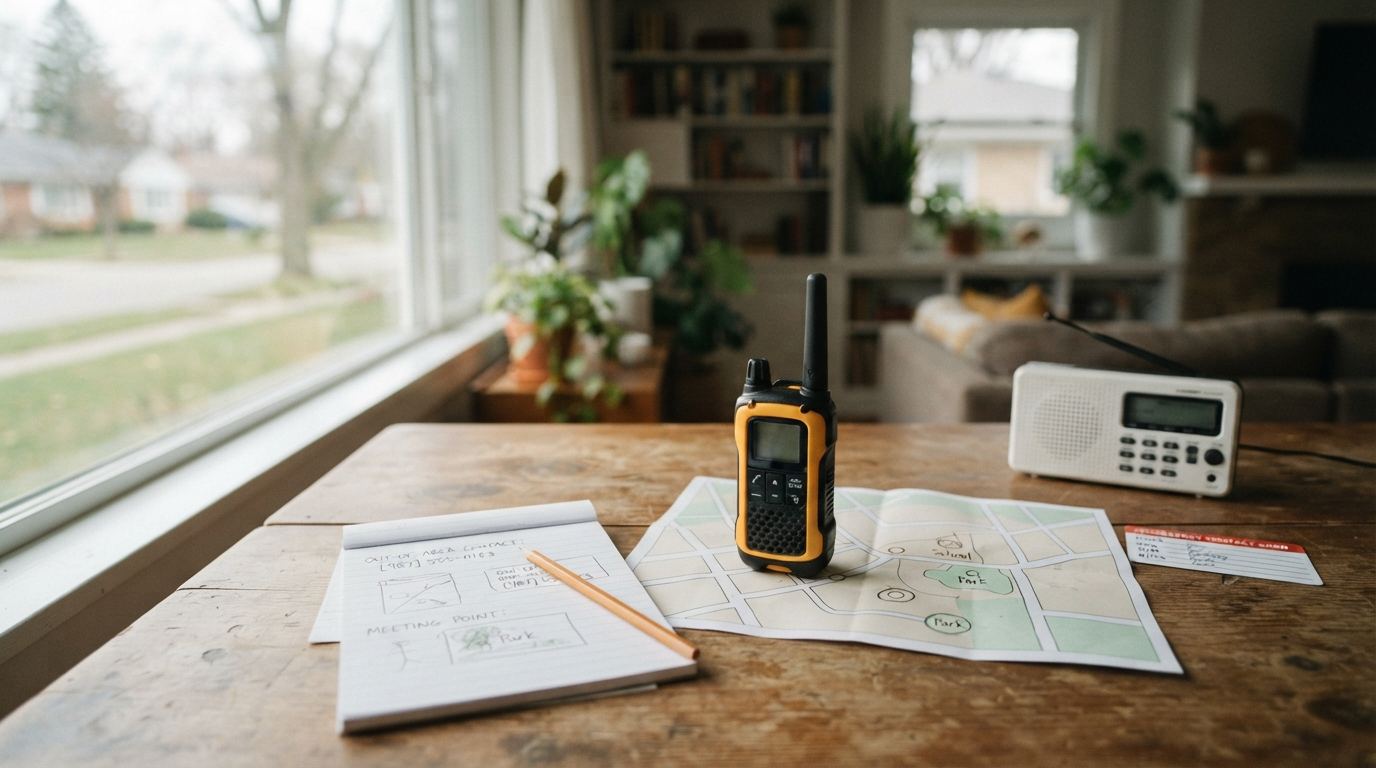
Cell networks can become congested or unavailable during disasters. Build a family emergency plan with contacts, meeting points, and radios for outages.
This article contains affiliate links. If you buy through these links, we may earn a small commission at no extra cost to you.
When cell service is disrupted, a phone may not connect, and a family scattered between work, school, and home may have no reliable way to find one another. The fix is not gear. It fits on one sentence: every family member texts the same out-of-area contact, then heads to one of two pre-agreed meeting points. Write that on a card, put a copy in every wallet, backpack, and glove box, and you have a plan that a $200 phone full of apps cannot replace.
Plans like this matter because service can be lost or overloaded. During Hurricane Ian, roughly 63% of cell towers in the storm's path stopped working, and restoration took days in hard-hit counties. Fires, floods, and grid failures can also disrupt local service. Phones rely on network infrastructure, so keep an independent alert path as well.
The three pieces the plan needs
- An out-of-area contact. Someone at least 100 miles away, far enough to be outside the disaster zone. Everyone in the family memorizes that number, and everyone texts it, not calls it, as soon as they are safe. During Ian, texts got through for hours after calls failed, because a text rides a fraction of the bandwidth a call does. One person, one number, easy to remember.
- Two meeting points. Point A is right outside your own home, the mailbox or the tree at the end of the driveway, for sudden local events like a gas leak or a downed tree. Point B is outside your neighborhood, a park, library, or school within walking or biking distance, for when the area itself is the problem. Both must be reachable without a car and without power.
- The card. Name, out-of-area number, both meeting points, and each person's cell number. A waterproof card in every wallet, backpack, and glove box, plus a copy taped inside the kitchen cabinet. Ready.gov publishes a free fillable family emergency plan template if you want a clean starting point.
Pick the meeting points now, at the kitchen table, not during the emergency. The family that "knows the plan" but never writes it down is the family that splits up in practice.
Radios: the backup that works when nothing else does
NOAA Weather Radio broadcasts 24/7 on seven VHF frequencies between 162.400 and 162.550 MHz, and most emergency radios receive those plus AM and FM. A radio needs no tower, no data plan, and no signal from anyone else. It can provide alerts during a cell-service outage, which is why it is the backbone of every family comms plan we recommend.
The Midland ER310 Emergency Radio is the one we'd hand the adults: 72+ hours of published battery life, NOAA alerts, a real SOS beacon, and a loud alert tone. It runs about $80. For kid backpacks and car glove boxes, the RunningSnail MD-090 Emergency Radio costs around $36, gets NOAA plus AM/FM, has a flashlight built in, and is cheap enough to buy a few of. For the house, the Kaito KA500 Emergency Radio runs on AC, DC, batteries, solar, and a hand crank, holds 40+ hours, and includes a reading lamp, which is the right call for multi-day outages. We compared these recommendations with the published features and owner reports in our best emergency radios guide.
| Model | Price | NOAA | Backup power | Best for | |
|---|---|---|---|---|---|
| Midland ER310 Emergency Radio | ~$80 | Yes, with SAME alerts | Crank | The adult's main radio | |
| RunningSnail MD-090 Emergency Radio | ~$36 | Yes | Crank + USB | One per backpack and car | |
| Kaito KA500 Emergency Radio | ~$50 | Yes | Crank + solar | Staying at home, long outages |
A sensible budget lands you at three radios per household: one per car and one for the adults at home. You do not need four of the same model. You need coverage.
Keep the radios and phones charged
Radios are only as good as their batteries, so the plan is not complete until you can recharge. A small portable power station keeps the whole comms kit alive through a multi-day outage. The EcoFlow RIVER 3 Portable Power Station holds 245Wh, recharges from wall, car, or solar, and will keep a radio running and phones charged for days. Its current listing runs about $249. If you are already shopping for one, our portable power station guide has runtime estimates for each load.
Check it before you need it
- Crank the radio once a month and confirm you can get a NOAA broadcast on 162.550 MHz, the default frequency for most of the US.
- Do a family drill. Everyone texts the out-of-area contact from wherever they happen to be, then walks to meeting point A. Ten minutes, no stress, done on a Saturday.
- Cache the numbers. The out-of-area contact should also be in your phone's ICE (In Case of Emergency) entry, because first responders are trained to check there.
Checklist (print and keep with the radios)
- Out-of-area contact chosen, number memorized by everyone
- Meeting points A and B agreed and written down
- Wallet card written for every family member
- One radio per car and one for home
- NOAA frequency confirmed (162.550 MHz)
- Portable power station or spare batteries set aside
- Family drill done once this month
The strongest emergency plan is not the one with the most expensive radio or the longest checklist. It is the one where every member of the family can answer two questions from memory: who do I text, and where do I go. Answer those two, and you can take care of the rest from wherever the disaster finds you.
Frequently asked questions
Why an out-of-area contact instead of just texting each other?
Local networks are the fragile part: during Hurricane Ian roughly 63% of towers in the storm's path went down, while texts kept getting through for hours after calls failed because they ride a fraction of the bandwidth. One person 100+ miles outside the disaster zone becomes the single message board everyone can reach.
How do kids without phones fit the plan?
The same way everyone else does, on paper: every family member memorizes the out-of-area number and carries a waterproof card with both meeting points. Point A is right outside the home for sudden events; Point B is a park or school within walking distance when the whole neighborhood is the problem. A cheap NOAA radio in each kid backpack covers the rest.
What frequency do I tune an emergency radio to?
162.550 MHz is the default NOAA Weather Radio frequency for most of the US, one of seven VHF broadcasts between 162.400 and 162.550 MHz. Crank the radio once a month and confirm you receive the broadcast, which is exactly what our monthly drill asks you to do.