
How to Put Out a Grease Fire Without Making It Worse
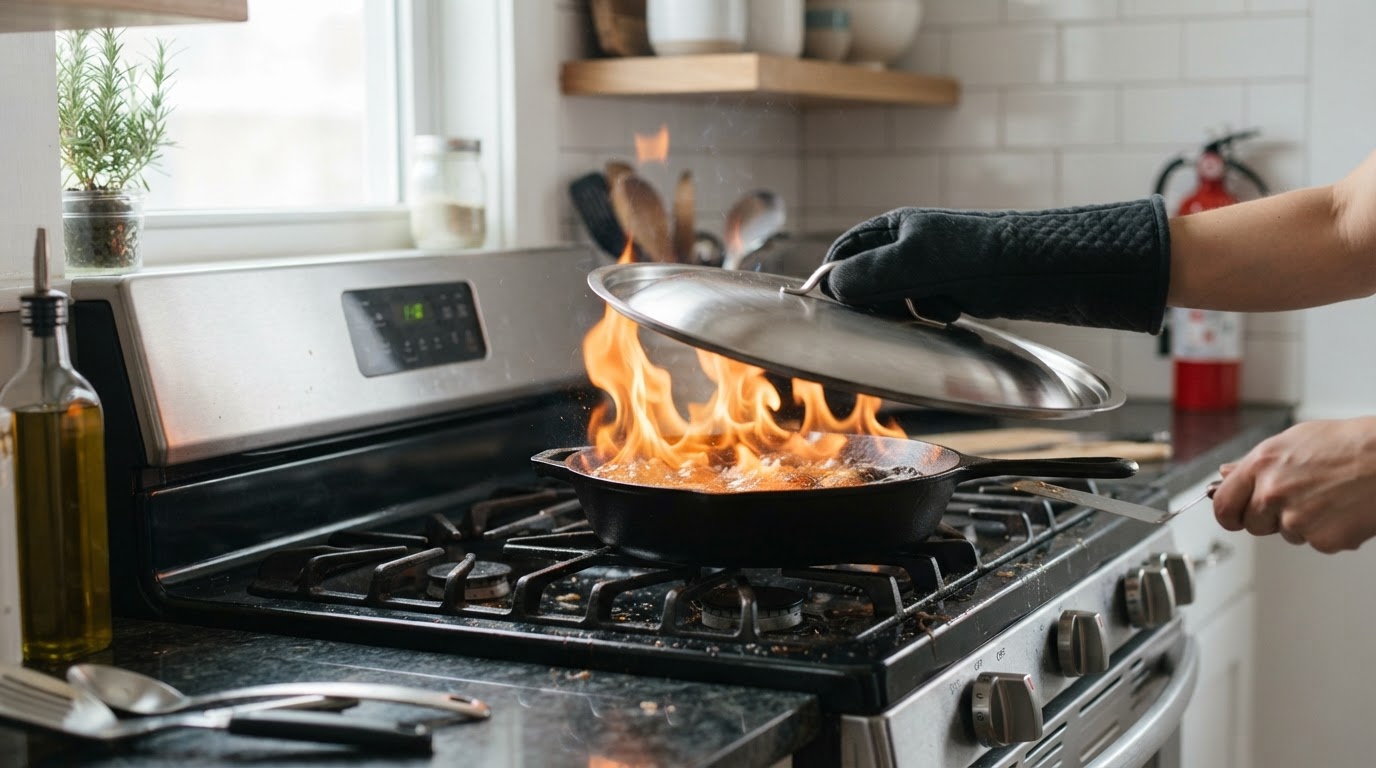
Turn off the burner, slide a metal lid over the pan, and never reach for water. What actually ends a grease fire, what makes it explode, and when to leave.
This article contains affiliate links. If you buy through these links, we may earn a small commission at no extra cost to you.
The flame is a foot tall and the pan is the only thing burning. This is still a kitchen problem, not a house problem, and what decides which one it becomes is the next thirty seconds. Water is the instinct, and it is the one move that turns a contained pan fire into a room fire.
The moves that work are quieter: cut the heat, cover the pan, wait.
Quick answer: Turn off the burner if you can reach it without passing through flame. Slide a metal lid or cookie sheet slowly over the pan from the side. Leave it covered until the pan is completely cool. Never use water, and never move the pan. If the fire is taller than the pan, has spread to the cabinets or the range hood, or the room is filling with smoke, get everyone out and call 911.
Most of these fights are winnable. Cooking is the leading cause of reported home fires and home fire injuries in the U.S.; NFPA counts an average of 158,400 home cooking fires a year from 2017 to 2021, 44 percent of all reported home fires. USFA data shows 93 percent of residential cooking fires never spread beyond the pan. Oil, fat, and grease are the leading material ignited, and cooking fires peak in November.
The first minute, step by step
- Turn off the burner. Do it first unless reaching the knob means passing through flame; the burner under the pan is what feeds it. The American Red Cross puts this first, right before covering.
- Slide a lid over the pan, slowly. Metal only: a lid, a cookie sheet, or another pan that nests inside. Slide it on from the side, hand and forearm out of the plume. Do not slam it down; Red Cross guidance warns flames can shoot out the side.
- Wait, and do not peek. Leave the cover on until the pan is fully cool; lifting it lets oxygen back in while the oil is still hot, and a fire that looks out can flare right back up.
Skip glass lids; they can shatter. And once the cover is on, the pan stays on the stove: walking it to the sink or out the door sloshes burning oil across your path.
Why water makes it worse
Water and burning oil do not mix the way people expect. Water is denser, so it sinks under the oil, hits the hot metal, and flashes to steam. The steam expands violently and throws burning oil outward, which is how a pan fire becomes a kitchen fire. The Red Cross is blunt: never pour water over a grease fire, and the same goes for a wet towel.
Never throw flour or baking powder, either. Flour is a combustible dust, the hazard class OSHA regulates in industry, and a cloud of it can flash when it meets a flame. Baking soda can smother a small flare if you can dump a generous amount without reaching over the flames, but it takes more than a spoonful and does nothing for a real fire.
If the lid is not enough
If flames persist under the cover, or the fire has moved off the pan, there are two tools and one rule.
A fire blanket smothers a flare when you can lay it flat over the source without leaning over the pan; the BOZZYS Emergency Fire Blanket (40 x 40) runs about $11 and hangs by the stove. A standard home extinguisher, rated 1-A:10-B:C, covers a pan fire and the materials around it; the Kidde FA110G Home Fire Extinguisher (1-A:10-B:C) is about $20. Use it only with a clear exit at your back and only if the fire is small. The PASS technique and the fight-or-leave rules are worth ten minutes now.
The rule: if the fire is still burning when the extinguisher runs out, this is a house fire. Get out, close the door behind you, and call 911.
Deep fryers and turkey fryers
A deep fryer holds quarts of oil and a turkey fryer holds gallons, so a fryer fire has a bigger fuel supply and less margin. If one ignites, cut the heat if the controls are safe to reach; otherwise leave and call 911. NFPA's guidance for outdoor fryers: keep them away from the house, and never move a burning one.
After the fire is out
- Keep the lid on until the pan is cool, and keep the pan out of the sink and dishwasher.
- Throw away the oil or food that was in the pan. It has been through a fire and possibly under extinguisher powder.
- If an extinguisher was used, wipe down nearby surfaces; the powder drifts.
- If the fire touched cabinets, the hood, or the wall, call the fire department; fires can smolder out of sight.
If anyone was burned, the clock starts immediately: cool running water for 20 minutes is the first aid that matters most. If the fire spread at all, everyone should already be moving toward the meeting spot outside.
How these fires start, and the habits that prevent them
An oil fire needs no flame. A pan left on high heat will reach its autoignition point and light itself, which is why unattended cooking is the leading factor in cooking fires, per NFPA. The prevention list is short:
- Stand by your pan. That is CPSC's phrase, and it is the whole game. Leave the kitchen, and the burner goes off first.
- Keep anything that can burn three feet from the stovetop. Oven mitts, towels, food packaging. NFPA puts this in its three kitchen rules, along with never cooking when you are sleepy or have been drinking.
- Turn pot handles in. CPSC calls for handles turned toward the back of the stove, and children and pets kept at least three feet from the cooking area.
- Keep the alarm working. NFPA research shows working smoke alarms cut the risk of dying in a home fire by about 60 percent, and alarms failed to operate in 16 percent of fatal fires where they were present. A sealed-battery unit like the First Alert PR710 10-Year Sealed Battery Smoke Alarm (about $33) removes the dead-battery failure mode for ten years.
The pan fire you handle in thirty seconds never becomes a story. Keep a lid within reach before you start frying, and the worst case stays a dented dinner.
Source notes: NFPA Home Cooking Fires report and smoke alarm research; U.S. Fire Administration cooking fire data; CPSC cooking safety guidance; American Red Cross kitchen fire guidance.
Frequently asked questions
What should I do the moment a grease fire starts?
Turn off the burner if you can reach the knob without passing through flame, then slide a metal lid or a cookie sheet slowly over the pan from the side. Leave it covered until the pan is completely cool. Never use water on burning oil, and never move the pan. If the fire has grown beyond the pan or the room is filling with smoke, get out and call 911.
Can I use baking soda, salt, or flour on a grease fire?
Baking soda can smother a small flare if you can dump a generous amount without reaching over the flames, but it will not handle anything bigger. Flour is worse than useless: it is a combustible dust that can flash and spread when it hits a flame, and fire-safety guidance warns against it. The reliable tools are a metal lid, a sheet pan, or a fire blanket.
How long do I leave the lid on the pan?
Until the pan is completely cool, not just until the flames stop. Lifting the lid early lets oxygen back in, and hot oil can reignite. Once the pan has cooled, keep it out of the sink and throw away the oil or food it held; it has been through a fire and may be sitting under extinguisher powder.