
Home Fire Escape Plan: Draw the Floorplan, Pick Two Exits, Set a Meeting Spot
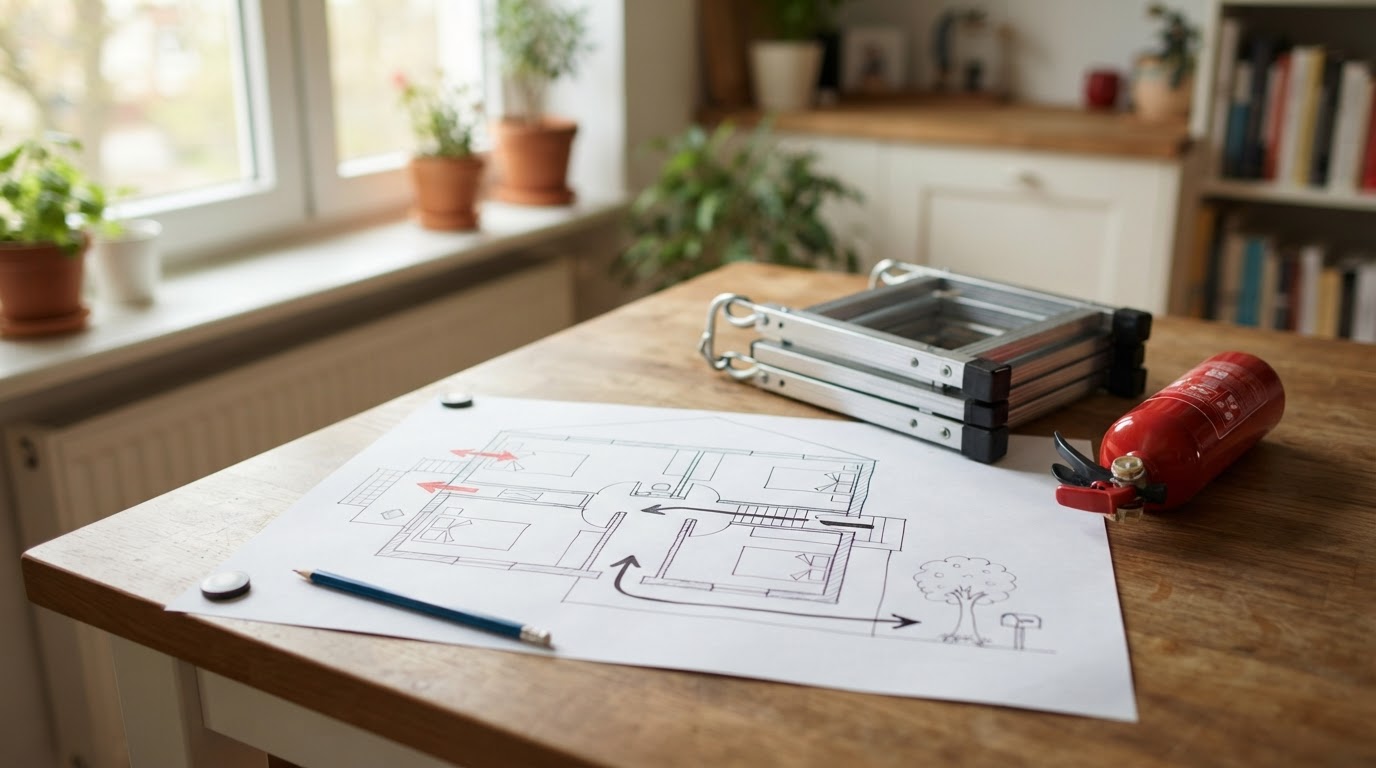
A home fire escape plan on one sheet: two exits per bedroom, a specific meeting spot, a 2-minute drill, and a 2-story escape ladder for the second-floor room.
This article contains affiliate links. If you buy through these links, we may earn a small commission at no extra cost to you.
The plan fits on one sheet of paper. Two exits from every bedroom, one specific spot outside, a 2-minute drill twice a year, and one escape ladder hung in the second-floor room with no other way out. It takes an afternoon to set up and an evening to rehearse.
Quick answer: Draw a floorplan. Mark every bedroom with two exits (the door and a window that opens wide enough to climb through). Pick one meeting spot outside (a specific tree, mailbox, or porch light, not a vague "out front"). Drill the family from a sound sleep to that spot in under 2 minutes, twice a year. Hang a 2-story escape ladder in any second-floor bedroom whose only other exit is the door.
Walk the home once, with a pencil
Do the plan with the lights on and the family together. Walk every room. In each bedroom, find the door and one window a person can open from inside without tools. Mark it on the floorplan with an X. If a bedroom has only one window and it does not open, that room needs a First Alert Two-Story Fire Escape Ladder hung on the wall next to it.
A few rooms to handle separately:
- Second-floor bedrooms with one window. The ladder is the second exit. The hallway is the part that burns first if a fire starts below.
- Basement bedrooms are the inverse. The stairway is the main exit; the second is a window well with a clear path to ground level.
- Apartments skip the ladder and add the hallway. Walk it from your door to the stairwell. Know the alternate. The one your neighbors use is the one that gets blocked.
The point of the walk is to commit two paths per sleeping person to muscle memory.
The meeting spot is specific
"Outside" is not a meeting spot. "The oak tree at the corner of the driveway" is. The spot has to be far enough from the house that nobody goes back in for someone already out, and it has to be a fixed object everyone can name in the dark from any direction. Common picks that work for most homes:
- A specific tree in the front yard, near a porch light or street light.
- The neighbor's mailbox on the corner, with the address in everyone's phone.
- A specific fire hydrant on the near side of the street.
Pick one. Print it on the wallet card. Tell the babysitter. The meeting spot only works when it is the first answer out of everyone's mouth.
Closed doors and tested alarms
Two habits make the plan work.
Sleep with bedroom doors closed. A closed door slows a fire's spread by enough minutes that the closed bedroom stays below lethal levels for at least 5 minutes while the hallway hits flashover. The door is not fireproof, but it buys time.
Test the smoke alarm the same night you drill. Press the test button for 5 seconds. Replace the battery or the whole unit if it does not chirp loud enough to wake a sleeper (85 dB at 10 feet is the floor). A First Alert SM210 10-Year Battery Smoke Alarm 10-year sealed-battery alarm goes in every bedroom, outside every sleeping area, and on every floor. Smoke alarms do not sense carbon monoxide; homes with gas appliances or an attached garage add CO detectors on every level.
For hard-of-hearing or heavy sleepers, add a strobe that fires when the alarm fires. A standard 85 dB alarm that wakes the rest of the house does not help the person who did not wake up. A hardwired hearing-impaired detector with a 177-candela LED strobe, like the First Alert BRK 7020BSL Hearing Impaired Smoke…, flashes the whole room the moment smoke is detected and interconnects with the rest of the system. A bed shaker under the pillow is the second line if a flashing light is not enough.
The 2-minute drill, twice a year
A plan on paper is not a plan. The drill is the plan.
- Pick a night when the family is home. Tell the kids this is practice, not play. One adult at the meeting spot with a flashlight, the other inside.
- Sound the alarm. Press the smoke alarm test button. Do not shout "fire." The alarm is the cue every time, so the family does not tune out the word.
- Time it. From the test-button press to the last person at the meeting spot, in under 2 minutes. The National Fire Protection Association target for a home escape is under 2 minutes. The bottleneck is usually one person going back for a phone or a pet. Both are out of scope. The rule is "get out, stay out."
- Run it once at night, once during the day, once a year each. The night drill is the hard one. The day drill confirms the ladder path works.
- Walk the plan the next morning. What slowed you down? A window that stuck? A rug that bunched? A child who went to the closet instead of the door? Fix it before the next drill.
For renters, the drill still works. The door is part of the plan, not the focus of it.
If you cannot get out
The plan has a stop-out point. When the door or window is blocked by smoke or heat, the path stops. Close the door, seal the crack with a wet towel, and go to the window. Open it a few inches to breathe, signal with a flashlight or light-colored cloth, and wait for firefighters. Never break a window unless an escape ladder is staged under it. Broken glass below a window you are about to climb through is a foot-cut before you ever leave the house.
A door feels hot from the back of the hand. If it is hot, do not open it. Use the second exit.
A UltraPro Personal Security Window and Door Alarm, 2… is a tampering signal, not a fire tool, but it is a useful night-time add for ground-floor bedrooms. It tells the adult that a window opened when nobody should have.
Ladder rules
The escape ladder is for second-floor bedrooms with no other usable window exit: hang it where an adult can reach it in the dark, practice deploying it during the day drill, and remember the closed door and the alarm are higher-leverage than the ladder.
The plan is for getting out, not for fighting the fire. If you keep an extinguisher, learn it before you need it: how to use a fire extinguisher.
The plan, end to end, is one sheet of paper, one afternoon of walking the home, and two drills a year. The 2 minutes you buy in a real fire are usually the only minutes there are.