
Chimney Fires: Warning Signs and What to Do
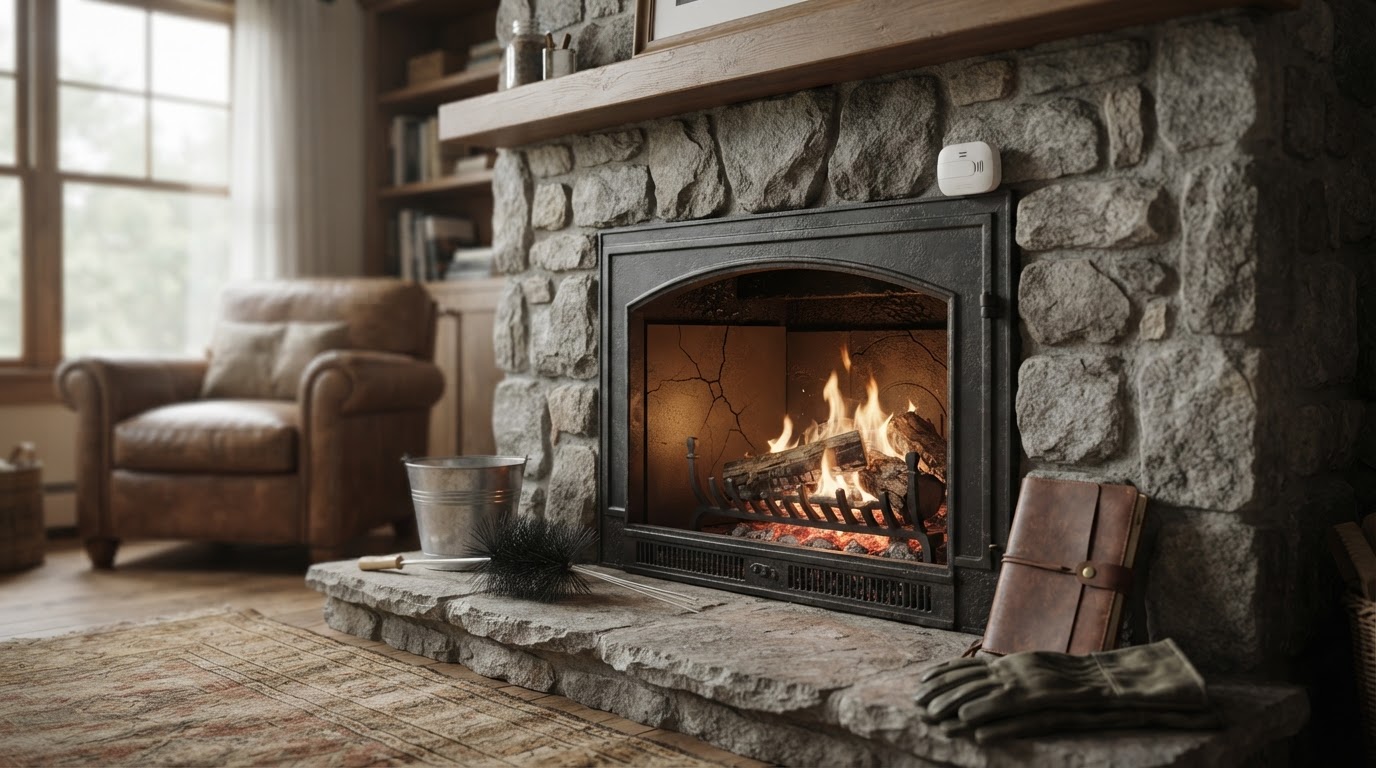
Chimney fires often burn undetected until they crack tile and mortar. The creosote warning signs, the yearly inspection, and what to do when one starts.
This article contains affiliate links. If you buy through these links, we may earn a small commission at no extra cost to you.
Chimney fires are a maintenance problem, and the maintenance is one appointment. Creosote, the residue that wood smoke leaves inside the flue, is what ignites. U.S. fire departments responded to an average of 13,120 confined chimney or flue fires (fires that stay inside the chimney) a year from 2016 through 2020, according to NFPA, which identifies failure to clean, mostly creosote from wood-burning equipment, as the leading factor in home heating fires.
Quick answer: Have the chimney inspected and cleaned by a professional before the first fire of the season. Burn dry, seasoned wood, and do not let the fire smolder. If you hear a low rumble or see dense smoke from the top of the chimney, call 911 before trying to put anything out, get everyone outside, and do not use the chimney again until it has been inspected.
Creosote: what it is and why it lights
A wood fire sends smoke and unburned particles up the flue. When they reach the cooler walls of the chimney, they condense into creosote: black or brown, crusty or flaky, tar-like or shiny, according to the Chimney Safety Institute of America (CSIA). In any form, CSIA says, it is highly combustible, and enough of it plus a hot flue is a chimney fire.
Three conditions make it build faster, all versions of a cool, starved fire:
- Restricted air. Glass doors closed, a damper not open wide, or too little make-up air keeps smoke in the flue longer.
- Unseasoned wood. Wet wood spends its heat boiling off water, so its smoke is cooler and dirtier.
- Smoldering burns. A choked-down stove or an overloaded firebox builds creosote faster.
Two fire shapes come out of this. The dramatic one roars like a freight train and throws flames or dense smoke from the chimney top. The quiet one, which CSIA says is the majority, burns slowly and is found later by an inspector. Both can hit around 2,000 degrees Fahrenheit, hot enough to crack masonry, displace mortar, and collapse a liner, opening a path for flames into the wood frame of the house. Factory-built metal chimneys are tested to 2,100 degrees; CSIA says a fire-damaged one must be replaced, not reused.
The inspection that prevents it
"Clean chimneys don't catch fire," is CSIA's summary. Its recommendation matches the U.S. Fire Administration's (USFA): inspect and clean the chimney once a year, and sooner whenever deposits or damage warrant it. Book it before the first cold snap; a sweep checks soundness, deposits, and clearances.
Burning so creosote builds slowly
- Dry wood only. EPA's Burn Wise guidance: burn wood at less than 20 percent moisture. Split, stack, and cover it, season six to 12 months, and check a split piece with a moisture meter like the General Tools MMD7NP Pinless Moisture Meter (about $49).
- Burn hot, with air. Open the damper before lighting, and give the fire enough air to burn rather than smolder; a partly open damper keeps smoke in the flue, which builds creosote.
- Nothing but wood. EPA guidance says trash, cardboard, plastics, and coated or pressure-treated wood release toxic chemicals and can damage the appliance; USFA says do not burn paper either.
- Respect the ash. USFA guidance: ashes go in a metal container with a lid, outside, at least 10 feet from the home. The JupiterForce Ash Bucket with Lid and Shovel, 5.15… (about $18) is exactly that: galvanized steel with a lid and shovel.
- Keep three feet clear. USFA: keep anything that can burn at least three feet from fireplaces and wood stoves.
The warning signs
Most slow chimney fires are found after the fact. CSIA keeps a list of what a sweep looks for; any one of these is a reason to stop burning and get an evaluation:
- Creosote that looks puffy or honeycombed, like popcorn.
- Creosote flakes on the roof, the ground, or in the firebox.
- Warped metal: the damper, the smoke chamber connector pipe, or a factory-built chimney.
- Cracked or collapsed flue tiles, or tiles with chunks missing.
- A discolored or distorted rain cap.
- Roofing material damaged by hot creosote.
- Heat damage to a TV antenna or dish.
- Cracks in the exterior masonry.
- Smoke stains at mortar joints or the tile liner.
When a chimney fire starts
Fire-department guidance for a suspected chimney fire is short:
- Call 911 first, before trying to put anything out. A fire that looks out can still be burning in a wall, attic, or roof.
- Cut the air if you can do it safely: close the stove's air controls and the damper, and keep an airtight stove's door closed.
- Never throw water. A hot stove or flue can crack from the thermal shock.
- Get everyone out, then check the roof from outside for sparks and spreading fire.
Afterward, the chimney stays out of service until a professional evaluates it. CSIA warns that the damage (cracked tiles, failed joints, warped liners) is often invisible, and that reusing the chimney can start a house fire. Document the damage with photos; CSIA notes most chimney fire damage is covered under homeowners insurance.
CSIA calls carbon monoxide the most dangerous effect of a chimney fire: the fire creates pathways for it to enter the home. The CDC counts more than 400 deaths a year from unintentional carbon monoxide poisoning that does not involve fires. A battery-powered alarm keeps that risk audible when the power is out: the Kidde Battery-Powered Carbon Monoxide Detector (about $23) runs on two AAs and sounds an 85 dB alert; the placement guide covers where each one goes.
If the fire escapes the flue
If smoke is rolling into the room, the fire has escaped the flue: that is a house fire. Everyone out, call 911 from outside, and use an extinguisher only on a small, contained fire with a clear exit behind you. A 1-A:10-B:C unit like the Kidde FA110G Home Fire Extinguisher (1-A:10-B:C) (about $20) belongs near the hearth; the PASS technique and fight-or-leave rules are worth ten minutes today. The home fire escape plan covers two ways out and a meeting spot outside.
For the rest of a no-heat plan, the winter heating safety guide covers clearances, the three-foot zone, and the carbon monoxide layer for every heat source.
Source notes: NFPA home heating fire research; Chimney Safety Institute of America (CSIA) chimney fire guidance; U.S. Fire Administration (FEMA) fireplace and heating safety guidance; EPA Burn Wise; CDC carbon monoxide data; fire-department chimney fire response guidance.
Frequently asked questions
How often should a chimney be cleaned?
Inspection is annual; cleaning happens when the inspection shows deposits worth removing. CSIA and the U.S. Fire Administration both call for a professional inspection once a year for every wood-burning system, and a household that runs a stove daily, burns unseasoned wood, or has an older chimney may need cleaning more often than that.
Can a chimney fire go out on its own?
Sometimes, and that is the dangerous case. Chimney-safety experts say most chimney fires burn slowly and go undetected, yet still reach temperatures around 2,000 degrees Fahrenheit that damage tile, mortar, and metal. Treat any suspected chimney fire as an emergency: call 911 and have the chimney evaluated before its next use.
Is the fireplace safe to use after a chimney fire?
Not until a qualified professional has inspected the chimney. Damage from the fire is often hidden, including cracked tiles, failed mortar joints, and warped metal liners, and using the chimney again in that condition can lead to a house fire or carbon monoxide in the home. Have it swept and evaluated first.