
Best Car Emergency Kits 2026: Reviewed Roundup of Roadside Kits
The best pre-built car emergency kit is the HAIPHAIK jumper-cable kit at about $38. We compared six top kits on what they include, what they skip, and value.
This article contains affiliate links. If you buy through these links, we may earn a small commission at no extra cost to you.
The car emergency kit we would put in our own trunk is the HAIPHAIK Car Emergency Kit with Jumper Cables at about $38. It is the only sub-$50 pre-built kit in the roundup that ships with 11.8-foot jumper cables rated for real engine starts, a folding shovel, a tow strap, and a carrying case that does not rattle. We compared six top pre-built kits on what they actually include, what is missing, and how much you pay per useful item. Two scenarios matter: the cold-morning dead battery, and the car in a ditch at midnight. The right kit covers both without you having to build one from scratch at 11 p.m.
How We Picked
We started with the kits that keep showing up in AAA's recommended-gear lists and roundups from Popular Mechanics, USA Today, and Family Handyman. We required each kit to ship with jumper cables, a reflective warning device, and a carrying case. We dropped kits where the cables were under 8 feet (too short to reach a donor car's battery in most engine bays) and kits where the only "first aid" was a single adhesive bandage pack.
Pricing was checked on each product page the day we wrote this. Ratings come from the live Amazon page; review counts are listed where the page exposes them.
Our Pick: HAIPHAIK 11.8ft Jumper Cable Kit
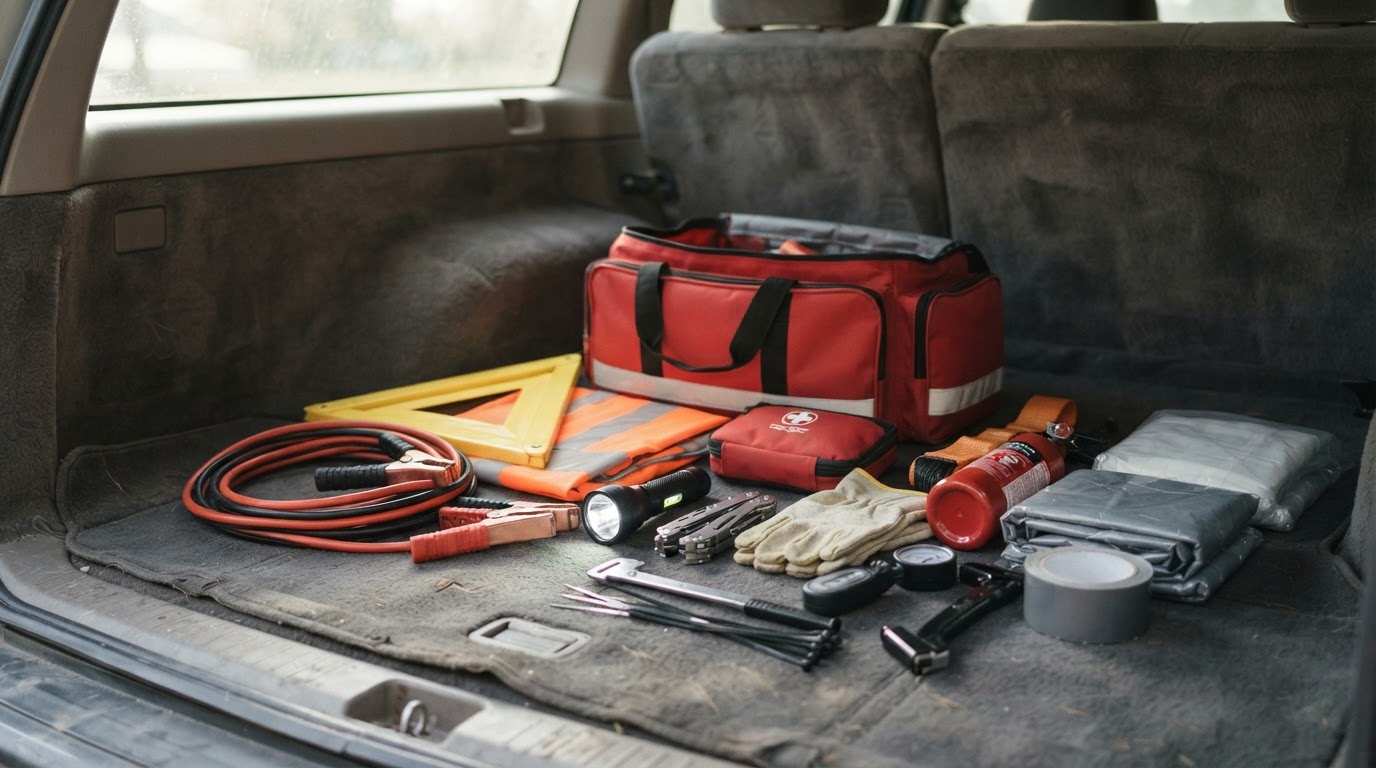
The HAIPHAIK Car Emergency Kit with Jumper Cables wins on price-per-utility. For about $38 you get:
- 11.8-foot jumper cables rated for gas engines up to about 6.0L (the same length range professional roadside services carry).
- A folding shovel that holds an edge for digging out of packed snow.
- A tow strap with rated hooks at both ends.
- A reflective warning triangle.
- A flashlight, work gloves, a tire-pressure gauge, and a basic toolkit.
- A zippered carrying case that fits behind a rear seat.
The kit has 4.6 stars across more than 3,500 reviews, which is the strongest sample-size signal in the roundup. The one thing it does not have is a tire inflator or an air compressor. If you also want to pump up a soft tire from a gas-station compressor failure, add a 12-volt inflator like the EPAuto 12V Portable Air Compressor (about $36).
Premium Pick: FS9 60-in-1 Lifeline Emergency Kit
The FS9 60-in-1 Lifeline Emergency Kit is the upgrade pick. It runs about $50 and carries a 4.8-star rating, the highest in this roundup. What it adds over the HAIPHAIK is a real first-aid pouch (bandages, gauze, an emergency blanket), a hard case that holds its shape under trunk heat, and a more organized layout where every tool has a pocket. The jumper cables are slightly shorter, but the kit overall is the more thoughtful package.
If you have a single car shared by two drivers and you want one box that lives in the trunk year-round without anyone needing to read instructions, this is the one. If you only want cables and shovel and you will build your own first-aid pouch, the HAIPHAIK saves you about $12.
The Tool-Layer Pick: Apollo Tools DT0006 101-Piece Mechanic Set
Pre-built roadside kits cover the "I am stranded" cases but skip the "I want to fix this right now" cases. A flat tire with a screw in the tread, a loose battery terminal, or a stuck exhaust hanger needs actual tools, not a folding shovel. The Apollo Tools DT0006 101-Piece Mechanic Tool Set is a 101-piece SAE and metric wrench and socket set in a compact case that fits in a glove box. It runs about $44, has a 4.3-star rating across more than 200 reviews, and is the kit most mechanics would actually reach for. For the tire itself, a Slime 2040-A Tire Repair Plug Kit pairs with the inflator: T-handle insertion tool, self-vulcanizing repair strings, and rubber cement glue let you fix a screw-in-the-tread puncture in roughly ten minutes without removing the wheel.
This is not a substitute for a roadside emergency kit. Pair it with either of the picks above. Together, they cover the "battery is dead" cases and the "something came loose" cases.
What About the Jumper Cables and the First Aid?
Two items show up in nearly every pre-built kit but rarely at the quality you actually want. Buy them separately if you can.
For a real dead battery, the NOCO Boost GB40 1000A Jump Starter is the better purchase than the cables in any kit on this list. It is a 1000-amp lithium jump starter that does not require a donor car, starts most gas engines dead-cold, and doubles as a USB power bank for your phone. It runs about $100. The cables in pre-built kits are a backup when the booster pack is in the house and the battery is in the car.
For first aid, the First Aid Only 298-Piece All-Purpose Kit (about $18) covers cuts, burns, sprains, and bites far better than the four-bandage packs that ship in most roadside cases. Add one to whichever roadside kit you buy.
What the Right Kit Does Not Replace
A pre-built car emergency kit covers the first 20 minutes of a breakdown. It does not cover staying warm overnight, getting unstuck from deep snow, or staying in radio contact when cell service is unavailable. For those layers, our winter car emergency kit guide covers blankets, traction mats, weather radios, and the overnight-stay rules. The two guides read well together: this one answers "what do I buy off the shelf," the winter guide answers "what else goes in the box."
The kit also will not change the tire for you, and the tire is the breakdown most people actually get. Before you need it, know whether your car carries a full-size spare, a donut, or nothing but an inflator kit, and where the jack and lug wrench live. Our flat tire guide walks the whole roadside sequence, from picking a safe stopping spot to re-torquing the lugs 50 miles later, and covers when the plug kit and inflator are the right fix instead of the jack.
FAQ
How often should I check the kit?
Once a season. Cables corrode if the case sits in trunk humidity. Replace any item past its date or with visible rust.
Can I leave the kit in the trunk year-round?
Yes, for the HAIPHAIK and the Apollo set. The FS9 hard case handles heat better than soft cases but still check the flashlight battery every six months.
What is the one item I should add no matter which kit I buy?
A real reflective warning vest like the XIAKE Class 2 Hi-Vis Safety Vest (about $6) for the person who gets out of the car to set up the triangle. Kits ship with triangles; the vest is almost always missing.