
Winter Car Emergency Kit: What to Pack to Survive a Breakdown
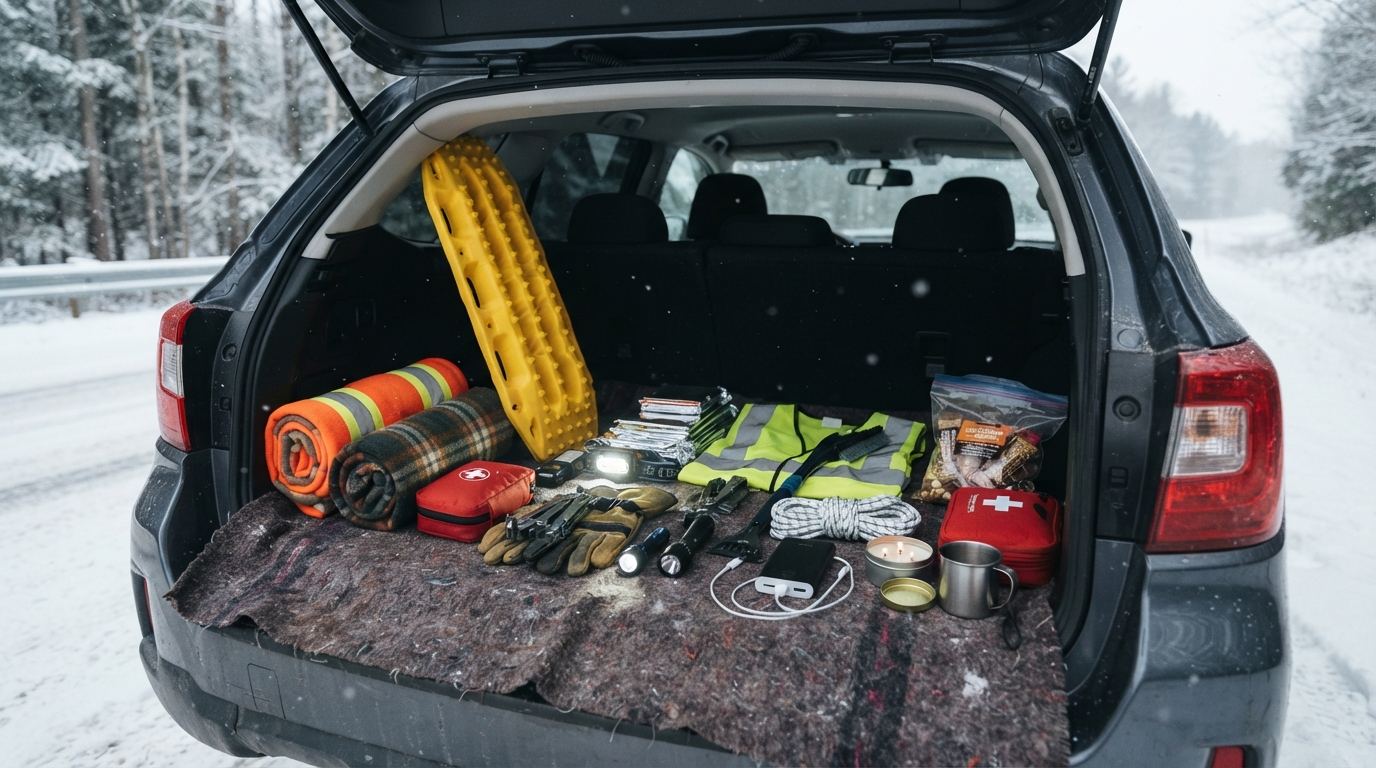
Build a winter car emergency kit that keeps you safe through a roadside breakdown: blankets, traction aids, power, food, first aid, and survival rules.
This article contains affiliate links. If you buy through these links, we may earn a small commission at no extra cost to you.
Last winter, a lake-effect blizzard stranded more than 400 drivers on a 20-mile stretch of interstate, some for over 24 hours in sub-zero temperatures. Weather offices warn that "stranded-motorist events" will be more likely this season.
AAA's cold-weather guidance: most winter breakdown fatalities involve people who left the shelter of their vehicle. An afternoon assembling a kit is cheap insurance.
Why You Need a Winter Car Emergency Kit
At 0°F with wind, unprotected skin can freeze in under 30 minutes. Your cabin gives you shelter, a windbreak, and a surface that holds heat longer than open ground. A winter car kit turns that shelter from "cold metal box" into "survivable refuge."
The Complete Winter Car Emergency Kit Checklist
Here's everything you need, grouped by job. The table is the reference list; the gear picks below are what we'd buy.
| Item | Why | Repurpose or buy | Cost |
|---|---|---|---|
| Wool or fleece blanket (2) | Heat retention; wool works when damp | Old blankets from home | $0–$25 |
| Insulated gloves, hat, coat, boots | Layers between you and hypothermia | Closet; see glove pick | $0–$80 |
| Hand warmers (air-activated) | 10+ hours of heat for hands or feet | Buy a box | ~$1 per pair |
| Flashlight or headlamp | Repairs, signaling, walking to help | Spare from home | $5–$30 |
| Reflective triangles + LED flares | Visible to plows | See picks below | $20–$40 |
| Hi-vis vest | Seen by traffic when you must exit | See pick below | ~$6 |
| Ice scraper and snow brush | Clearing snow, ice, exhaust pipe | See pick below | ~$17 |
| Folding shovel | Digging wheels out of snow | Camping shovel works | $10–$30 |
| Kitty litter or traction sand | Grit under drive wheels on ice | Buy a cheap bag | $5–$8 |
| Floor mats (temporary) | Emergency traction if you have no kitty litter | Free, in the car | $0 |
| Jumper cables or jump starter | Dead battery is the #1 cause | Cables ~$20; see jump pick | $20–$100 |
| USB power bank | Phone alive for 911 | Keep it charged | $0–$30 |
| Emergency radio | Weather alerts when phones lose signal | See radio picks | $36 |
| Snacks, protein bars, nuts | Energy during a long wait | Raid your pantry | $5–$10 |
| Water (bottled) (Crystal Geyser Alpine Spring Water, 1 Gallon…, ~$22) | Dehydration speeds hypothermia | Buy a case, keep 6 bottles | $5–$22 |
| First aid kit | Cuts, scrapes, minor burns | See pick below | ~$16 |
| Pocket knife or multi-tool | Cutting seatbelts and improvised fixes | From the toolbox | $0–$20 |
| Paper maps | No signal, no app, a map still works | Print one for your region | $0 |
Warmth is non-negotiable. Visibility (lights, triangles, vest) protects you from a snowplow that doesn't see your car. Traction (shovel, kitty litter, mats) is the difference between driving away in 10 minutes and waiting hours for a tow. Power (jump pack, bank) covers the most common failure points.
The Gear Worth Buying
Warmth
- Carhartt Men's W.B. Waterproof Insulated Work Glove (~$39, 4.6★): waterproof insulated glove for sub-freezing temps.
- HotHands Hand Warmers Value Pack, 10 Pairs (~$7 for ten pairs): air-activated, 10+ hours of heat.
Visibility
- CARTMAN Foldable Warning Triangles, DOT-Approved… (~$14): DOT approved, folds flat.
- Ecoangel USB-C Rechargeable LED Road Flares, 3-Pack (~$20–40): USB-C rechargeable, magnetic mount.
- XIAKE Class 2 Hi-Vis Safety Vest (~$6): ANSI Class 2 with pockets.
Traction and digging
- Mallory 532 26" Snow Brush with Ice Scraper (~$17): long-handled combo.
- Rhino USA Folding Survival Shovel with Pick (~$10–30): pick edge for ice.
- Fresh Step Extreme Clay Non-Clumping Cat Litter, 21… (~$26 for a 21-lb jug): non-clumping clay, a coffee can of it under each drive wheel gives the tire grip, and the rest still works in the litter box. Without a cat at home, a $5 bag of cheap litter does the same job.
- Emergency Devices Tire Traction Mats (2-Pack) (~$70): for stuck wheels.
Power
- NOCO Boost GB40 1000A Jump Starter (check current price): jump starter worth the upgrade over plain cables.
- Midland ER310 Emergency Radio (~$80): NOAA alerts.
- RunningSnail MD-090 Emergency Radio (~$36): budget radio pick.
First aid
- First Aid Only 298-Piece All-Purpose Kit (~$16): covers cuts, frostbite, minor injuries.
Overnight
- Teton Sports Celsius 0°F Sleeping Bag (Regular) (~$85): rated to 0°F for the worst-case night.
Where to Store the Kit
Keep the kit in a duffel or plastic tote in the trunk, but keep items you need first (scraper, shovel, blanket, flashlight, gloves) in the cabin. You don't want to dig through a frozen trunk to reach your ice scraper.
A rolling duffel does the trunk part better: High Sierra 28-Inch Wheeled Rolling Duffle Bag, 64L (~$160) holds 64 liters and rolls out of a frozen trunk instead of making you drag it.
Two extra storage rules:
- Check it twice a winter, once in November, once in January. Rotate water, replace expired hand warmers.
- Don't let it freeze you out, store jumper cables, power bank, and radio in the cabin when temps drop hard.
The kit only works if the car does. Run the winter car maintenance checklist before the first freeze, and if the car sleeps outside, check what not to leave in a car in winter so the cold does not wreck what you leave behind.
If you slide off the road, the first rule is stay in the car. It is your shelter, visible to search crews, and leaving it is how people get lost or freeze.
- Pull as far off the road as possible and set your hazards. Place warning triangles 100–200 feet behind you, then get back in.
- Run the engine in bursts, about 10 minutes every hour, just enough to keep the cabin warm. Charge your phone.
- Crack a window on the downwind side while the engine runs to prevent carbon monoxide buildup.
- Keep the exhaust pipe clear of snow, this is the killer. A blocked tailpipe fills the cabin with CO in minutes.
A battery-powered CO alarm is the backup your nose cannot be. The Kidde Portable Carbon Monoxide Detector… is the AA Kidde marketed for travel: it rides in the glove box and wails at 85 dB the moment CO crosses threshold, which is the warning you cannot get any other way when a drift covers the tailpipe before you restart.
- Signal for help, a bright bandana on the antenna or a flashlight sweep when you hear traffic.
- Stay awake and move, wiggle toes, swing arms, stretch gently to keep circulation up.
A crash changes the order. If anyone is hurt, control bleeding first and keep them still. A limb at an odd angle gets splinted in the position you found it; see splint a broken bone.
Call 911 if you have signal; if not, a NOAA-capable radio like the RunningSnail MD-090 Emergency Radio or Midland ER310 Emergency Radio will keep you informed about road closures.
What NOT to Do
- Don't leave the vehicle to walk for help unless help is visible nearby.
- Don't run the engine continuously with a sealed cabin. Carbon monoxide doesn't smell.
- Don't burn candles or improvised heat sources, open flames in a fabric-filled cabin end in fires.
- Don't drink alcohol to "stay warm." It opens blood vessels and makes you lose heat faster.
- Don't spin your tires. Rock the car gently back and forth.
- Don't wait until the storm hits. Kits assembled during a blizzard never get assembled.
Quick Recommendations
- Budget build (~$65): Scraper + shovel, thrift-store wool blanket, kitty litter, a $20 cable set, and the RunningSnail MD-090 Emergency Radio for alerts.
- Mid-range build (check the live total): Add a NOCO Boost GB40 1000A Jump Starter jump starter, headlamp, hand warmers, snacks and water, and a First Aid Only 298-Piece All-Purpose Kit first aid kit. The NOCO listing currently has no new featured offer.
- Premium build (check the live total): Add the Teton Sports Celsius 0°F Sleeping Bag (Regular) rated to 0°F, a Midland ER310 Emergency Radio radio, and a pair of Emergency Devices Tire Traction Mats (2-Pack).
This covers the cold half of the year. For the other half, start from the summer car emergency kit and layer the winter gear back in from October on.
The best kit is the one you pack before the forecast turns. Spend the hour this week, and if a blizzard does strand you this winter, you'll spend it warm, safe, and boringly fine.