
Hydroplaning: Why the Tires Float and How to Keep Control
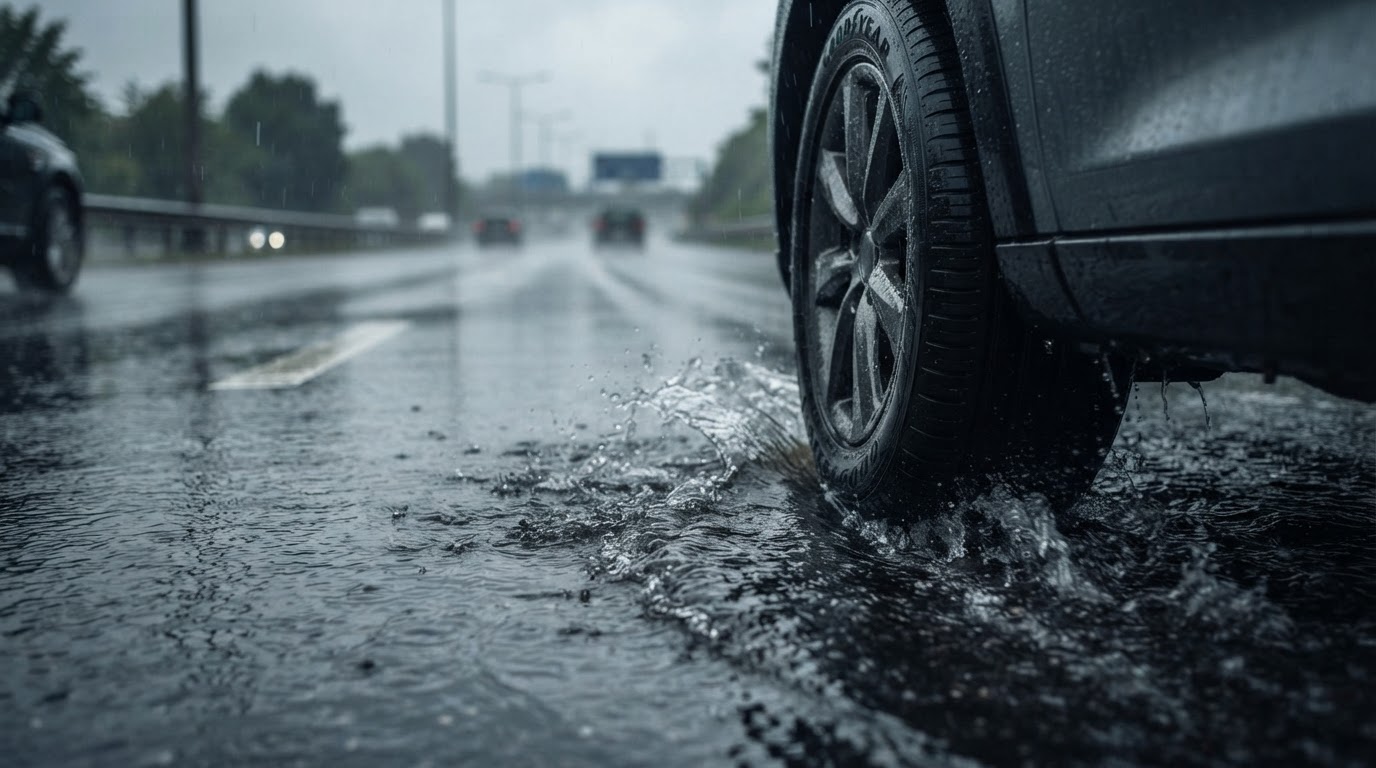
Hydroplaning starts around 35 mph on a wet road. Why tires lose the pavement, the first moves that recover grip, and the two checks that lower the odds.
This article contains affiliate links. If you buy through these links, we may earn a small commission at no extra cost to you.
The steering goes light, the engine revs, and the car keeps doing exactly what it was doing. That is hydroplaning: the tires have climbed onto a film of water and lifted off the pavement. Until they come back down, braking, steering, and throttle stop acting on the road, and the right reaction is not the obvious one. Ease off the accelerator. Hold the wheel where you want the car to go. Wait.
The threshold is lower than most drivers assume. AAA's wet-weather guidance puts it at as little as 1/12 inch of water on the road, where tires must push roughly a gallon of water per second out of the way to stay in contact, and notes that even new tires can lose some contact at speeds as low as 35 mph.
What to do when it starts
Three moves, in order:
- Ease off the gas, and do not brake. AAA's guidance is to gently ease off the accelerator; forceful braking pitches the car's weight forward and can turn a straight slide into a spin. Braking hard would not slow you much anyway, because the tires are riding water rather than pavement.
- Steer where you want the car to go, in small corrections. Keep the wheel pointed down your lane. AAA recommends steering in the direction the vehicle should go until traction returns. Large corrections while the tires are floating are how a straight hydroplane becomes a sideways one.
- When the tires load back up, slow down gradually. Grip returns with a little weight and feel in the wheel. Straighten out, brake gently to a speed that matches the water, and add following distance; that spacing is NHTSA's standing advice for slick roads.
It is the same touch as a snow recovery, where the trick is gentle throttle and no wheelspin; our guide to getting a car unstuck from snow runs the same principle in a colder setting.
What is happening under the tire
Tread grooves exist to move water. When water arrives faster than the grooves can channel it away, pressure builds under the contact patch and starts lifting the rubber off the road, the way a waterski rides on water a swimmer would sink through.
- Speed. The faster the tire meets water, the more it has to clear per second. AAA's 35 mph figure is a floor, not a limit, and at highway speed water can separate the tire from the pavement entirely.
- Water depth and road shape. Ruts, dips, and the low side of a crowned road hold deeper water. That is where the wheel twitches first, sometimes with no puddle in sight.
- Your car. NHTSA's severe-weather guidance notes that every vehicle handles differently on wet roads, and a light car on wide tires will float sooner than a loaded truck on the same stretch of highway.
The two checks that cut the odds
Both take minutes, and both are worth doing before the next rainy week rather than after it.
Tread depth. Hold a quarter upside down in one of the tire's main grooves. If you can see the top of Washington's head, that groove is at or under 4/32 inch. The legal minimum in most states is 2/32, but AAA's wet-pavement testing found tires worn to 4/32 braked an average of 87 feet longer from highway speed than new ones, a 43 percent increase, with about a third less handling ability. Treat 4/32 as the line where you start tire shopping, not as a comfort zone.
Pressure. NHTSA calls for a check at least once a month, with tires cold (the car parked for three hours or more), set to the door-jamb placard rather than the maximum number printed on the tire sidewall. A tire that is low enough to matter usually looks fine, and the dashboard light only fires once a tire is significantly underinflated. A 12-volt inflator like the EPAuto 12V Portable Air Compressor (about $36) reads the pressure and shuts off at the number you set, so the check and the fix are one driveway job.
While you drive
- Match speed to the water. AAA's rule is to slow down in proportion to what is on the road; 35 mph is where trouble starts, not where it ends.
- Switch cruise control off in rain. AAA specifically warns against it: a car that loses traction under cruise control keeps trying to hold its speed.
- Leave more space. Wet pavement grows stopping distances, as the AAA wear testing shows, so add seconds to your following distance on top of the dry-weather gap.
- Drive in the tracks of the vehicle ahead. Its tires have already pushed much of the water aside, AAA notes.
- Keep the glass clear. Streaky blades smear the road into guesswork at exactly the wrong moment. Blade makers recommend a fresh set every six to twelve months; a Bosch ICON 24" Premium Beam Wiper Blade runs about $36 and takes five minutes to fit.
For the cold-weather half of grip, the winter driving guide covers ice and black ice, where the same ease-off instinct applies to a slicker surface.
When it is not a hydroplane
If the water is deep enough to hide the lane markings, or if it is moving, this is flooding, not a wet-road grip problem, and the maneuver is different: you do not drive in. NHTSA's message is Turn Around Don't Drown, and the National Weather Service notes that 12 inches of rushing water can carry away most cars. The flash flood warning guide covers what to do when the water wins.
After the slide
A hydroplane that ends in contact with another car, a guardrail, or a curb is a crash; work through the first steps after an accident before anything else. If you are simply stopped on the shoulder, turn on your hazards, keep your seat belt on, and stay off the traffic side while you check the car. Then add the quarter and the pressure gauge to this weekend's list, because the next rain is not going to check first.
Frequently asked questions
What should I do if my car starts to hydroplane?
Ease off the accelerator and do not brake forcefully, AAA guidance says, then steer in the direction the car should be going until the tires regain traction. Once you feel grip return, slow down gradually and increase your following distance. Keep cruise control off in the rain so you can react immediately.
How much water does it take to hydroplane?
Less than most drivers think. AAA puts the threshold at as little as 1/12 inch of water on the road, where tires must push aside roughly a gallon of water per second to stay in contact. Even new tires can lose some contact at speeds as low as 35 mph; at highway speed, water can separate the tire from the road entirely.
How do I check whether my tires are ready for rain?
Use the quarter test: insert a quarter upside down into a main tread groove, and if the top of Washington's head is visible, that groove is at or under 4/32 inch. AAA wet-pavement testing found tires at 4/32 inch braked an average of 87 feet longer from highway speed than new tires. Check pressure monthly when tires are cold, set to the door-jamb placard (NHTSA).