
Canned Food Shelf Life: What Actually Fails First (and How to Check)
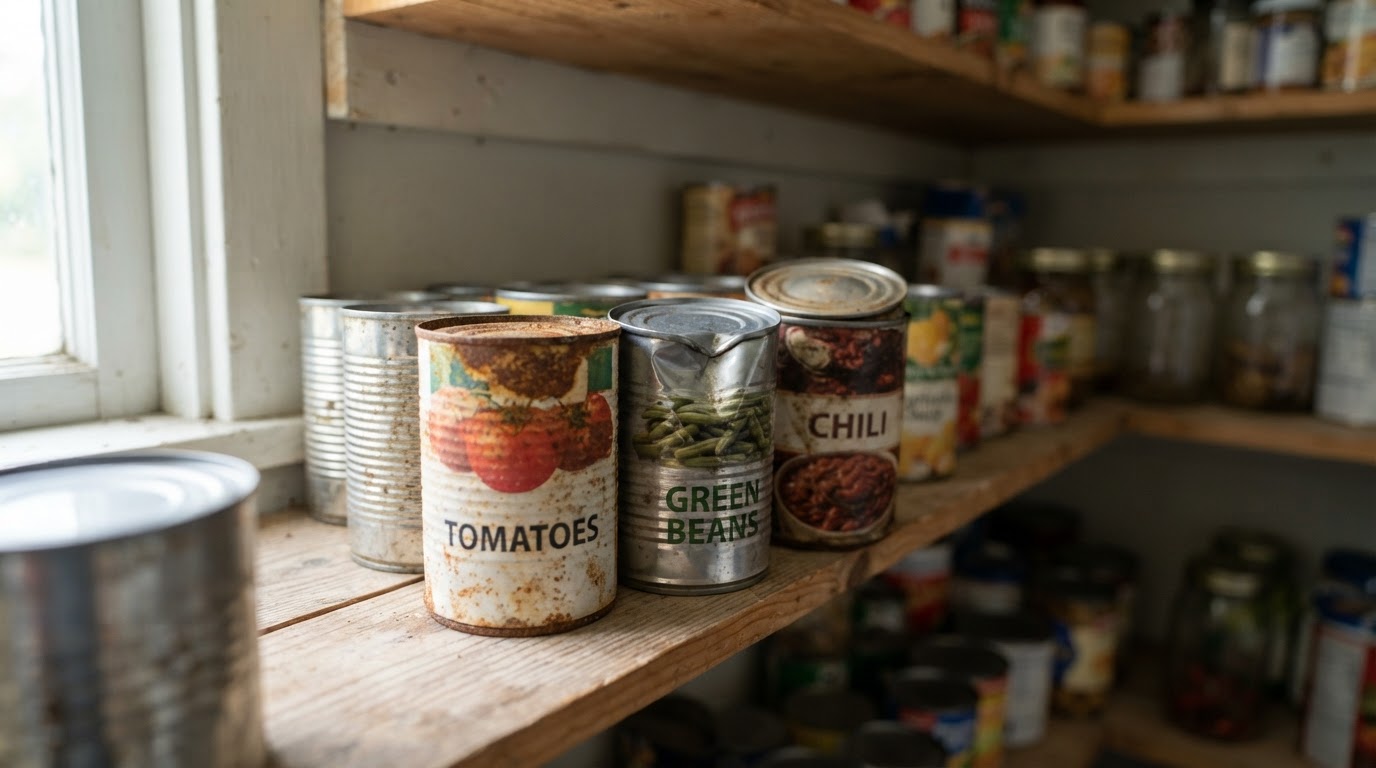
Canned food lasts 2 to 5 years, but acid and heat cut that fast. Learn what fails first and a 30 second check for rust, swell, and seam dents before opening.
This article contains affiliate links. If you buy through these links, we may earn a small commission at no extra cost to you.
The can fails before the food does. That is why the rim you can see and feel tells you more than the date on the lid.
In a cool pantry most cans keep 2 to 5 years. Tomatoes and fruit turn by about 18 months. Cream soups and coconut milk brown next. Beans, meat, chili, and plain vegetables hold longest. Heat cuts every number in half. A 30 second check for rust, swell, and seam dents catches the few cans that are actually unsafe.
See also our food and water storage guide and emergency food comparison.
How long cans actually last
USDA and extension guidance agree: low acid cans kept at or below 75F stay safe well past best by if the seal holds. Best by is a quality date, not a safety deadline.
| Food in the can | Cool pantry, 50 to 70F | Hot garage, 85 to 95F | What goes first |
|---|---|---|---|
| Tomatoes, fruit in juice, pickles | 12 to 18 months | 6 to 9 months | Acid eats lining, then metal. Sour or metallic taste |
| Milk, cream soup, coconut milk | 12 to 18 months | 6 to 9 months | Fat separates and browns. Dark color, grainy texture |
| Soups, chili, beans, meat, plain vegetables | 2 to 5 years | 1 to 2 years | Labels fade before food fails. Softens after year three |
| Syrup fruit, pumpkin, condensed milk | 2 to 3 years | 12 to 18 months | Sugar preserves, but the seam rusts first |
Every 18F above 70F roughly halves quality life. Write the purchase month on each can, rotate first in first out, and check twice a year.
Cans are the affordable core, not the longest-lived layer. For a decades-long reserve, a Mountain House Essential Bucket carries 22 servings with a stated 30-year sealed life. It needs water, so use it as a deep-pantry backup, not a replacement for rotating cans.
What fails first
Not a single date but a hierarchy.
1. Acid wins. Tomatoes, pineapple, citrus, and vinegar brines attack the coating, then the metal. Darkening or pinholes can appear long before the date.
2. Milk and fat next. Cream soups and coconut milk separate as fat oxidizes. Families toss browned soup anyway. Keep these coolest.
3. Syrup holds, seam rusts. Sugar preserves, yet a sticky seam in humidity still rusts.
4. Low acid holds longest. Beans, tuna, chicken, and green beans eat well at year three and test safe at year five in a cool pantry if the can is perfect.
A Datrex 3600 Emergency Food Bar sits outside this hierarchy. Many households pair a two week can shelf with one bar per person because the bar needs no opener, no heat, and no water, and keeps a five year life in heat where cans fade.
The 30 second check
Check every can you open and again at each clock change.
Rust. Light surface rust that wipes off is cosmetic. Pitting rust that leaves a rough pit under a fingernail or orange at the seam means moisture reached the metal. Toss it.
Swell. A normal lid flexes and pops back. A swollen lid bulges and does not flex, or the can hisses or spurts on opening. Any swell, leak, or spurting means toss it without tasting. Swell can signal spoilage gas, including botulinum, with no reliable smell.
Seam. Run a finger around the top, bottom, and side seams. Feel for a sharp crease, a dent crossing a seam, or an unfolded seam. Body dents that avoid the seam are dings. Dents that deform a seam are a seal risk.
Dent. Small body dents are fine. Deep dents where a finger sits inside, sharp points, or any dent with rust at the crease go to trash.
Pass all four and the can is a good candidate. Fail any one and the date does not save it.
Botulism and the boil caution
Botulism is rare and serious. The toxin has no smell or taste. USDA guidance is to discard swollen, leaking, or badly seam dented low acid cans outright.
Older advice to boil suspect low acid food 10 to 20 minutes outside the can exists because a rolling boil can inactivate toxin, but it does not fix a broken seal. In everyday life, throw the suspect can away and open a good one. Never feed suspect cans to pets.
Garage versus pantry
Humidity and swing kill cans before age does.
A pantry at 65 to 70F and under 60 percent humidity is ideal. Off the floor on a shelf is enough.
For tight spaces, a WaterBrick 3.5 Gallon Stackable Water Container holds 3.5 gallons, stacks under a bed, and doubles as dry-goods storage. It supports the long-life layer but does not replace a dry shelf or can inspections.
A garage at 85 to 95F is a different class. Heat cooks quality, condensation rusts seams, and even an inch of floodwater wicks into seams. After any flood contact, discard submerged cans. Washing the outside does not verify the seal.
If the garage is your only space, lift cans 4 inches off concrete on wood or plastic and shorten rotation. Turn acid and milk cans within 9 months there, low acid within 18.
Keep a manual opener with the cans. Pop tops fail, and a smooth edge opener like the OXO SteeL Can Opener leaves no razor lip off grid.
Pantry door checklist
Tape this where you see it.
Every meal, 30 seconds:
- Lid flat, not bulged. Press center, it gives slightly.
- No hiss, leak, or spurting on opening.
- No dent crossing a seam. No sharp crease.
- No pitting rust.
Every clock change, 5 minutes:
- Wipe seams, look for orange at the rim.
- Read marker months. Pull anything within 6 months of range to the front.
- Move new cans to back, old to front.
- Press each old lid once for swell.
- Opener still with the cans.
After heat or water:
- Hot summer in garage: pull acid and milk cans first.
- Any can that sat in water or heavy condensation: discard.
- Label unreadable: mark contents and month before it falls off.
What to stock next to the cans
A Datrex 3600 Emergency Food Bar per person lives in the go bag and the car, not the pantry. The food and water storage guide has the two week amounts. For canned versus freeze dried math, see emergency food types compared, and for burner steps, cook without power.
Canned food is still the cheapest way to cover two weeks. Keep it cool and dry, check the seam before the date, and you will rarely toss a good can or keep a bad one.