
Stranded in Your Car for 2 Days: Stay, Signal, Stay Warm
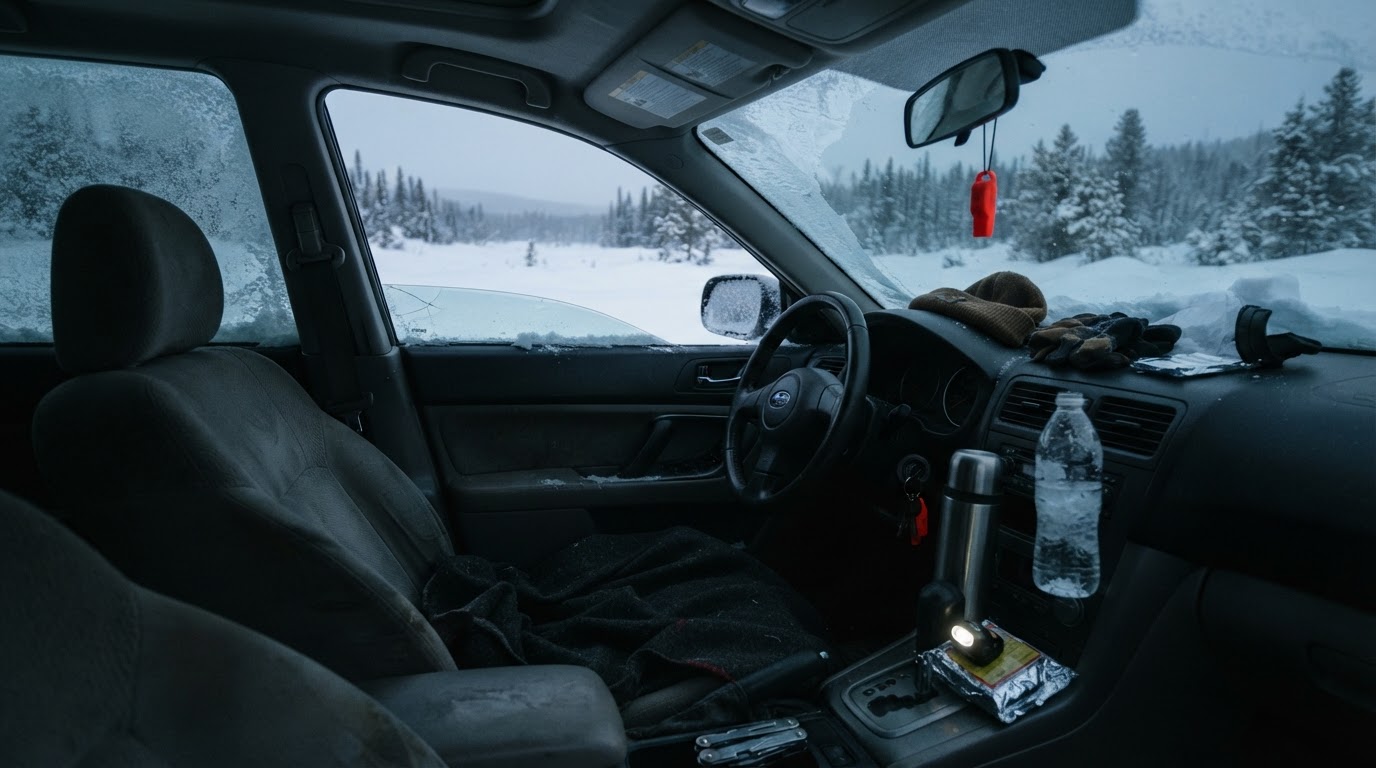
Stranded 24 to 72 hours in a car? Stay put, signal for help, run the engine in short bursts, and treat the cabin as a survival shelter until help arrives.
This article contains affiliate links. If you buy through these links, we may earn a small commission at no extra cost to you.
If your car is stuck in deep snow, in a remote area, or behind a closure nobody is plowing tonight, the safest move is to stay put. AAA tracks winter breakdown fatalities every season, and the dominant pattern is drivers who left the vehicle to find help. Rescuers find cars. They do not always find people walking through a whiteout or down an unlit rural road. For the layering and engine-burst mechanics that get you through a sub-zero night, see our how to stay warm in a car without heat guide.
First ten minutes: secure the car and decide to stay
Before anything else, stop spinning the tires. Spinning digs you deeper, builds an ice patch under the drive wheels, and burns fuel you will need for heat. Shift to park, set the parking brake, and read the situation.
If the engine is dead, the gas tank is below a quarter, the road is closed ahead and behind, or visibility is near zero, the decision is made: stay with the car. Tie a bright cloth to the antenna so the car is visible before nightfall. Put on every layer you have before you start burning calories.
Engine for heat: ten minutes on, fifty off, with a clear tailpipe
The way to use the engine for cabin heat is short bursts on a long timer. Run the engine for ten minutes, then shut it off for fifty. A modern four-cylinder idles at about 0.2 to 0.3 gallons per hour, so a ten-minute burst uses roughly a fifth of that, and the cabin holds that heat long enough.
The exhaust check is the step that saves your life. A blocked tailpipe fills the cabin with carbon monoxide in minutes, and carbon monoxide does not smell. Clear the pipe before every engine start. Crack a window an inch on the downwind side while the engine runs, even in sub-zero weather, so the cabin air keeps cycling.
A small CO alarm that lives in the cabin turns the invisible into a wail before you notice the headache. The Kidde Portable Carbon Monoxide Detector… is the AA-battery Kidde marketed for travel: lightweight enough to ride in a glove box, 85 dB siren when CO crosses threshold. Toss it on the passenger seat during a long trip and check it the way you check the tailpipe: before the first engine start, and again after every drift piles higher.
Run the heater on its lowest setting with the fan on low. High heat and a high fan push warm air out the cracked window faster than the engine can make it. A Midland ER310 Emergency Radio on a NOAA frequency tells you when the storm is breaking and when plows are expected to be on your stretch of road.
Signaling so someone spots you
The signal method that works depends on daylight. During the day, the bright cloth on the antenna and any reflective material laid on the roof catch the eye of a plow or helicopter miles out. Reflective triangles placed a hundred feet behind the car also help, but only if you can walk back safely without stepping into a drifted lane.
At night, the cabin dome light on with the engine off is visible for miles in clear air. Flares or rechargeable road LEDs like the Ecoangel USB-C Rechargeable LED Road Flares, 3-Pack (about $20) behind the car are the next layer. A RunningSnail MD-090 Emergency Radio emergency radio has a flashlight and a hand-crank backup, so it covers the radio and the signal light without draining your phone battery. Charge the phone from a EcoFlow RIVER 3 Portable Power Station if you have it. A charged phone is a 911 line and a GPS pin.
The signals that do not work: honking the horn for hours (drains the battery, which you need for the engine), yelling out the window (no one is within earshot in a whiteout), and walking to the nearest farmhouse without telling anyone where you went (if you get hurt out there, nobody knows where to look).
Water, food, and the things that quietly become the problem
You can survive a long time without food. You cannot survive a long time without water, especially with the heater running and dry winter air pulling moisture out of you. A gallon of water per person per day is the rule. If you do not have that much, melt snow in a pot on the heater vents while the engine runs. Do not eat snow: it drops your core temperature and the volume to get the same water is enormous.
Eat sparingly. The goal is to keep blood sugar stable so you stay alert. A few squares of a chocolate bar, a handful of nuts, or a granola bar every two to three hours is enough. Heavy meals make you sleepy, and sleepy drivers in stranded cars make bad calls.
Keep the cabin sealed except for the cracked window when the engine runs. Close every vent you can. Roll up blankets or coats and stuff them into the footwells to block the cold air pooling at your feet. The cabin holds heat better than open ground, and it holds it better when you do not let the heat leak out the bottom.
When the storm breaks
When the radio reports plowing in your area, or you can hear a plow in the next lane over, that is when you start signaling more actively. Honk three times, pause, three times. Wave a bright cloth out the window. Keep the dome light on and the engine off so the battery is ready for the next start.
When the car is moving again, drive slow. The road will be uneven, drifted, and possibly icy even where it looks clear. The job is to reach a town, not to race to one.
A EcoFlow RIVER 3 Portable Power Station in the trunk can charge a phone for a week of standby, run a small LED strip, and top up a radio. None of it is a substitute for staying with the car. The right frame is the cabin as a shelter, the engine as a heater with a timer, and your job as keeping all three working until someone spots the bright cloth.