
What NOT to Leave in Your Car in Winter (and Why)
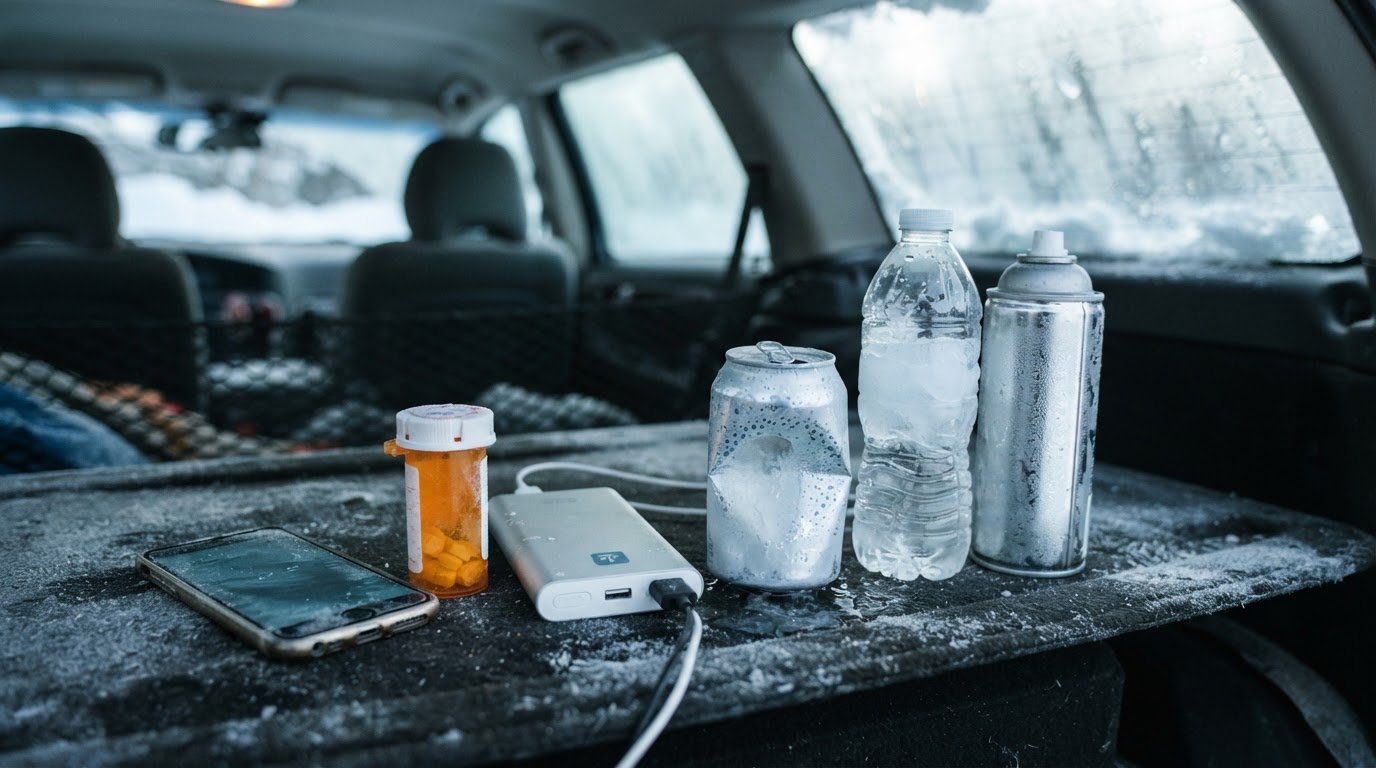
Six things to bring inside on the first cold night before a hard freeze: phones, canned drinks, aerosols, medications, lithium power banks, and water bottles.
This article contains affiliate links. If you buy through these links, we may earn a small commission at no extra cost to you.
Bring phones, medications, liquids, aerosols, and lithium jump packs or power banks inside before a hard freeze. Leave cables, blankets, shovels, and other cold-tolerant gear in the car. A parked car can become cold enough overnight to burst a drink, disable a phone, or ruin a dose, and most damage is avoidable with one trip to the trunk before the temperature drops.
This is the list to run on the first cold night. The full winter car kit is a separate question; this guide covers what the cold can damage.
Phones, tablets, and anything with a lithium battery
Lithium-ion batteries lose capacity fast in cold. Apple publishes a below-10°C (50°F) operating warning for iPhones; below freezing, a charged phone may refuse to turn on or shut off. Capacity usually returns when warm, but a dead phone in a dead car means no help.
Two rules cover most situations:
- Bring the phone inside overnight if the forecast is below 20°F.
- Do not leave a lithium jump pack in a trunk at -10°F for a week and expect its full rated capacity.
Take the phone, tablet, and jump pack inside. Warm a cold battery gradually before charging; never put it on a heater.
Canned drinks, aerosols, and anything else pressurized
Soda cans, beer, and seltzer burst because their water expands roughly 9% when frozen solid, leaving the can nowhere to put it.
Less obvious offenders:
- Glass bottles of carbonated drink can crack at the seam.
- Aerosol cans (deodorant, hairspray, lubricant, and brake cleaner) can leak or burst in a hard freeze.
- Windshield washer fluid rated above the night's low can freeze in the reservoir or on the windshield.
Pull sparkling water inside when lows approach 0°F. A sticky trunk is avoidable.
Medications, especially insulin and EpiPens
Most oral medications tolerate a cold car for a few hours. Some do not, and the consequence of ruining a dose is not worth the cost of bringing the bottle inside.
The hard cases:
- Insulin loses potency once it freezes. The CDC says not to let insulin freeze; a glove box on a -10°F night is not safe.
- EpiPens and other injectable emergency medicines have an official storage range of 59°F to 86°F. A 0°F car is out of spec.
- Inhalers can crack or lose metered-dose accuracy if frozen.
- Glaucoma drops and other eye medicines may have similarly narrow storage ranges.
Take temperature-sensitive medication inside and follow the label or pharmacist. Do not improvise a storage temperature.
Water bottles and anything else that expands when it freezes
A reusable plastic water bottle in a trunk can deform, split its cap, and soak the cargo area. The same risk applies to water-based items:
- Glass jars of sauce or salsa can crack at the seam.
- Wine bottles can push out their corks as the liquid expands.
- Antifreeze is fine because it is formulated for the cold.
Bring liquids inside, or use containers rated for the forecast low.
Lithium power banks, jump packs, and USB tool batteries
The chemistry is the same as a phone battery. A 10,000 mAh power bank left in a car at -10°F for a week may lose much of its usable capacity. A jump pack needed at 6 AM on a dead-battery morning is exactly the item that should not spend the coldest part of the night in the trunk.
A discharged lithium cell that freezes can suffer permanent damage. Bring lithium tools inside for the cold stretch. A spare cable can stay; the charged battery brick should not.
What stays in the car without worry
Cold does not harm the basic materials in these items:
- A shovel, kitty litter, or traction mats (sand may harden, but it does not burst).
- Jumper cables (copper does not lose a charge).
- Wool blankets and most synthetic layers. Cotton is the one to avoid when wet.
- A spare tire, paper towels, and a spare phone cable. The cable is fine; the charging brick may be sluggish in extreme cold.
If you want a small set of winter-car replacements that can stay in the vehicle, these three fit the rule:
| Cold-safe pick | Why it belongs in the car |
|---|---|
| NOONE 2-Gauge Jumper Cables | Copper cables do not lose stored charge. They need a donor car, but are a dependable alternative to a lithium jump pack. |
| Coghlan's Dynamo Flashlight | The hand crank provides an LED fallback when a cold battery torch is sluggish. Test it before winter. |
| Arcturus Military Wool Blanket (80% Wool, 66" x 90") | 80% wool has no battery or liquid to freeze and insulates when damp. Keep it dry. |
Theft is a separate question. Do not leave visible valuables in the car; this article is only about cold damage.
A 30-second routine that prevents all of it
On the first night the forecast calls for a low below 20°F, walk to the car and grab:
- Phones and tablets.
- Cans, bottles, medications, and aerosols.
- Power banks and the jump pack if you normally leave them in the car.
That 30-second routine avoids every temperature failure. Keep the items in the same entryway tray.
For the full kit to keep in the car for a breakdown, see our winter car emergency kit guide. If you are driving in snow and ice, the winter driving guide covers speed, skids, and what to do if you get stuck.
Frequently asked questions
Does cold permanently damage lithium batteries?
Not from one cold night. Temporary capacity loss usually recovers when the battery warms. Permanent damage is more likely when a battery is discharged and frozen for an extended period.
Can I keep a case of water in my car in winter?
Only if the case and containers are rated for the forecast low. Standard bottled water freezes around 0°F, and the bottles can split.
Is it safe to leave canned drinks in the car overnight?
A can may survive a 30°F night, but a hard freeze can split it. Bring cans inside when temperatures are expected below freezing rather than cleaning a sticky trunk later.