
How to Stay Warm in a Car Without Heat (Stranded Overnight)
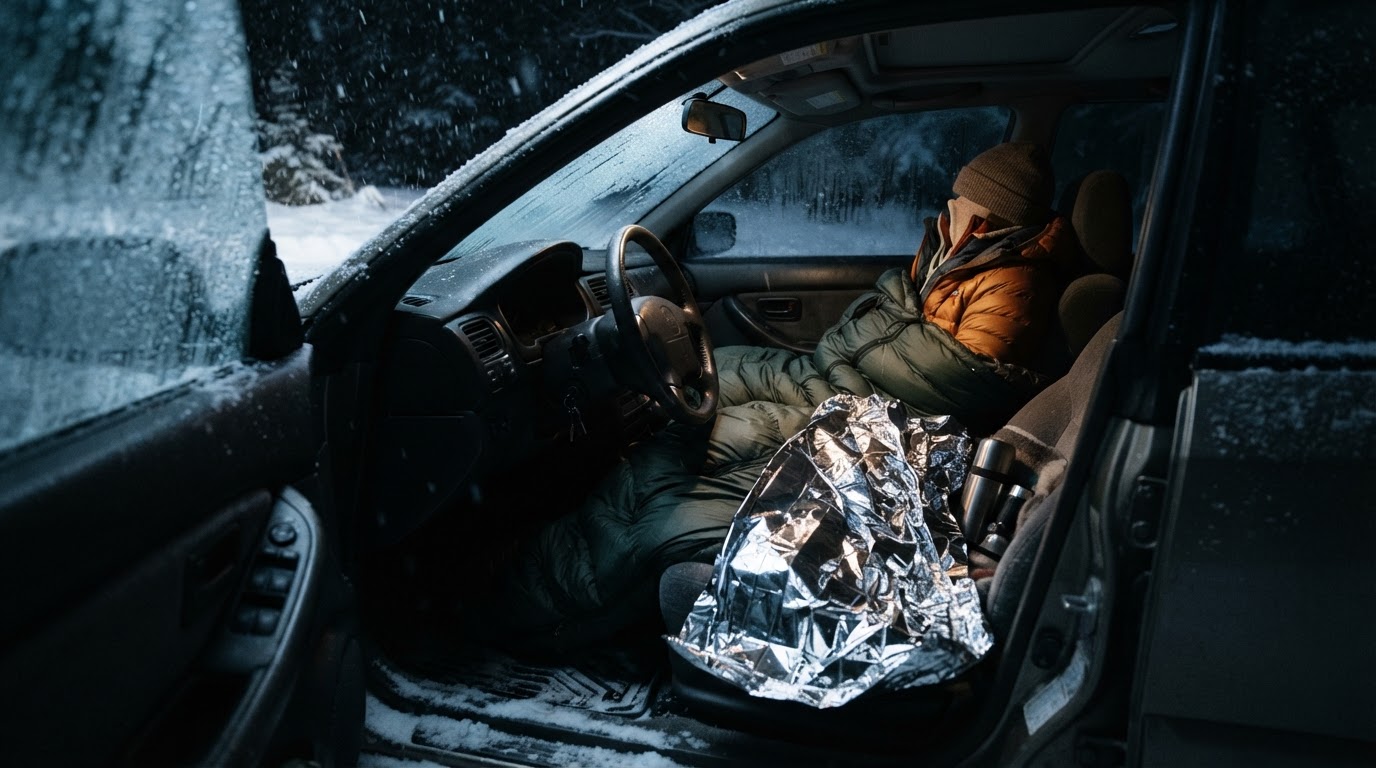
Stranded in a car without heat? Layer like a base camper, trap heat with a mylar bivy, run the engine in 10-minute bursts, and never burn a candle in the cabin.
This article contains affiliate links. If you buy through these links, we may earn a small commission at no extra cost to you.
Your car can keep you alive through a sub-zero night. It is shelter, a windbreak, and a surface that holds heat longer than open ground. The job is to turn the cabin into a survivable refuge, and the order matters: trap the heat you already have before you try to make more.
If the engine is dead, the gas tank is below a quarter, or you are buried in a drift with a clogged tailpipe, stay put. AAA's own data shows most winter breakdown fatalities involve drivers who left the vehicle to find help. Rescuers find cars. They do not always find people walking in whiteout conditions.
This is the order to use: layer first, seal the cabin, run the engine in safe bursts, and use disposable heat sources where they earn their place.
1. Layer the way a winter camper would
Clothing traps air; trapped air holds heat. The car is the windbreak, your clothes are the insulation. Skip the single heavy parka and build three layers:
- Base layer against the skin. Merino or synthetic long underwear, never cotton. A wet cotton t-shirt against your ribs in a cold car is how people lose fingers. A merino long-sleeve top like the MERIWOOL Men's Base Layer Top, 100% Merino Wool… (about $65, 4.7 stars from 4,400+ ratings) keeps insulating when you sweat; it layers under the fleece without bulk.
- Mid layer for insulation. Fleece, down puffy, or a wool sweater. This is the workhorse layer; if you only have one thing on, this is what to put on. The Columbia Men's Steens Mountain 2.0 Full Zip Fleece… (about $46, 4.7 stars from 53,000+ reviews) is the fleece version: it keeps insulating when damp, where down loses its loft.
- Outer shell for wind. A waterproof jacket or even a trash bag with a head hole. The packable pick is the Frogg Toggs Ultra-Lite2 Rain Jacket (Men's) (about $25, under a pound), which stays in the trunk without taking space. Wind cuts the effective temperature by 20°F or more.
Hats, gloves, and a neck gaiter are not optional. You lose heat fastest through your head, your hands, and the gap between your collar and your jaw. A MERIWOOL 100% Merino Wool Ski Neck Gaiter seals the collar gap and doubles as a face cover when the wind picks up. It runs about $21. Wool socks inside dry shoes keep your feet working when you need to dig out a tailpipe at 2 AM.
2. Trap the heat you already have
Once the layers are on, the next move is to stop bleeding heat into the cabin floor and roof. Two pieces of gear do almost all the work here.
A mylar bivy bag, the kind that looks like a foil sleeping bag, reflects up to 90% of your radiated body heat back at you. Pull it on over your layers, draw the hood up, and zip the draft tube. A Emergency Mylar Bivy Sleeping Bag (3-Pack) is about $20 for a 3-pack, and the 3-pack is the move: one in the cabin, one in the trunk, one in the house kit.
A real sleeping bag handles the rest of the gap. A Teton Sports Celsius 0°F Sleeping Bag (Regular) is rated to 0°F, and inside a foil bivy inside the cabin, you stay warm with the engine off for hours at a time. If you do not own a sleeping bag, a wool blanket plus a SOL 90% Heat Reflective Emergency Blanket over the top is a serviceable backup; the mylar alone is the layer that makes the difference. A Arcturus Military Wool Blanket (80% Wool, 66" x 90") is about $25, is 80% wool so it still insulates when damp, and folds small behind the seat.
Shrink the cabin you are heating. Close all the interior doors, stuff a jacket or towel in the gap under the rear hatch, and only sit in the front seats. A two-seat front cabin holds heat three to four times longer than the whole interior of a minivan with the third row open.
3. Run the engine in 10-minute bursts, not continuously
A running engine is a heat source and a carbon monoxide source at the same time. Treat the heat as a budget: 10 minutes on, 50 minutes off, with a window cracked an inch on the downwind side and the exhaust pipe clear of snow.
The 10-minute number is not arbitrary. A cold engine idling for 10 minutes raises cabin temperature about 20°F to 30°F in winter clothing. After that, you are paying for fuel and wear without meaningful heat gain. The 50-minute off cycle lets the engine and exhaust cool, drops your CO exposure for the next start, and conserves fuel. A quarter tank of gas is roughly 6 to 8 hours of burst cycles, more than enough to wait out a normal road closure.
The exhaust check is the step that saves your life. A blocked tailpipe fills the cabin with CO in minutes, and CO does not smell. After every snowfall, scrape the pipe clear before you restart, and never run the engine if you cannot see the tailpipe.
A battery-powered CO alarm that lives in the cab is the backstop when the pipe hides under fresh drift. The Kidde Portable Carbon Monoxide Detector… is the AA Kidde marketed for travel: it sits in the glove box the rest of the year and rides the passenger seat in winter. The 85 dB siren is the warning your nose cannot give you when a snowdrift climbs the tailpipe unnoticed.
4. Hand warmers and body-heat sharing
Air-activated hand warmers earn their place here. Crack a HotHands Hand Warmers Value Pack, 10 Pairs pair, shake them to activate, and stage them at the small of your back, between your socks and the shoe tongue, or inside your mittens. The chemical heat is small but steady, and the small-of-the-back placement is the trick: warming the core warms the hands and feet, which is where cold bites first.
If you are stranded with another person, share heat on purpose. Sit together under the bivy and the sleeping bag, backs against each other, with the mylar side out. Body-to-body contact under a shared reflective layer is a genuinely warm setup.
What not to do in a cold car
A few common ideas kill people in this exact scenario:
- Do not burn a candle or improvised heater in the cabin. Open flame in a small space with fuel vapor and fabric is how stranded nights end in fires.
- Do not run the engine with a sealed cabin or a buried tailpipe. CO does not smell, and it does not care how experienced a driver you are.
- Do not drink alcohol to "stay warm." It opens blood vessels near the skin, making you lose heat faster and impairing the judgment you need to keep the exhaust clear.
- Do not leave the car to walk for help unless you can see a building or a plowed road within a mile. The car is shelter, and a car is what rescuers will be looking for.
For the kit that goes in the trunk before the storm hits, our winter car emergency kit covers the pack list. If you are stuck because the storm hit before the plows, the car stuck in snow recovery steps cover the get-out attempt.