
Winter Car Maintenance Checklist: 7 Things to Do Before the First Storm
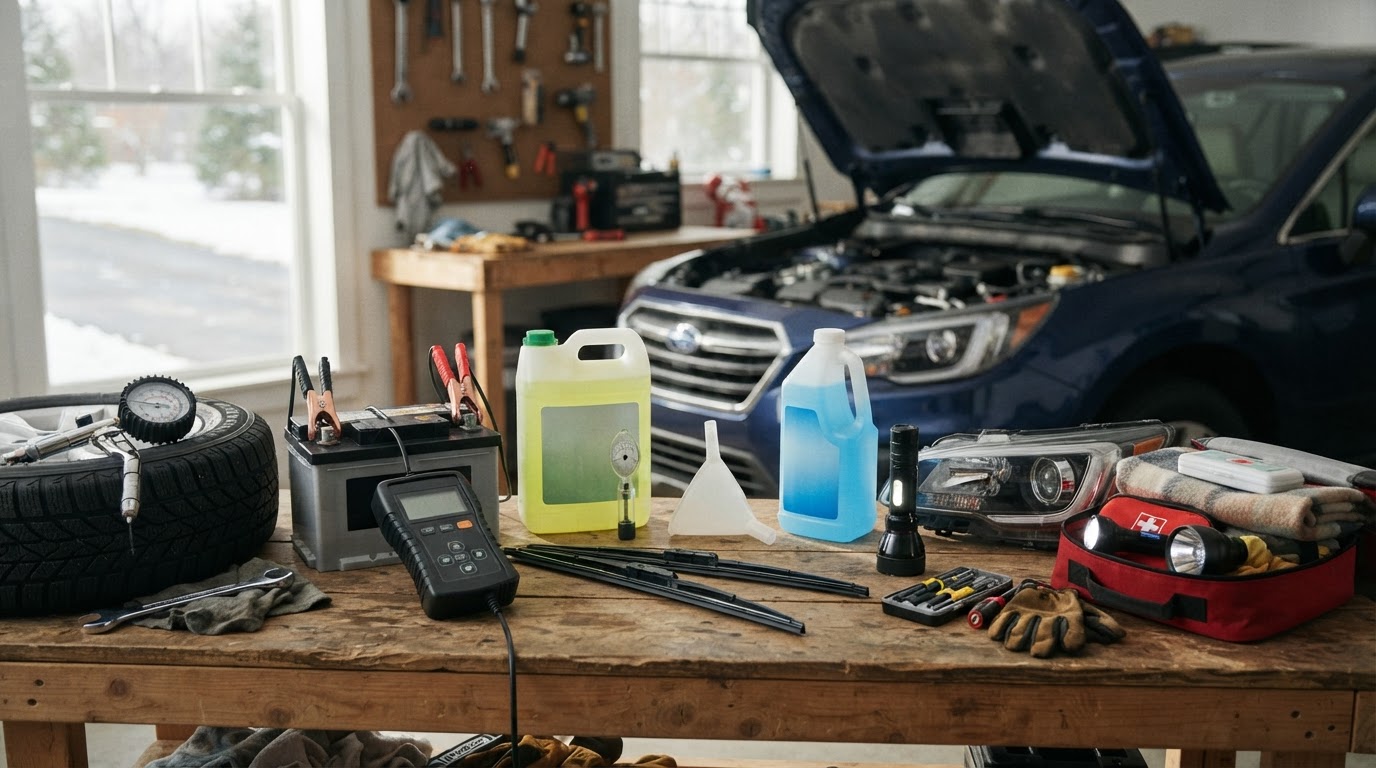
A 7-step winter car maintenance checklist: battery test, tire pressure, coolant mix, wipers, washer fluid, lights, and a 10-minute emergency kit audit.
This article contains affiliate links. If you buy through these links, we may earn a small commission at no extra cost to you.
Most winter breakdowns aren't bad luck. They're maintenance someone skipped in October because the first storm wasn't on the forecast yet. A battery that read "fine" at 70°F delivers about half its cranking amps at 0°F. A tire that was 32 psi in October reads 26 in January because pressure drops roughly 1 psi for every 10°F of air temperature. Washer fluid that works at 40°F freezes to a solid brick on the windshield at 10°F.
None of this is hard to fix. Do it on a Saturday in November and you probably won't need a tow in February.
1. Test the battery and clean the terminals
Cold is hard on a weak battery. A resting reading below about 12.4 volts means the battery is partly discharged, not automatically bad. Ask an auto-parts store or shop for a load test. Replace the battery if it fails that test or repeatedly loses charge. Four or five winters is a reason to test early, not a verdict.
While you're in there, pull the terminals off and clean the white or green crust off with a wire brush or a toothbrush and a baking soda paste. Rinse, dry, and smear a thin layer of dielectric grease on the posts before reconnecting. A tube like the Permatex 81150 Dielectric Tune-Up Grease costs about $6 and coats a dozen cleanings. Corroded terminals mimic a dead battery by adding resistance.
Keep a set of jumper cables in the trunk. A NOONE 2-Gauge Jumper Cables is a 20-foot, 2-gauge set with insulated clamps and a reverse-polarity warning. Clean corrosion from the battery posts before relying on any clamp to make solid contact. When a cold morning beats the maintenance anyway, the jump start guide walks through the cable order and booster-pack method.
2. Check the tire pressure and the tread
Pressure drops about 1 psi for every 10°F of air-temperature fall, so a tire that was fine on a warm October morning will read several pounds low by the first cold snap in December. The door-sticker number on the driver's-side jamb is the target, not the number molded on the tire sidewall; that one is the maximum.
A driveway check takes ten minutes with a compressor and a gauge. The EPAuto 12V Portable Air Compressor plugs into the cigarette lighter, reads a digital PSI, and shuts off at the number you set. That's the same kit that earns its place in your trunk for the case where a tire is going flat on a cold morning.
Tread matters more in winter than people think. Below about 4/32 of an inch in the outer grooves, wet and snowy grip falls off fast. The penny test catches the worst cases; if Lincoln's head is fully visible across the top, you need new tires before the snow flies.
3. Confirm the coolant mix
Coolant does two opposite jobs: carry heat away from a hot engine in July and not freeze inside the block in January. The mix of antifreeze to water controls both. Most cars spec a 50/50 mix, which protects to roughly -35°F.
The cheap test is a hydrometer like the ATD Tools 1106 Antifreeze and Coolant Tester, a few dollars at any parts store. Suck a sample from the overflow tank and read the gauge: the squeeze bulb draws coolant into a tube where floating balls mark your freeze point, about ten seconds of work. If the freeze protection reads weaker than about -20°F for your climate, top off with the right coolant for your car (most engines need a specific formulation; check the owner's manual). Don't dump plain water in to top off, it dilutes the mix and the freeze point climbs.
A frozen engine block isn't a slow failure. Water expands about 9% when it freezes, and the block cracks before you hear anything. By the time the engine stops turning over, the damage is done.
4. Top off winter-rated washer fluid and replace the wipers
Summer washer fluid freezes around 32°F, which makes it useless on the first cold morning and worse than useless when it freezes on the windshield. Winter fluid, rated to -20°F or -40°F, costs a couple of dollars a gallon and is the right fill from the first frost to the last. The ready-to-pour garage jug runs about $11; the Rain-X 2-in-1 All Season (-25°) Winter Washer Fluid holds to -25°F, beads water, and clears snow and ice on the first spray.
Wiper blades that smeared in October are a hazard in January. Rubber hardens in the cold and loses contact with the glass. Blades under a year old and the fluid topped off is the move; blades older than a year get replaced. A premium beam blade like the Bosch ICON 24" Premium Beam Wiper Blade runs about $34 and holds its edge through ice and salt; check your blade lengths, since most cars take a different size per side.
5. Walk around and check every light
Cold mornings are dark commutes. Walk the car with the lights on and check the headlights (low and high beam), brake lights, turn signals, reverse lights, and the license-plate bulb. A burned-out tail light is a fix-it ticket in most states, and a ticket is a stop on a cold morning.
Replace any light that is out according to the vehicle manual. Some cars use a simple replaceable bulb; others use LED or HID assemblies that need more involved service. If you must stop on the shoulder, place CARTMAN Foldable Warning Triangles, DOT-Approved… only when you can do so without entering traffic.
6. Confirm the exhaust pipe is clear before every cold start
This isn't a maintenance task, but it belongs on this list. Before you start the car in deep snow, clear the tailpipe. A blocked exhaust pipes carbon monoxide straight into the cabin with the windows up and the heat on, and CO is the silent killer of stranded drivers who thought they were just running the engine for warmth.
7. Open the trunk and check the emergency kit
Walk to the back of the car and open the trunk. Confirm the jumper cables are still there, the blanket hasn't become a dog bed, the flashlight takes a charge, and the water bottle hasn't frozen and split. A charged Anker Power Bank 10,000mAh USB-C riding in the glove box is the difference between a working phone in a January breakdown and a dead one. Replace anything expired or missing. Run the kit through a winter car emergency kit check, not a wishful "I think there's a blanket back there" check.
A two-minute trunk walk-through in November is the difference between a working kit in February and a stranded car with a frozen block and a dead phone.