
Best Portable Power Stations for Home Backup in 2026
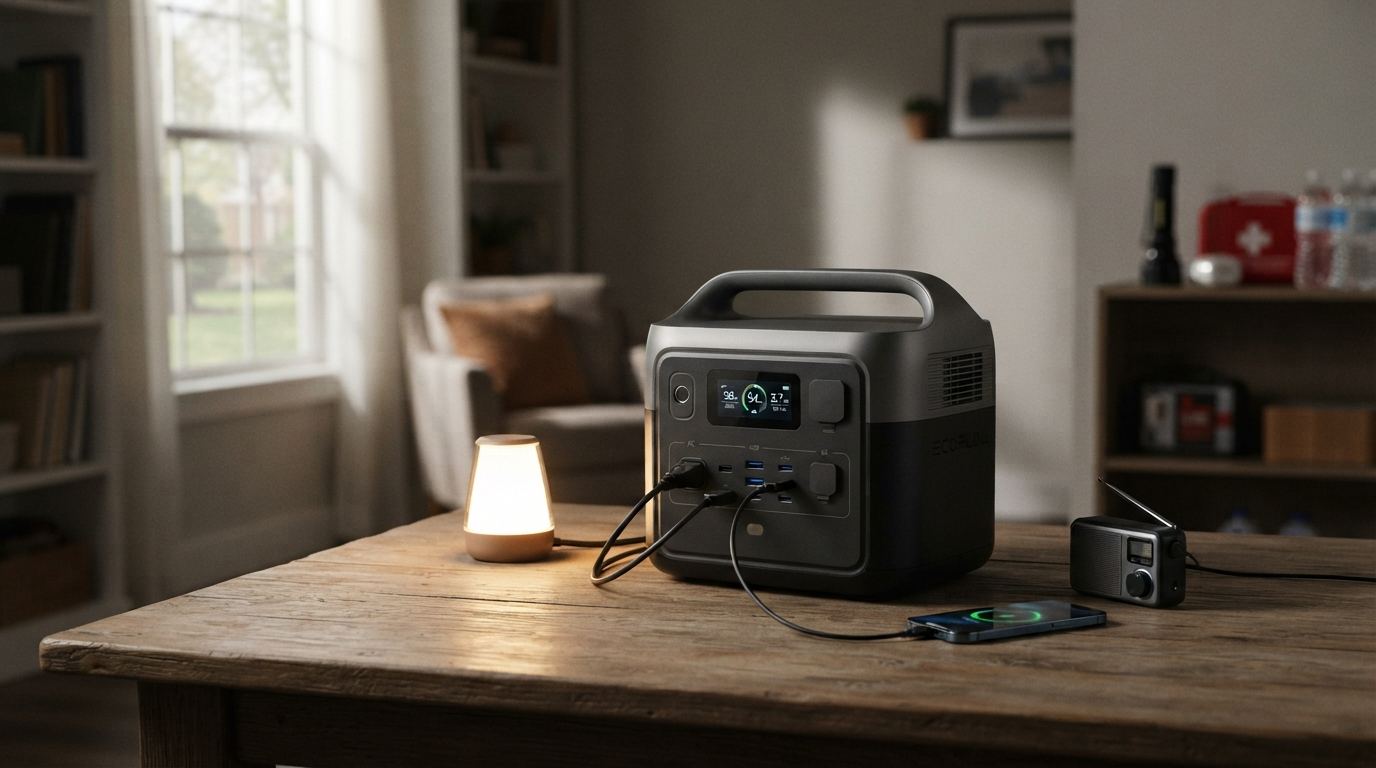
Portable power stations for home backup, compared from published specifications and capacity math. EcoFlow RIVER 3 has 245Wh, 300W output, and solar input.
This article contains affiliate links. If you buy through these links, we may earn a small commission at no extra cost to you.
For most homes, the portable power station to buy in 2026 is the EcoFlow River 3: a 245Wh lithium battery with a 300W AC inverter (600W with X-Boost) and solar input. We compared 12 stations using published specifications and capacity math, and this guide estimates what each one can run. The number that matters isn't the watt-hours printed on the box, it's whether the thing keeps your CPAP working through the night and the fridge cold until morning. Here's the math that decides it. For the specific case of running a fridge through an outage, we ran that math separately in portable power station fridge runtime.
The Number That Matters: Watt-Hours, Not Watts
Watts tell you how fast a device draws power. Watt-hours tell you how long the station can supply it. A station's usable capacity is roughly 85% of the rated number, the inverter and its own electronics eat the rest.
The rule: runtime (hours) ≈ (capacity in Wh × 0.85) ÷ watts of the device.
So a 245Wh station has about 208 usable watt-hours. A phone that pulls 15Wh per full charge gives you about 13 charges. A 30-watt CPAP gives you about 7 hours. A 1,500-watt space heater needs more than the station's entire 600W X-Boost ceiling just to turn on, that's the conversation-ender right there.
Our Pick: EcoFlow River 3
Let's get to the answer first, because it's the station most people should buy.
The EcoFlow RIVER 3 Portable Power Station is a 245Wh station rated at 300W continuous output (600W with X-Boost), recharging from a wall outlet in about an hour, from a car's 12V port, or from solar panels when the sun's back. What sets it apart: lithium iron phosphate (LiFePO4) cells, which hold up for a few thousand recharge cycles (a decade-plus of weekend outages) instead of the few hundred cycles cheaper lithium-ion stations die after. It covers the loads a home actually needs in an outage: phones, radios, a CPAP, a modem, LED lights, and a laptop. The current listing runs about $249, so compare its price with the 300+ Wh competitors before buying.
What a 245Wh Station Will Run (and For How Long)
| Device | Typical draw | Runtime on 208Wh usable |
|---|---|---|
| Smartphone (per full charge) | ~15Wh | ~13 charges |
| Router + modem | ~15W | ~13 hours |
| LED bulbs (10W each) | 10W | ~20 hours per bulb |
| CPAP, no heated humidifier | ~30W | ~6–7 hours |
| CPAP with humidifier | ~60–70W | ~3 hours |
| Laptop | ~50W | ~4 hours |
| Mini fridge (compressor running) | ~50–60W | ~4 hours run time (usually a full evening in practice, since fridges cycle on and off) |
| Full-size fridge | 150–300W | Only briefly (the compressor startup spike is near the inverter's limit, and it drains the battery fast) |
| Space heater, AC, microwave | 1,200–1,500W | Won't run. Over the 600W X-Boost limit |
Two honest caveats. First, real-world runtime is closer to the low end of these ranges: inverters, cold batteries, and aging cells all eat into capacity. Second, refrigerators are the trap: a mini fridge is fine, but a full-size fridge running on a 245Wh station empties it in a few hours. If your plan is "keep the big fridge going for days," that's a gas generator's job, not a battery station's.
Recharge It Three Ways
The River 3's flexibility is the point. Wall power refills it in about an hour when the outage is short. In the car, the 12V outlet slowly tops it up on the way to a charging point. And solar means it's not disposable after one night: the EF EcoFlow 110W Portable Solar Panel (110W, folding, IP68) can refill the RIVER 3 in a day of decent sun, about 3 hours at full output in ideal conditions, a full day when clouds and angles eat into it. Pair that with a solar-capable radio for the long haul, the Kaito KA500 Emergency Radio runs on solar and hand crank, so news and weather alerts keep flowing even after the station is drained.
Build the Outage Shelf Around It
A station alone doesn't keep you informed. This setup covers communication plus a night of small-appliance power; check the station's live offer before totaling it:
- The EcoFlow RIVER 3 Portable Power Station, the power.
- The Midland ER310 Emergency Radio, NOAA alerts and news with 72+ hours of battery, loud enough to wake the house.
- A backup radio for the car kit: the RunningSnail MD-090 Emergency Radio at $36 is fine for that job.
Run the radios on their own batteries and hand cranks first. Save the station's charge for the things with no other power source: the CPAP, the fridge, the router, phone recharges.
Why Not Just a Gas Generator?
For most households, the honest answer is that a battery station covers the outages that actually happen (a night to a weekend) with none of a gas generator's baggage. No gasoline to store and keep fresh, no carbon monoxide risk (battery stations are safe to run indoors, which a gas generator is emphatically not), no pulling a cord in a storm, no oil changes, no noise.
The tradeoff is easier to judge than a fixed price comparison. Small inverter generators usually run $400–600 and need fuel. The River 3 is silent, but its current listing runs about $249, so compare the total. A gas generator earns its keep when you need 600W-plus continuously: a full-size fridge and freezer, a sump pump cycling, or multiple days of cloudy weather. If that's your situation, buy a generator and a CO alarm, run it 20 feet from any door or window, and never indoors. But if your outages look like the last few (phones dying, fridge thawing, no internet) a battery station is the quiet answer to the actual problem.
The Bottom Line
The EcoFlow RIVER 3 Portable Power Station is the portable power station we'd buy for home backup: 245Wh is enough for a phone, radio, CPAP, and lights through a weekend outage, and the LiFePO4 battery means it'll still be doing its job a decade from now. Match it to your loads with the runtime math above, and you'll know before the lights go out exactly what it can carry, and what it can't.
Frequently asked questions
What can a 245Wh power station actually run in an outage?
Do the math before you buy: usable capacity is about 208 watt-hours once inverter losses eat their share. That covers roughly 13 phone charges, 13 hours of router and modem, 20 hours per 10W LED bulb, or 6 to 7 hours on a 30W CPAP without a heated humidifier. Anything over the 600W X-Boost limit, like a space heater, AC, or microwave, will not run at all.
Will a portable power station keep my full-size fridge cold?
Not for long. A full-size fridge's compressor startup spike sits near the 600W X-Boost limit, and its draw empties a 245Wh battery within a few hours. A mini fridge is the realistic job: about 4 hours of compressor time, usually a full evening in practice since fridges cycle on and off. Keeping a big fridge going for days is a gas generator's job.
How long does it take to recharge from solar?
A wall outlet refills the River 3 in about an hour when grid power returns. From a 110W folding panel, figure about 3 hours at full output in ideal conditions, and plan on a full day of decent sun once clouds and panel angles eat into that.