
Lost Documents After a Disaster: How to Replace IDs, Deeds, and Policies
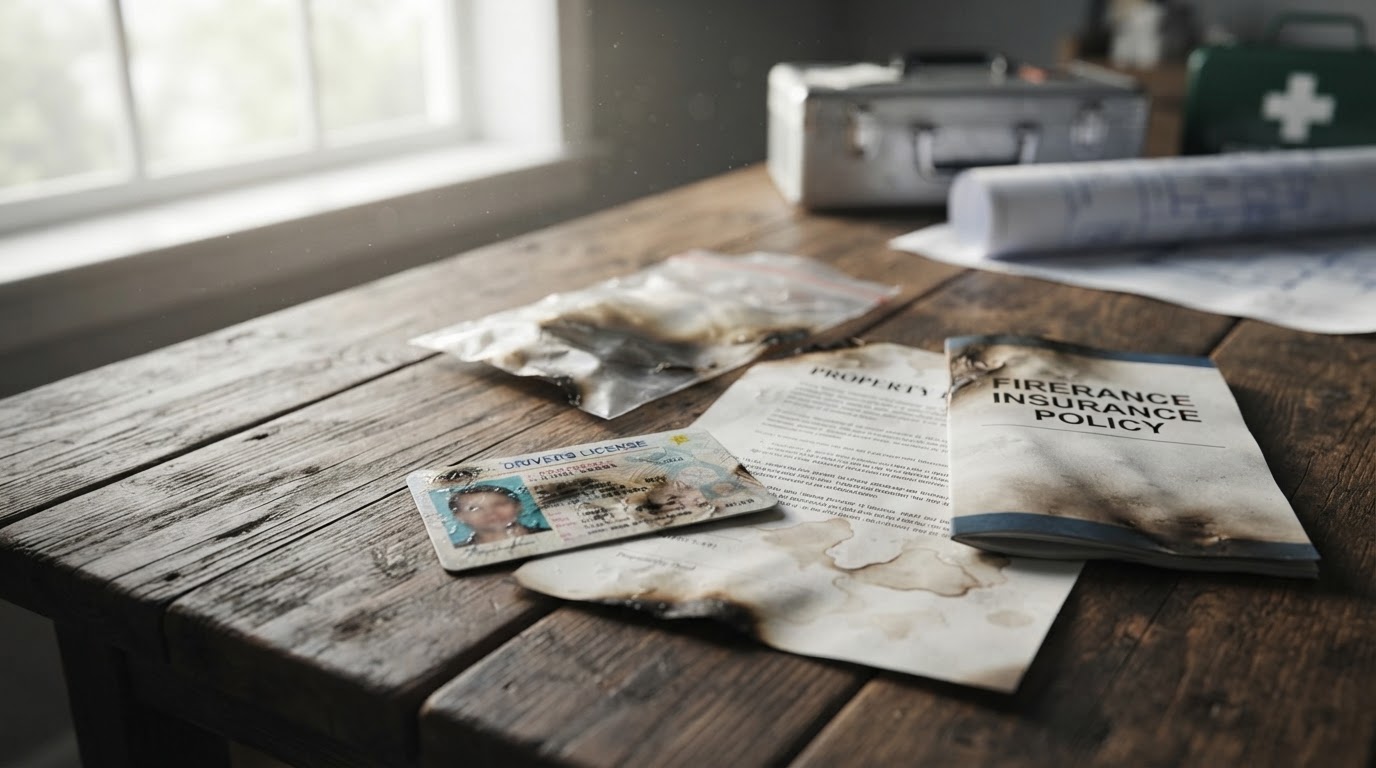
Fire or flood can take your IDs, deeds, and policies at once. The order to replace each one, what it costs, and how to keep the new copies safe for good.
This article contains affiliate links. If you buy through these links, we may earn a small commission at no extra cost to you.
If a fire, flood, or tornado takes your records, you are not starting from nothing. Every document you lost exists as a record somewhere else: the state has your birth certificate, the county has your deed. Replacing them is a sequence, not a scramble.
Quick answer: Freeze your credit first (free, and it takes minutes), then replace in dependency order: state ID, birth certificate, Social Security card, passport, then property and tax records. Costs run from nothing for a tax transcript to about $165 for an adult passport book, and many states waive replacement fees in declared disaster areas.
Do these five things in the first 72 hours
- Ask your insurer for a copy of your declarations page. Your carrier keeps the policy on file, so the paper itself does not need replacing.
- Freeze your credit at all three bureaus. The FTC notes a freeze is free, does not affect your credit score, and stops anyone from opening new accounts in your name. Lost IDs plus a mailing address in flux is the window identity thieves work in.
- Collect copies from anyone who already holds one. Your bank, mortgage servicer, and employer all keep records that prove who you are and what you owe.
- File a police report for anything stolen, and save the number. Stolen documents get flagged faster, and the report is accepted as evidence.
- Write one fact sheet. Every replacement below asks for the same core facts: legal name, date and place of birth, Social Security number, and your previous address.
Where each document comes from
| Document | Who replaces it | What to know |
|---|---|---|
| Driver's license or state ID | Your state DMV | Many states waive replacement fees for declared-disaster residents; Florida's DMV, for example, waives license, ID, and title fees |
| Birth, marriage, or divorce certificate | The state vital records office where the event was recorded; the CDC links every state's office | The base record to request first when your wallet is empty; fees and ID rules vary by state |
| Social Security card | ssa.gov or your local Social Security office | Free, by mail. The SSA says you usually do not need the card if you know your number |
| Passport | Report the loss on Form DS-64, then apply in person on Form DS-11 | $130 application fee plus a $35 execution fee for an adult book, per the State Department, which also publishes disaster-specific passport guidance |
| Deed or property records | The county recorder or register of deeds where the property sits | The deed is a public record, so a certified copy is a routine request |
| Vehicle title | Your state motor vehicle agency, or the lienholder if the car is financed | A financed car's title lives with the lender, who can supply a copy faster |
| Insurance policies | Your insurer | Free. Ask for the declarations page by email, and check the coverage limits while you have it open |
| Tax records | IRS Get Transcript, free online, or 800-908-9946 | Free and immediate, and they work as proof of income or address |
The passport takes two forms: DS-64 reports and cancels the old book, and DS-11 is the application itself, submitted in person. Applying without reporting leaves a passport that someone else can still try to use.
Break the catch-22
The hard case is having no photo ID at all. Records offices want identification before they release a certificate, and the DMV wants a birth certificate before it will issue an ID.
Start with the record that does not depend on you. A birth certificate is filed permanently with the state where you were born, so it is the first request to make when your wallet is empty. Tell the vital records office that a disaster took everything, then ask what alternative proof it accepts: many offices allow a notarized request, secondary documents, or an application by an immediate family member, but the rules differ by state.
FEMA keeps a Replacing Vital Documents page that routes you to the right office for each record, and the Red Cross lists replacing vital documents among its recovery services. If one office turns you away, call the next: the record exists, and the release path usually does too. If the event triggers a federal declaration, our FEMA disaster assistance guide covers the aid side.
Rebuild the storage layer before the replacements arrive
New originals will trickle in over the next month or two. Store them the way the last set should have been stored.
Three things do the work: a bag that leaves with you, a box that stays home, and a copy that lives online. The DocSafe Fireproof Document Bag is an eight-layer zip bag, about $20, sized for passports, titles, and policy pages; it resists heat and splashes, though it is not immersion-rated, so in flood country a roll-top dry bag is the better carrier. The SentrySafe 1210 Fireproof Box holds originals at home in a box UL-classified to 1550°F for 30 minutes, about $27. Scan each replacement as it arrives into one password-protected cloud folder, and keep an offline copy on a Samsung BAR Plus 128GB USB 3.1 Flash Drive that opens on any computer without a login.
Copies in the bag, originals in the box, scans in the cloud. If your documents lived in a binder that burned, our go-bag document binder guide covers the binder itself.
What not to do
Go direct. Every replacement above comes from a government office or your insurer, and none charges a finder's fee. Skip any service that wants payment up front to "recover" your records: the offices on this list are the fastest path, and most are free.
Your replacement order
- Freeze credit at Equifax, Experian, and TransUnion (free)
- Ask your insurer, bank, and lender for the copies they hold
- State ID or driver's license (ask about disaster fee waivers)
- Birth certificate from the state vital records office
- Social Security card (free, and often optional)
- Passport: DS-64 report first, then DS-11 in person
- Deed, title, and policy pages from the recorder, the motor vehicle agency, and your insurer
- Tax transcripts from IRS.gov if you need proof of income
- Scan everything into the cloud folder, then store the paper properly
Source notes: FEMA's Replacing Vital Documents guidance; Social Security Administration; U.S. Department of State passport guidance and fee schedule; Federal Trade Commission credit freeze guidance; CDC directory of state vital records offices; Florida DMV disaster fee waivers; IRS Get Transcript.
Frequently asked questions
What should I replace first after losing my documents?
Freeze your credit first, then replace in dependency order: state ID or driver license, birth certificate, Social Security card, and passport. Property and tax records come last because no other record depends on them.
How do I replace a birth certificate with no photo ID?
Start at the state vital records office where you were born, since that record does not depend on any document you still own. Tell the office a disaster took everything and ask what alternative proof it accepts; many allow a notarized request, secondary documents, or an application by an immediate family member, and the rules differ by state.
Do I have to replace my Social Security card?
Often no. The Social Security Administration says you usually do not need the physical card if you know your number, and a replacement is free by mail when you do want one.