
The Grab-and-Go Document Binder: IDs, Insurance, and Deeds Ready to Carry (2026)
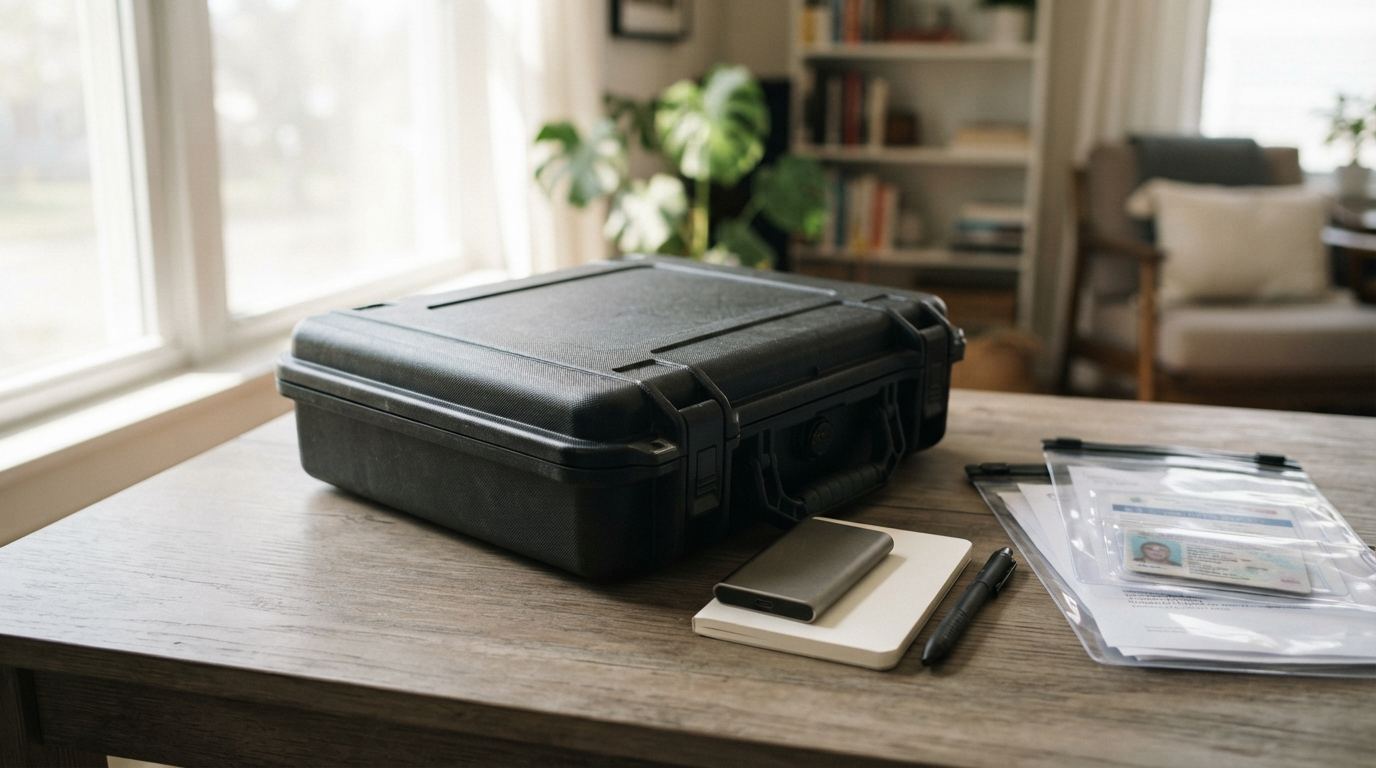
Build a grab-and-go document binder and fireproof home copy: which IDs, deeds, and policies to pack, how to waterproof them, and where to keep a digital backup.
This article contains affiliate links. If you buy through these links, we may earn a small commission at no extra cost to you.
If you have 90 seconds to leave, you will not have time to hunt for a passport or insurance card. One afternoon fixes it: a slim binder you can grab, a fireproof box at home for the originals, and a password-protected copy in the cloud.
This is the paperwork layer next to your go bag. For the full pack list see our ultimate bug out bag checklist and get home bag checklist. For the one-room version see our shelter-in-place guide.
Why a binder beats a drawer
Families who could prove who they were, what they owned, and who insured it got help weeks faster. FEMA after-action interviews keep finding that. A drawer scatters proof across folders and wallets; a binder puts it in one place, in the order someone at a counter would ask for it. One grab, one answer.
What goes in the binder
Keep it to copies where you can. Originals stay in the fireproof box unless you are evacuating. The binder carries clean photocopies plus a one-page contact sheet on top. Four tabs are enough.
1. Identity and travel. Passport photo pages, driver licenses, birth certificates, Social Security cards, marriage or custody papers, any visa or residency cards. Add a recent family photo; it helps at reunification points more than you expect.
2. Property and finance. One page per account: bank name, last four digits, phone number. Same for mortgage or lease, car title or loan, and where your emergency cash lives. The last four plus the phone number gets a banker on the line without handing a thief much.
3. Insurance. Home or renters, auto, health, life, and flood if you carry it. Copy the declarations page (policy number, agent, limits), not the 40-page booklet. Walk every room with your phone and upload the video to the same cloud folder.
4. Medical and household. One page per person: prescriptions with doses, allergies, blood type if known, doctor and pharmacy numbers, vaccination history, advance directives if you have them. Add vet records if you evacuate with pets. Our pet emergency kit guide covers why shelters ask for them.
If it does not help you prove who you are, prove what you own, or get medical help, it does not belong in here.
Two copies with one job each
The binder is the copy that moves. Use a zippered pouch or a half-inch binder with sheet protectors, letter size, not a bulky three-ring that fights you at the door. One purchase covers the whole spec: the Sooez Accordion File Organizer with Zipper… is a letter-size accordion that zips shut with the four sections built in, so identity, property, insurance, and medical stay separated without extra protectors or tabs. Keep it under a pound and clip it inside your bug out bag or on the shelf right above it.
The box is the copy that stays. Paper burns fast. A UL-classified box rated to 1550 degrees for 30 minutes buys firefighters time. The SentrySafe 1210 Fireproof Box is the standard: 0.18 cubic feet, key lock, letter-size, about $27. Put passports, original deeds, Social Security originals, the contact sheet, a USB with the same scans, and a few hundred in small bills inside. Set it low in an interior closet and tell every adult where the key lives.
Our shelter-in-place guide uses the same split: one box that stays, one envelope that goes. If you get the evacuation order, move the USB and a few originals to the pouch and go. A Midland ER310 Emergency Radio on SAME alert wakes you for your county only, so you grab the binder because the county told you to.
The digital copy: one folder, everywhere
Paper is for counters and shelters. Your phone is for the rest.
- Scan, do not photograph. Lay pages flat, use your phone's scanner at 200 dpi or higher, save as PDF.
- Name them plainly:
2026-passports.pdf,2026-insurance-declarations.pdf, so dates tell you what is stale. - Put them in one password-protected folder in Drive, iCloud, or Dropbox. Share it with your out-of-town contact. Copy the same PDFs to a Samsung BAR Plus 128GB USB 3.1 Flash Drive in the SentrySafe 1210 Fireproof Box and a second copy in the binder's front pocket. The metal-cased stick survives the bottom of a go bag and opens on any machine you find without logins, which is what you want when the cloud is unreachable.
- Turn on two-factor. A file you cannot open at a shelter is not help.
Test it from another device: open the folder, open a PDF, read a policy number. If that takes more than 30 seconds, fix it now.
Where the binder lives
The best binder is the one tied to the bag you actually grab.
- Clipped to the bug out bag. When you grab the bag, you grab the proof.
- A single-page copy in the car. IDs, insurance cards, and the contact sheet in a zip bag in the glove box.
- On the shelf if you shelter in place. Box shut, binder ready.
Tell two people where both copies live. A plan that lives in one head fails when that person is not home.
Waterproof and maintain it without overthinking
Sheet protectors plus a zippered pouch handle rain and a flooded trunk.
Do it twice a year when you rotate food and water; piggyback the clock-change cadence from our food and water storage guide:
- Swap any expired ID copy, re-scan, replace the PDF.
- Re-export declaration pages after renewal.
- Re-shoot the home video if you bought anything worth claiming.
- Refresh the USB. Copy, eject, put it back.
Stick a note inside the cover: "Last refreshed: 2026-08-__." Future you will thank present you.
Your grab-and-go binder checklist
- Zip pouch or half-inch binder with sheet protectors and four tabs, letter size
- Tab 1 copies: passports, licenses, birth certificates, Social Security, custody papers
- Tab 2: one page per account (last four + phone) + mortgage/lease + title
- Tab 3: declarations pages + agent numbers, plus phone video of every room
- Tab 4: prescriptions with doses, allergies, doctors, vaccine history; vet records if needed
- Front pocket: one-page contact sheet and USB with scans
- Home box: SentrySafe 1210 Fireproof Box low in an interior closet with originals, sheet, USB, and small-bill cash
- Digital folder: password-protected cloud copy tested from a second device
- Two adults know where both copies live and when you refreshed them
Paper does not feel like preparedness until the claims line moves and yours does not. Build the binder, box the originals, back them up, and put the whole thing where your feet will be when the alert comes.