
Renters Insurance After a Disaster: What Covers Your Stuff and What Doesn't
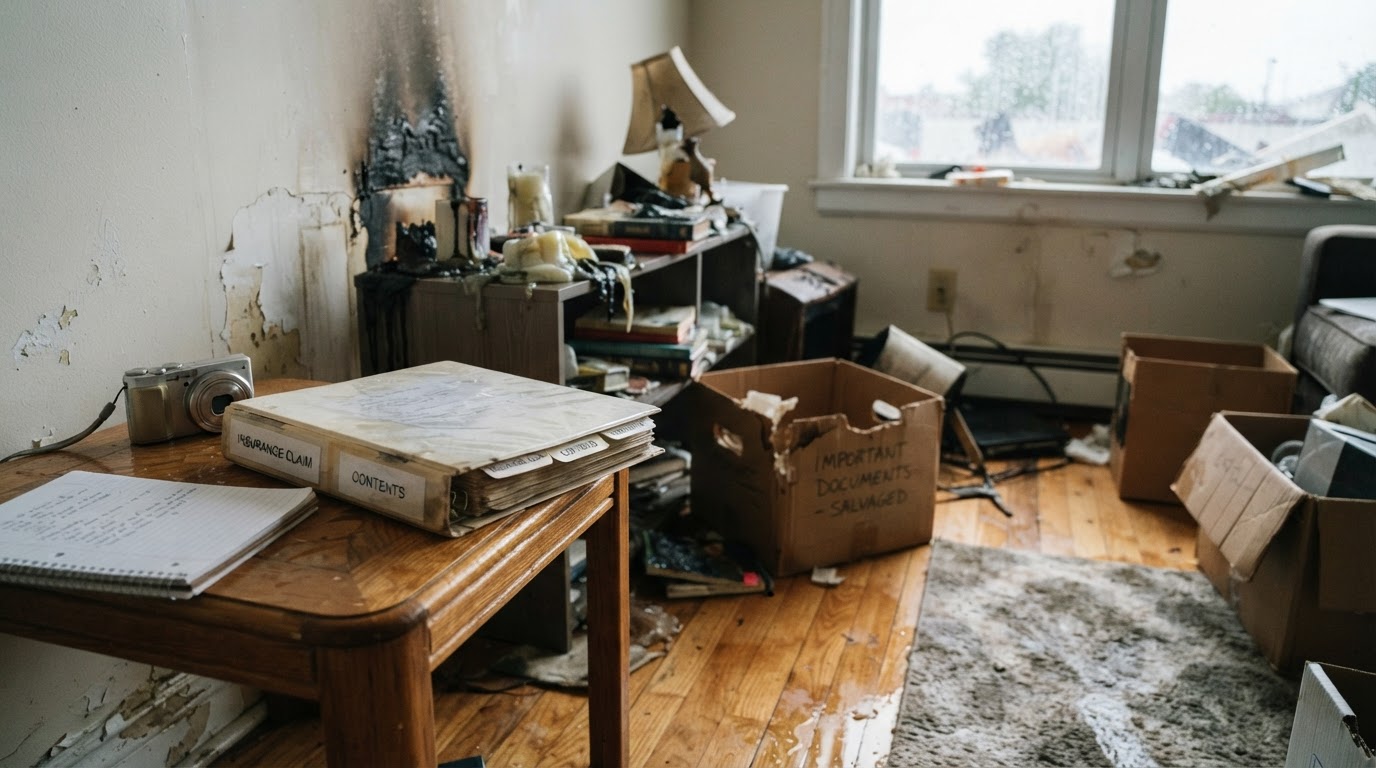
What a renters policy pays after a flood, fire, or storm, what it excludes, how renters document their belongings, and how to file a claim step by step.
This article contains affiliate links. If you buy through these links, we may earn a small commission at no extra cost to you.
A standard renters policy covers your belongings, your liability to other people, medical payments, and the cost of staying somewhere else if the unit becomes unlivable. It is the cheapest disaster coverage you can buy, and it excludes the two hazards that destroy the most renter property: flood and earthquake.
Quick answer: Buy a renters policy even if you think you have nothing worth insuring. The four coverages are personal property, personal liability, medical payments, and loss of use, and liability limits generally start around $100,000 (Insurance Information Institute). The landlord's policy covers the building and nothing of yours. Flood needs a National Flood Insurance Program contents-only policy. Earthquake needs a separate policy or endorsement, and in California your insurer must offer it.
What a renters policy actually covers
Renters policies are written on the HO-4 form, the renter's form in the standard homeowners program (NAIC data call). Four coverages matter:
- Personal property. Your stuff, on a named-perils basis. Theft, fire, smoke, vandalism, falling objects, and a burst pipe or overflowing appliance count. A flood rising through the door does not. Jewelry, furs, firearms, and artwork get their own sub-limits.
- Personal liability. If you damage someone else's property or injure someone, including a guest who slips on a wet floor. Limits generally start around $100,000 (Insurance Information Institute), the level most landlords require, and coverage generally applies on and off the premises.
- Medical payments. Bills for someone injured in or around your home, independent of whether your liability applies.
- Loss of use. Additional living expenses if the unit becomes uninhabitable after a covered loss.
Set the contents limit to what it would cost to replace everything, not what it cost, then check whether the policy pays actual cash value or replacement cost. Actual cash value deducts depreciation, so a five-year-old sofa gets written down.
The two gaps that matter
Flood. Renters policies do not cover flood damage, and the landlord's does not either. FEMA's NFIP renters brochure says it directly: a landlord may have flood insurance for the building, but that policy will not cover your personal belongings. The fix is a contents-only NFIP policy, which protects up to $100,000 of tenant-owned property and has a 30-day waiting period after purchase. Our flood insurance guide covers the mechanics.
Earthquake. Standard renters policies exclude earth movement by name. In California, Insurance Code 10081 requires every residential property insurer to offer earthquake coverage to the named insured, and the California Earthquake Authority writes renters policies as well as homeowners policies. Elsewhere availability varies, so get the answer in writing.
Also excluded by default: sewer backup, unless you buy the endorsement, and gradual leaks with the mold that follows. A burst pipe that overflows a cabinet is covered. A drip you ignored for six months is not.
The landlord's own policy never covers your furniture, electronics, or clothes, only the structure. The American Red Cross's disaster financial planning guide puts it plainly: a landlord's insurance will not cover damage to a renter's possessions.
Document it before it happens
The claim only works if you can prove what you had. Ready.gov's guidance is the operating standard: keep a detailed inventory including brand, price, purchase date, model, and serial number, add photos or video, and store it somewhere you can reach after the event.
- The NAIC home inventory app is free on iPhone and Android. It groups belongings by category, scans barcodes for accuracy, and uploads photos.
- Rite in the Rain Weatherproof Pocket Notebook, 3.5… (about $8) is the damage log you write in the parking lot in the rain, on a phone with no battery left.
- Samsung BAR Plus 128GB USB 3.1 Flash Drive (about $40) holds the offline copy of the inventory video and the scanned policy pages. It opens on any machine without a login when the network is down.
- Sooez Accordion File Organizer with Zipper… (about $10) holds the paper file: policy, inventory, receipts, and claim correspondence in separate pockets.
- DocSafe Fireproof Document Bag (about $20) keeps the lease, policy pages, and ID in one zip bag that handles heat and splash. It is not immersion-rated, so for a flooding unit use a roll-top dry bag.
The full document system is our grab-and-go document binder guide.
Filing the claim
- Call your insurer, then write it down. Ready.gov tells you to file claims promptly because policies carry time limits, and to keep a record of every call, date, and promise.
- Photograph before you clean. Every damaged item, in place, with something for scale. The Red Cross is explicit: do not throw out damaged furniture, and keep clothing, because smoke and water damage makes items unrecoverable even when they still look fine.
- Keep every receipt. Temporary lodging, meals, moving costs, storage, dry cleaning. Red Cross lists temporary residence, additional living expenses, and storage as costs renters policies commonly cover.
- Hold damaged items until the adjuster says they can go, and log anything you remove for safety.
- Do not pad the loss. Inflating a claim is the fastest way to a denial and a fraud flag.
When the loss is a flood, an earthquake, or a declared disaster
Flood and earthquake claims go to different insurers, and the gap belongs to you. Your renters carrier does not pay a flood claim, and your flood policy does not pay an earthquake claim.
Federal help sits on top of all of it. FEMA's Individuals and Households Program covers renters as fully as owners: FEMA's fact sheets say assistance for renters can include short-term lodging, temporary housing, essential personal property, and uninsured medical, dental, child-care, moving, and storage expenses. It supplements insurance rather than replacing it, and you still file with your insurer and submit the settlement or denial letter. The walkthrough is our FEMA disaster assistance guide.
Quick recommendations
- Buy the policy. Liability limits generally start around $100,000.
- Read two numbers on the declarations page: the contents limit, and actual cash value versus replacement cost.
- Buy flood separately and early. The NFIP contents-only policy has a 30-day waiting period.
- Ask about earthquake. Standard renters policies exclude it.
- Photograph everything now and keep the file somewhere dry.
- Keep $100 to $200 in small bills. Card readers and ATMs fail with the power.
Sources: NAIC consumer insight on renters policies and the NAIC homeowners-forms data call (HO-4); Insurance Information Institute on liability limits; FEMA NFIP renters brochure; California Insurance Code 10081; FEMA Individuals and Households Program fact sheets; Ready.gov document-and-insure guidance; American Red Cross disaster financial planning guide.
Frequently asked questions
Does renters insurance cover flood damage?
No. Flood is excluded from standard renters policies, and the landlord policy does not cover your belongings either. The fix is a contents-only National Flood Insurance Program policy, which covers up to $100,000 of your property and carries a 30-day waiting period after purchase (FEMA).
Does my landlord insurance cover my stuff if there is a fire?
No. The landlord policy covers the building. The American Red Cross states plainly that a landlord insurance policy will not cover damage to a renter's possessions, which is why renters insurance matters even in a well-insured building.
How much renters insurance do I need?
Set your contents limit to what it would cost to replace everything you own, not what it cost, and confirm whether the policy pays replacement cost or actual cash value, which deducts depreciation. For liability, limits generally start around $100,000, which is also the level most landlords require.