
Winterize Your Home Before the First Freeze: 2026 Checklist
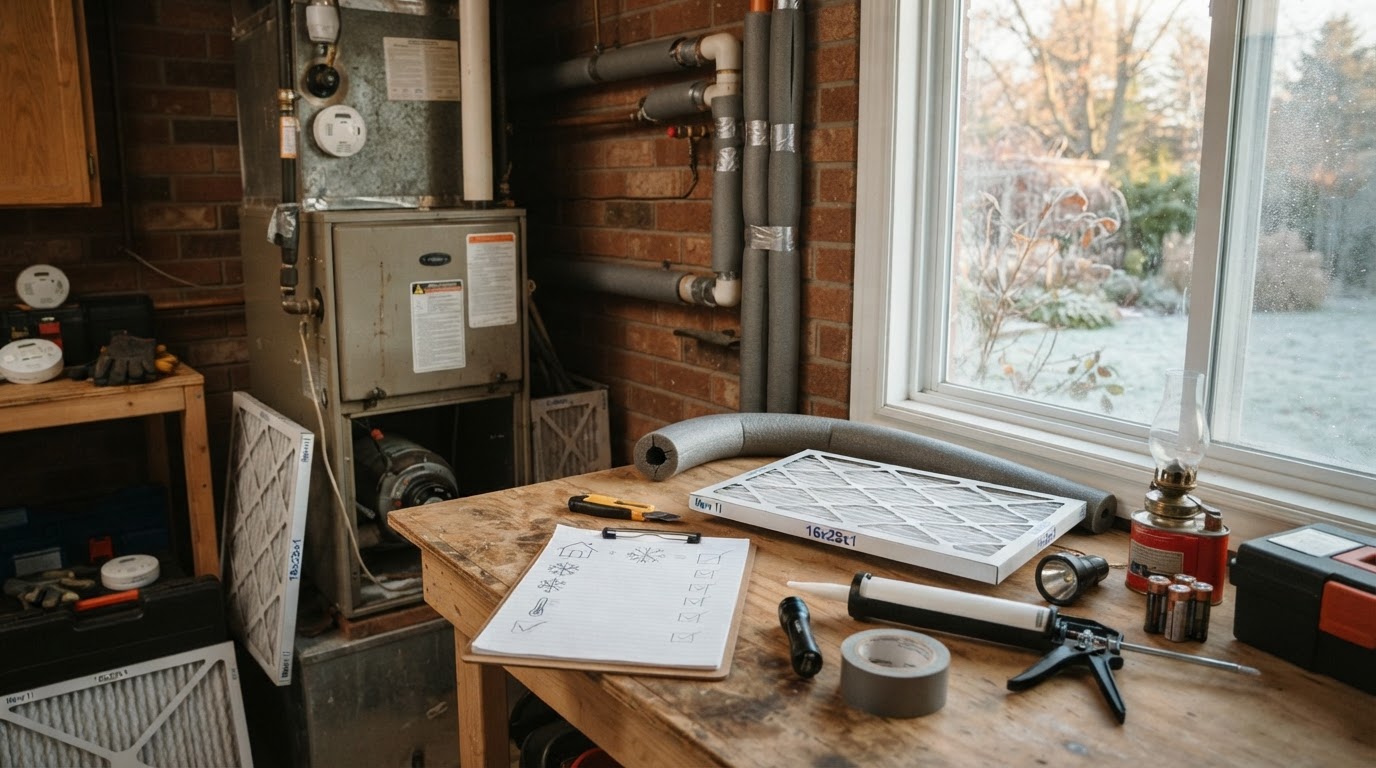
Winterize your home before the first freeze: furnace and filter checks, pipe insulation, draft sealing, and a backup heat plan in one pre-winter checklist.
This article contains affiliate links. If you buy through these links, we may earn a small commission at no extra cost to you.
One October weekend stops most of the January emergencies. Winterizing your home is a two-day checklist, not a skill: furnace checked, pipes protected, drafts sealed, backup heat planned, gutters clear. Do it before the first hard freeze and your winter self will be bored. That is the goal.
The freeze date matters more than you think. Pipes that burst in a February deep freeze were usually lost in the November warm spell, the night nobody expected the temperature to drop. This guide is sequenced: heat, water, drafts, roof, so the expensive failures get covered first.
1. Heat: Furnace, Filter, Thermostat
The furnace is the one appliance that can't wait. One that dies in January gets repaired in January, at emergency rates, if the part is in stock. Get it serviced in September. Ask for a heat exchanger check, because that is how carbon monoxide gets into a house, and change the filter. In winter, swap the filter every one to two months; a dirty one makes the furnace run longer and hotter. A MERV-13 filter like the Filterbuy 20x20x1 MERV 13 Air Filter (2-Pack) (about $34 for a two-pack) catches more, only if your blower can move air through it.
Your thermostat does real work. Run 68°F during the day, cooler at night, and never below 55°F when you are away. That 55°F floor is the pipe-protection number, whether you leave for a weekend or a month.
While you are up, test the smoke and CO detectors and put fresh batteries in. The Kidde Battery-Powered Carbon Monoxide Detector runs on two AA batteries and keeps listening through a power failure, which is exactly when furnaces, space heaters, and cracked heat exchangers misbehave.
2. Pipes: The Failure That Floods
A burst pipe is not a leak. It is water through the ceiling at gallons per minute, the most expensive failure on this list, and the most preventable.
- Know your shut-off valve and test it now. When water is spraying, your whole job is stopping the flow in seconds. Find the valve, usually where the main line enters near the meter, and confirm it actually turns.
- Disconnect garden hoses and shut off outdoor spigots before the first freeze. Water trapped in a hose freezes, expands, and cracks the fitting back into the wall. Shutting the valve protects the line without emptying the spigot body, which still holds water. The Frost King FC2 Plastic Faucet Cover traps still air around the outside faucet so that last bit stays liquid, about $6.50 per spigot.
- Insulate exposed supply runs in crawlspaces, garages, and under sinks. The Duck Brand Insulating Foam Pipe Covers, 0.75-Inch x… are pre-slit foam tubes that slide over copper or PEX for about $21 for a 4-pack.
- Below about 20°F, open under-sink cabinets and let the farthest faucet from the meter drip. Moving water freezes far less easily than still water.
- If you leave town, keep the thermostat at 55°F. A cold house with warm pipes is cheaper than a flooded one.
The full temperature-by-risk table lives in our winter storm survival guide. If the freeze wins anyway, melted snow is your fallback: our snow-melting guide covers the ratios and fuel math.
3. Drafts: The Silent Heat Leak
Air leaks account for a big share of a home's heat loss, and they are the cheapest thing on this checklist to fix. Frost King R338H Self-Stick Rubber Foam… self-sticks to the door jamb and seals the daylight gap most front doors show at the edges; one ~$3 roll does a door, and two or three more cover the attic hatch and the basement door. A draft stopper under the door is a separate five-minute job: the MAXTID Adjustable Under-Door Draft Stopper, 36 in… slides under and seals that bottom gap for about $13. Then hit the draftiest windows with Duck Brand Indoor 10-Window Shrink Film Insulator…: tape the film to the frame, shrink it with a hair dryer, and each window gains a dead-air layer. About $23 covers ten windows.
Two jobs people skip: gasket covers behind exterior-wall outlets, and the fireplace damper closed when the firebox is empty. Both take minutes.
4. Roof and Gutters: Ice Dams
Clean the gutters before the freeze, not after. Ice dams form when attic heat melts snow near the ridge and the water runs down and refreezes at the cold eaves, backing up under the shingles and dripping into the walls. Two fixes: seal the attic air leaks that feed the warm roof, and keep the gutters clear so meltwater has an exit. If a dam forms anyway, calcium chloride in a pantyhose leg laid across it melts a channel; leave the ice alone otherwise. A long-handled roof rake clears snow from the ground and beats a ladder: the Extreme Max 5600.3207 Shingle-Saver 21' Roof Snow… reaches 21 feet with a 24-inch blade that slides under the snow without digging into the shingles, so you pull the load off from the driveway instead of climbing up there.
5. Water Heater, Sump Pump, and the Outdoor Stuff
- Sump pump: pour a bucket of water into the pit. It should kick on and drain. Test it now, not during the March thaw, and know whether the pump has a battery backup.
- Water heater: set to 120°F and, if it sits in an unheated garage, wrap the tank: an R10 insulation blanket like the Frost King SP57/11C All Season Water Heater… wraps a 40-80 gallon tank in about twenty minutes for roughly $35, holding the water above freezing through a week-long cold snap. A garage water heater is a common freeze casualty.
- Irrigation: have sprinkler lines blown out. Buried lines crack silently and surface in spring as a soggy yard.
- Window AC units: pull them, or cover and seal them. An uncovered unit is a draft with a heat exchanger in it.
6. Backup Heat That Won't Kill You
Plan the no-furnace night now, because the furnace is the thing most likely to be down mid-outage. Heat one room, not the house. Electric space heaters are the only no-brainer indoor heat when the furnace is dead, and the rules are short: 3 feet from anything flammable, straight into a wall outlet and never an extension cord, off before sleep. The GiveBest Portable Ceramic Space Heater is ETL-listed with tip-over and overheat shut-off, has 750W and 1500W settings, and costs about $27. It is the heater we point people to when they ask for one that checks those boxes.
Whatever you do, a generator, grill, or camp stove stays outside, 20 feet from doors and windows. Indoor combustion in a winter outage is how whole families die of carbon monoxide, and it is the one mistake this site will not hedge on.
7. The Printable Checklist
- Furnace serviced, heat exchanger checked, filter swapped (Filterbuy 20x20x1 MERV 13 Air Filter (2-Pack))
- Smoke and CO detectors tested, fresh batteries, one CO alarm per floor (Kidde Battery-Powered Carbon Monoxide Detector)
- Main water shut-off valve located and tested
- Hoses disconnected, spigots shut off, sprinklers blown out (Frost King FC2 Plastic Faucet Cover)
- Exposed pipes insulated, cabinets opened below 20°F (Duck Brand Insulating Foam Pipe Covers, 0.75-Inch x…)
- Thermostat plan set: 68°F day, 55°F away
- Weatherstripping and window film on the drafty windows (Frost King R338H Self-Stick Rubber Foam…, Duck Brand Indoor 10-Window Shrink Film Insulator…)
- Gutters cleared (Frost King Gutter Scoop, Black)
- Sump pump tested, battery backup checked (Wayne ESP25n 12-Volt Battery Backup Sump Pump)
- Backup space heater in place with a clear 3-foot zone (GiveBest Portable Ceramic Space Heater)
- Window AC units covered or removed
Two days in October buys you a winter where nothing in the house fails. It is the cheapest night's sleep you will get all year.
Frequently asked questions
When should I winterize my home?
Do it before the first hard freeze, while temperatures still sit above freezing at night. One October weekend covers it. The order that matters: furnace and filter, then pipes, then drafts, then gutters and roof.
What temperature should I keep my house so pipes do not freeze?
Never below 55°F, even when you are away for weeks. Below about 20°F outside, open under-sink cabinets so warm air reaches the pipes and let the farthest faucet drip. Insulate exposed supply runs in crawlspaces and garages.
What is the cheapest winterizing fix that matters most?
Knowing and testing your main water shut-off valve, then disconnecting garden hoses and insulating exposed pipes. A burst pipe floods a room in minutes, and stopping the water in seconds is what limits the damage.