
Emergency Cordage and Knots: Bank Line vs Paracord
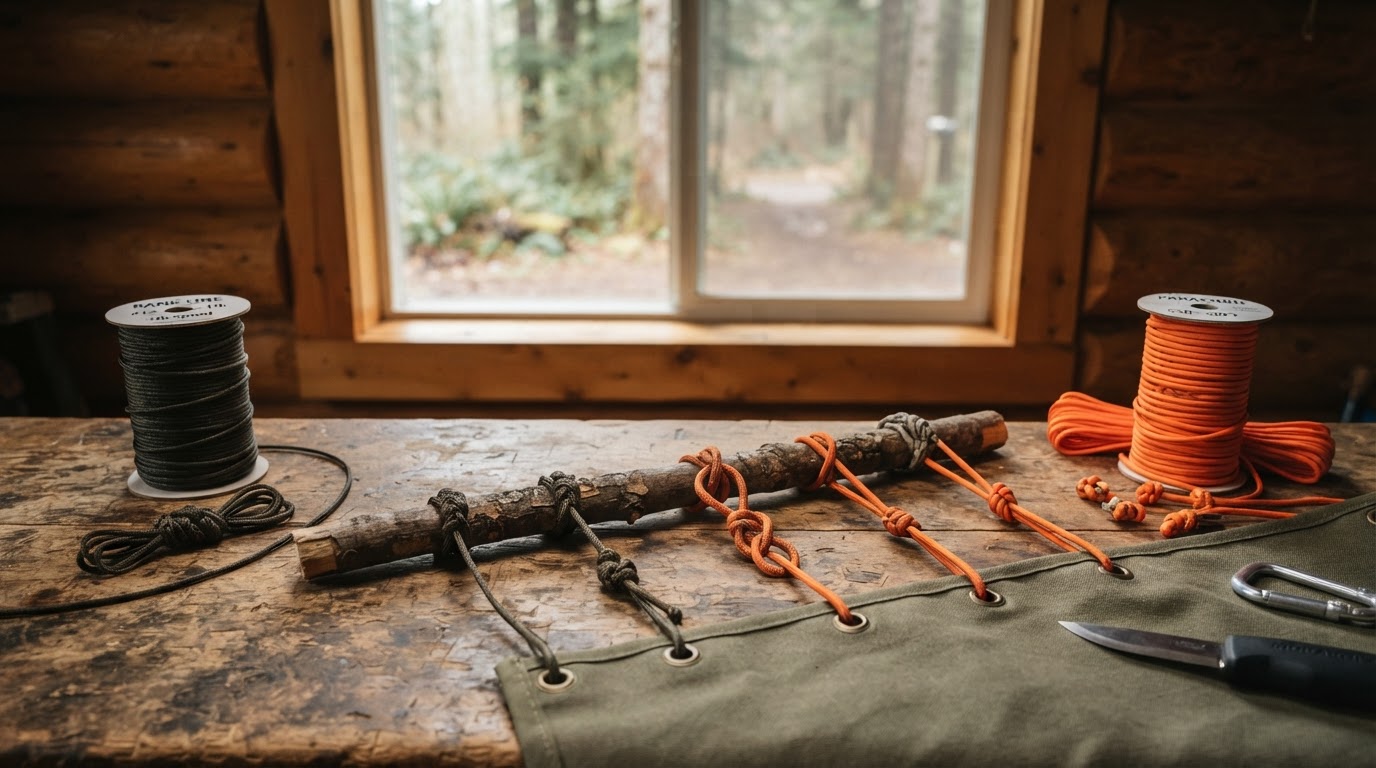
Tarred bank line or paracord: which cord belongs in your kit, and the five knots that build a tarp shelter, rig a ridgeline, and actually hold under load.
This article contains affiliate links. If you buy through these links, we may earn a small commission at no extra cost to you.
The direct answer: carry both, because they do different jobs. Paracord is the stretchy generalist that lashes loads and absorbs shock. Tarred bank line is the low-stretch specialist that grips itself, which is exactly what a ridgeline or a snare loop needs. If you can carry only one, make it the bank line, because its knots stay tight instead of creeping loose overnight.
Most gear lists treat cord as one line item. A checklist says Amazon Basics 550 Paracord, 100 ft… and moves on. The first night you hang a tarp in the rain, you learn the real skill is knowing which cord to pull for which job, and tying the knot that holds.
What each cord actually is
Paracord, properly called 550 cord, is a braided nylon sheath around seven inner strands. Rated around 550 pounds, it stretches roughly 30% before damage. That stretch is a feature when a load jerks, and a defect when you want something rigid. Wet nylon also swells and loosens, so a bowline that felt tight at dusk can slide by morning.
Texas Bushcraft Tarred Bank Line is the opposite animal: a twisted nylon twine soaked in tar, in this case the #36 size at about 350 pounds of breaking strength. Three things make it behave differently. First, near-zero stretch, so anything you tension stays tensioned. Second, the tar coating makes the cord sticky against itself, so hitches lock instead of walking. Third, tarred nylon resists rot, mold, and UV years longer than bare paracord, which is why bank line spent a century on crab pots and trotlines left in the water.
Bank line vs paracord, job by job
| Tarred bank line #36 | 550 paracord | |
|---|---|---|
| Stretch | Almost none | ~30% before damage |
| Knot security | Tar grips itself; hitches lock | Slick; needs backup knots |
| Weather | Rot, mold, and UV resistant | Degrades faster in sun |
| Shock loads | Poor; no give | Excellent |
| Best job | Ridgelines, snares, netting, lashing | Gear repair, towing pulls, improvising |
The pattern: tension jobs want bank line, and bounce jobs want paracord. Clothesline, ridgeline, gate latch, snare, netting, sewing awl work all reward zero stretch. Dragging a cooler over gravel or rigging a shock-absorbing hang wants the stretch.
The five knots worth practicing
Five knots cover nearly everything cordage does at camp. Each takes a few minutes to learn and about a week of nightly practice to tie without thinking.
Bowline. A fixed loop that never jams, even after loading. Memory trick: a rabbit comes out of the hole, around the tree, back down the hole. Your loop around a post, a tree, or a person's chest in a rescue. If you learn one knot, learn this.
Taut-line hitch. An adjustable loop that grips under load but slides when you push it, so you can dial tension on a guyline. This is the knot that keeps a tarp drum-tight all night, and the one that fixes sagging in ten seconds the next morning.
Trucker's hitch. The compound pulley for cinching a load: tarp ridgeline, mattress on a roof, bandage on a splint. Tie a slip loop mid-line, pass the working end through it as a pulley, and multiply your pulling force about three times before locking it with two half hitches.
Square knot. Two ends of the same line joined flat. It holds bandages and bundles, and it is honest about its limits: it slips under uneven load, so it is for securing, not life-safety loads.
Prusik. A small loop of cord that grips a larger line like a ratchet and slides when unlocked. Cleat your ridgeline with one, or use two as ascenders to climb a fixed rope. It needs a smaller cord than the host line, one more reason a hank of thin bank line earns its place.
The tarp shelter workflow, step by step
Here is where the knots turn into a roof. With a Tarp 12x16 ft Heavy Duty 12-mil Waterproof and two lines, an A-frame goes up in about ten minutes.
First, string the ridgeline. Tie a bowline around the first tree at chest height, run the bank line to the far anchor, and finish with a trucker's hitch cinched hard. Bank line matters here: paracord's stretch means a ridgeline that sags after the first rain.
Second, pitch the tarp over the ridgeline and center it. Pull the four corners out at roughly 45 degrees so rain sheds instead of pooling, and stake them through the tarp's grommets. A pack of 12-inch steel stakes like Heavy Duty Tent Stakes 12 inch Steel Pegs 8-Pack drives into soft ground with a boot heel and holds through wind gusts that pull lesser pegs out; if the ground is too hard, a rock in a bag tied to each corner is the weight fallback.
Third, run guy lines. Paracord is fine here, and a taut-line hitch on each corner stake lets you re-tension as the wind shifts. Two corner guys per long side is the sturdy version; one per side is the fast version.
Fourth, add one prusik-loop mid-guy on the windward side. When a gust hits, the prusik slips a few inches and re-grips, absorbing the shock that would otherwise yank a stake out.
For cutting cord and crimping frayed ends mid-job, a small pliers tool beats a knife or your teeth. Leatherman Wingman Multi-Tool rides in most bags anyway, and its pliers grip wet nylon far better than fingers do.
Field care and the habits that matter
Keep both cords as ready-to-use hanks, not loose coils stuffed in a pocket. Chain or coil each one, tie it off, and hang it. Inspect for cuts and fuzzy sheath before every trip, and retire damaged sections by cutting them out and rejoining with a double fisherman's knot.
Wet-weather habit: retighten ridgelines at dusk and again after the first rain. Nylon shrinks slightly as it dries, and a line tensioned in morning humidity will sing loose by evening.
One habit beats every knot on paper: practice them when nothing is at stake. Tie the bowline and taut-line a few nights a week while watching TV, with your hands, not your eyes. In the dark, in the rain, wearing gloves, muscle memory is the skill, and the cord is just the material.
That is the whole craft. Two cords with opposite personalities, five knots with specific jobs, and a ten-minute shelter you can pitch in rain. Paracord still earns its slot for repair and shock work, but tarred line is what holds camp together overnight. The full packing list shows where both fit, and fire starting in wet conditions pairs naturally with this, since dry shelter and dry fire are the same problem: moisture, defeated by setup.