First Things First: What to Buy First for Preparedness (Under $100)
New to preparedness? Start here. Your first $100 should cover clean water, real first aid, and bleeding control. A simple priority order, not a gear wish list.
This article contains affiliate links. If you buy through these links, we may earn a commission at no extra cost to you.
Prepping feels like a wall of gear, but the first purchase order is short: clean water, first aid that can actually stop bleeding, and a way to keep both close. That is the entire first $100. Everything else is a hobby purchase until those two problems are solved.
This guide is the starting point: what to buy first, in what order, under $100, and what to skip until later. If you already know how to build a full go-bag, the under-$100 bug out bag build is your next step. This one is for the month before that: the home baseline that covers 90% of realistic emergencies.
The $100 Starter Set: Three Purchases, One Priority Order
FEMA's own guidance and a century of disaster after-action reports keep landing on the same two near-term threats: no drinkable water and uncontrolled bleeding. Radio, food, and power are the next chapter, genuinely, but later. So the first three buys attack water and blood. If a disaster escalates into a federal declaration, FEMA Individuals and Households Program can supplement those buys after the fact with repair and replacement grants; the step-by-step apply-and-document walkthrough is in our FEMA disaster assistance guide.
| Item | Why it's first | Cost | |
|---|---|---|---|
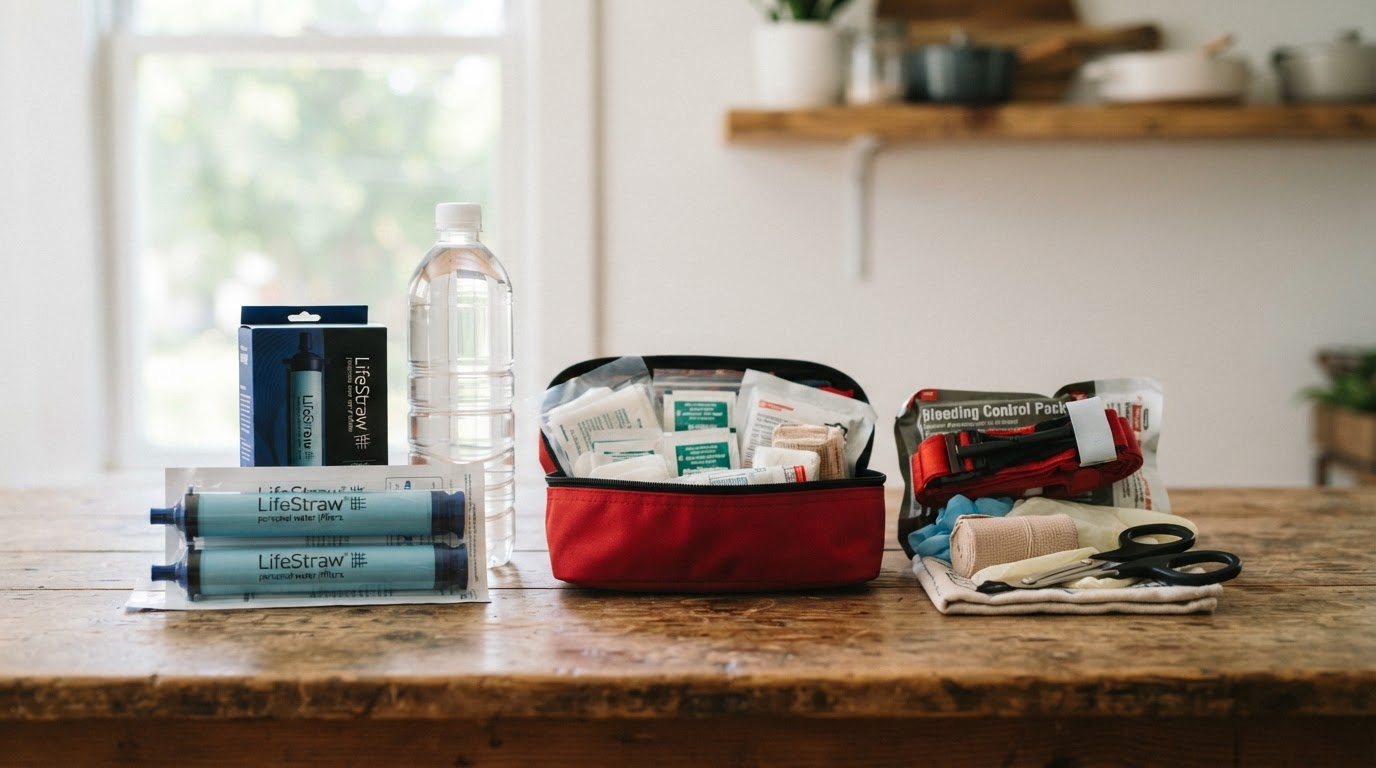
| 1 | Sawyer Squeeze Water Filtration System | Turns any creek, lake, or rain barrel into drinking water, the single resource you'll run out of fastest | ~$46 |
| 2 | Adventure Medical Kits Mountain Series Hiker… | A compact first aid kit with trauma dressings, not just band-aids, fits a pocket or daypack | ~$34 |
| 3 | QuikClot Kaolin Clotting Gauze | The bleed-control layer: clotting gauze for a wound a bandage can't handle | ~$13.49 |
| Total | ~$93.49 |
Why this order? Water is the survival non-negotiable: you can improvise shelter and light, you cannot improvise clean water. A filter is the one piece of "gear" that is really infrastructure: fill it from any source and it becomes safe. Then first aid: in the window before help arrives, the difference between a pressure dressing and a gauze pad is minutes of life. Our severe bleeding guide explains the technique these products support.
If You Can Only Buy One Thing
Buy the water filter. Sawyer Squeeze Water Filtration System filters 100,000+ gallons, screws onto standard bottles, weighs less than a snack, and is the cheapest lifesaving purchase in the entire preparedness catalog. Everything else on this list is a close second; nothing else is a close first.
What to Buy in the Second Hundred (Not This One)
- A NOAA radio: RunningSnail MD-090 Emergency Radio (~$36) pulls weather alerts and works as a flashlight. This is the natural "next $50" after the starter set, and it's the same radio we recommend stocking in multiple places.
- A water container: Reliance Aqua-Tainer 7 Gallon Water Container… (~$52) holds 7 gallons with a spigot. Store it after the filter, since a 7-gallon tank you fill from the tap is your 72-hour buffer.
- Food: start by rotating a few extra cans and shelf-stable staples you already buy. Our food and water storage guide covers the real math.
What to Skip Entirely (For Now)
- "Survival" bundles and military-grade kits. They score high on impulse and low on usefulness. You now know the exact three items that matter; anything a bundle adds beyond those three is noise.
- An expensive knife or multi-tool. A $15 tool from your drawer does 90% of the job until you've upgraded everything else.
- Freeze-dried food by the case. First, rotate the pantry you already have. Long-shelf-life food is a "second hundred" and beyond purchase.
- Tactical clothing, pouches, and organization. Gear that gets worn rarely, carried less.
The Mindset That Replaces the Panic
The fastest way to waste the first $100 is to buy for the scenario instead of for the failure. A flood kit, a grid-down kit, and a first-aid kit share the same backbone: water and bleeding control. Buy those two first and you cover much of the common risk before you own a single "disaster" labeled product. That framing matters more than the gear: the households that fare best in an emergency are not the ones with the most gear, but the ones whose basics were already in place before the news cycle turned serious. No one assembles a kit calmly mid-event. The purchasing you do now, in the calm weeks, is the part of preparation that actually works. Build the complete bug out bag checklist in the months after, not the days before an event.
Quick Recommendations
- The first $100: Sawyer Squeeze Water Filtration System, Adventure Medical Kits Mountain Series Hiker…, QuikClot Kaolin Clotting Gauze.
- If you buy only one thing: the water filter.
- Second hundred, in order: an emergency radio, a 7-gallon water container, then food storage.
- Skip first: survival bundles, tactical gear, and case lots of freeze-dried food.
Start with water and bleeding control, stay under $100, and you've done the part that matters. The rest is refinement.