
Best Space Heaters for Winter Outages (2026)
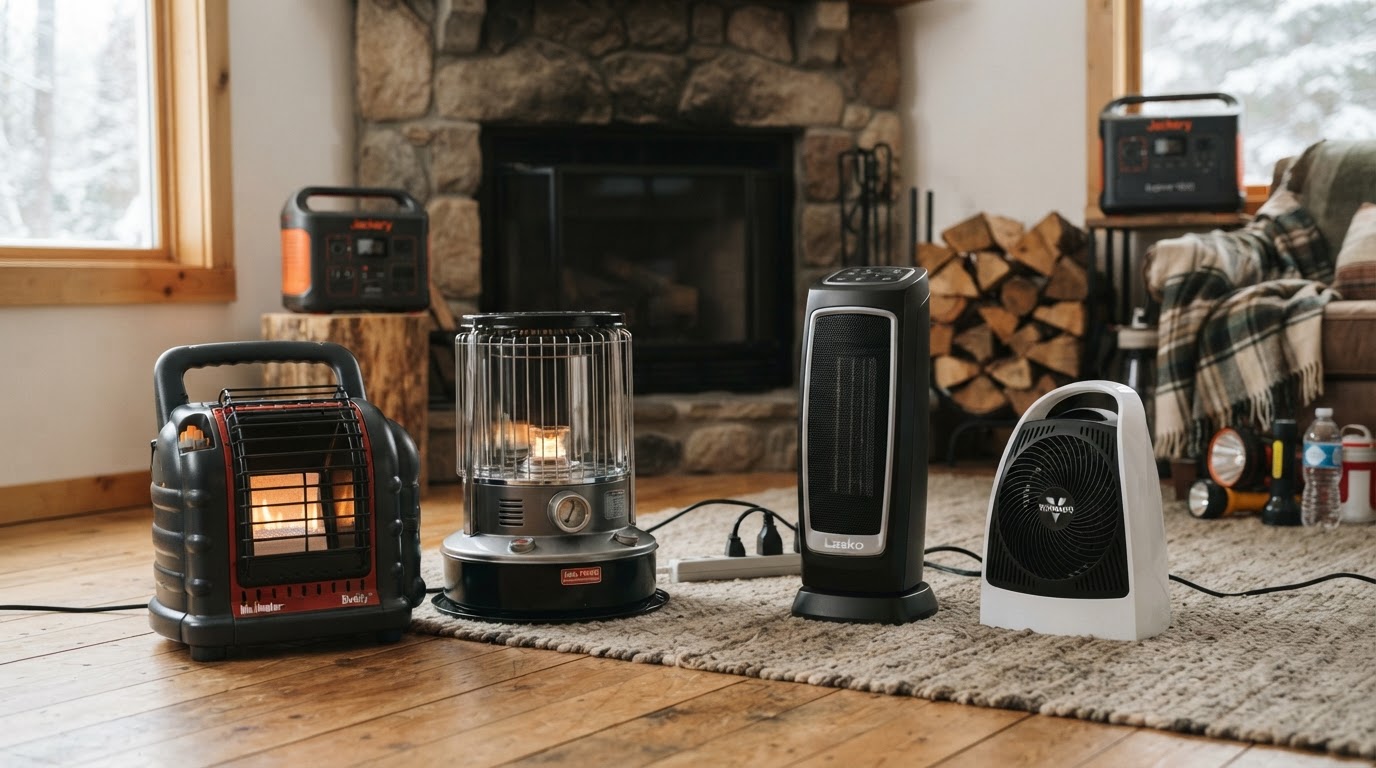
Four space heaters for winter outages, $33 to $184: two fuel heaters that need no electricity plus two electric picks for when the grid or generator is back.
This article contains affiliate links. If you buy through these links, we may earn a small commission at no extra cost to you.
A space heater is the fastest way to take the chill off one closed room, and the fastest way to flatten a small battery. Which one makes sense comes down to a single question: do you have real AC power right now? If the grid is back or a generator is running outside, an electric heater is honest heat. If the house is still dark, only a fuel heater earns its floor space. Four picks below, two for each situation, from about $33 to about $184.
If your situation is a dead grid with nothing but a power station, skip this whole list. The right move is warming yourself instead of the room, and the personal-warmth ladder shows why a 50-watt throw beats a 1,500-watt heater thirty to one.
Start with your power situation
| Your power right now | Buy this type | Picks below |
|---|---|---|
| Grid back, or generator running outside | Electric | Ceramic, oil-filled radiator |
| Still dark, no generator | Fuel, zero watts | Propane Buddy, kerosene Sengoku |
| Small power station only | None of these | Heated throw instead |
The runtime math is blunt: even a 750-watt low setting sits above what a 245Wh station can carry. That is a does-not-run problem, not a drains-fast one.
Budget electric: fast heat once power is back
The GiveBest Portable Ceramic Space Heater (about $33) is the simple pick for grid or generator power. It runs 750 watts on low and 1,500 on high, with a thermostat, an ETL listing, and the tip-over plus overheat shutoff pair that should be non-negotiable on any heater you sleep near.
Ceramic means a fan blowing over a hot element, so rooms warm up in minutes. The tradeoff is noise and dry air: fine for an evening in a closed bedroom, less pleasant left on all night. Three rules come with every electric heater in this guide. It plugs straight into a wall outlet, never a power strip or extension cord. It keeps three feet of clearance on every side. And it heats one closed room, not the house.
Portable fuel: heat with zero electricity
The Mr. Heater Portable Buddy Propane Heater (MH9BX) (about $90) is the outage pick for most households. It is an indoor-rated radiant propane heater with 4,000 and 9,000 BTU settings, an oxygen-depletion shutoff, and about five hours of heat on a one-pound propane canister. It needs no electricity at all: no fan, no plug, no battery.
Plan fuel the way you plan heat. One-pound canisters are the grab-and-go option, and a 10-foot hose lets the same heater drink from a 20-pound grill tank for multi-day outages. Crack a window in the room per the manual, keep the clearance rules from the electric section, and confirm the carbon monoxide alarm on that floor has a fresh battery. The alarm and ventilation rules apply to every fuel heater in this guide, not just generators.
Steady electric: silent overnight warmth
The De'Longhi Oil-Filled Radiator Heater (EW7707CM) (about $130) is the bedroom heater for once power is back. Sealed oil inside the fins stores heat, so the radiator keeps warming the room between thermostat cycles instead of blasting and idling the way a fan heater does. No fan means no noise, which is why this type owns the overnight slot.
Be honest about the plug: on high it draws the same 1,500 watts as the ceramic, so it needs the same real AC power and the same wall-outlet rules. What the extra money buys is comfort, not efficiency. The room feels steadier, the air stays less dry, and there is no fan hum at 2 a.m. The adjustable thermostat plus tip-over and overheat shutoff round out a heater built to be left on in a closed room.
Long-burn fuel: the multi-day room heater
The Sengoku HeatMate Portable Kerosene Heater (HMN-110) (about $184) is the premium fuel pick. It is an indoor-rated kerosene heater putting out 10,000 BTU from a 1.2-gallon tank, good for up to 14 hours on a fill, with a push-button start that needs no electricity and no matches. For a multi-day outage where propane canisters would pile up, one kerosene jug covers a room through the night and into the morning.
Kerosene asks one thing electricity never does: fuel storage. Keep it in a blue-labeled kerosene container in a ventilated spot away from living areas, never in a milk jug or a gas can someone could confuse. The full clearance, cord, and fuel rules cover storage plus the three-foot rule, and they are worth reading before the first cold snap, not during it.
What each pick costs to run
At average U.S. residential rates reported by the Energy Information Administration, roughly 17 cents per kilowatt-hour, a 1,500-watt heater costs about a quarter per hour. The fuel heaters cost whatever their fuel costs, with zero draw at the plug:
| Pick | Draw | Cost per hour | Runs on |
|---|---|---|---|
| GiveBest ceramic (low / high) | 750W / 1,500W | about 13 / 25 cents | Grid or generator |
| De'Longhi oil-filled (high) | 1,500W | about 25 cents | Grid or generator |
| Mr. Heater Buddy | 0W | one 1-lb canister per ~5 hours | Nothing but propane |
| Sengoku HeatMate | 0W | one 1.2-gal fill per ~14 hours | Nothing but kerosene |
Before the next cold snap, put the plan on paper:
- One closed room chosen, door towel and window blanket staged
- GiveBest ceramic (GiveBest Portable Ceramic Space Heater) on a wall outlet with three feet of clearance (grid/generator heat)
- De'Longhi radiator (De'Longhi Oil-Filled Radiator Heater (EW7707CM)) placed for silent overnight duty (grid/generator heat)
- Mr. Heater Buddy (Mr. Heater Portable Buddy Propane Heater (MH9BX)) plus spare one-pound canisters staged (no-power heat)
- Sengoku HeatMate (Sengoku HeatMate Portable Kerosene Heater (HMN-110)) plus a labeled kerosene jug stored ventilated (multi-day heat)
- CO alarm (Kidde Battery-Powered Carbon Monoxide Detector) on the heated floor tested, window-crack rule posted
Frequently asked questions
Can a portable power station run a space heater?
No, not at any practical size. Even a 750-watt low setting is triple what a 245Wh station can carry, so the heater never really starts. Heat the person with a low-watt throw instead and save the station for phones and a radio.
Which space heater works with the power completely out?
A fuel heater: an indoor-rated propane or kerosene model that needs no electricity. Both picks below run with zero watts, which is exactly why they are the outage picks rather than the backup plan.
Are oil-filled radiators cheaper to run than ceramic heaters?
At the plug, no. Both draw up to 1,500 watts on high. The radiator wins on comfort: its sealed oil mass keeps giving off heat between thermostat cycles, so the room feels steadier and the heater runs silent.