
Can a Portable Power Station Run a Space Heater? The Math Says No
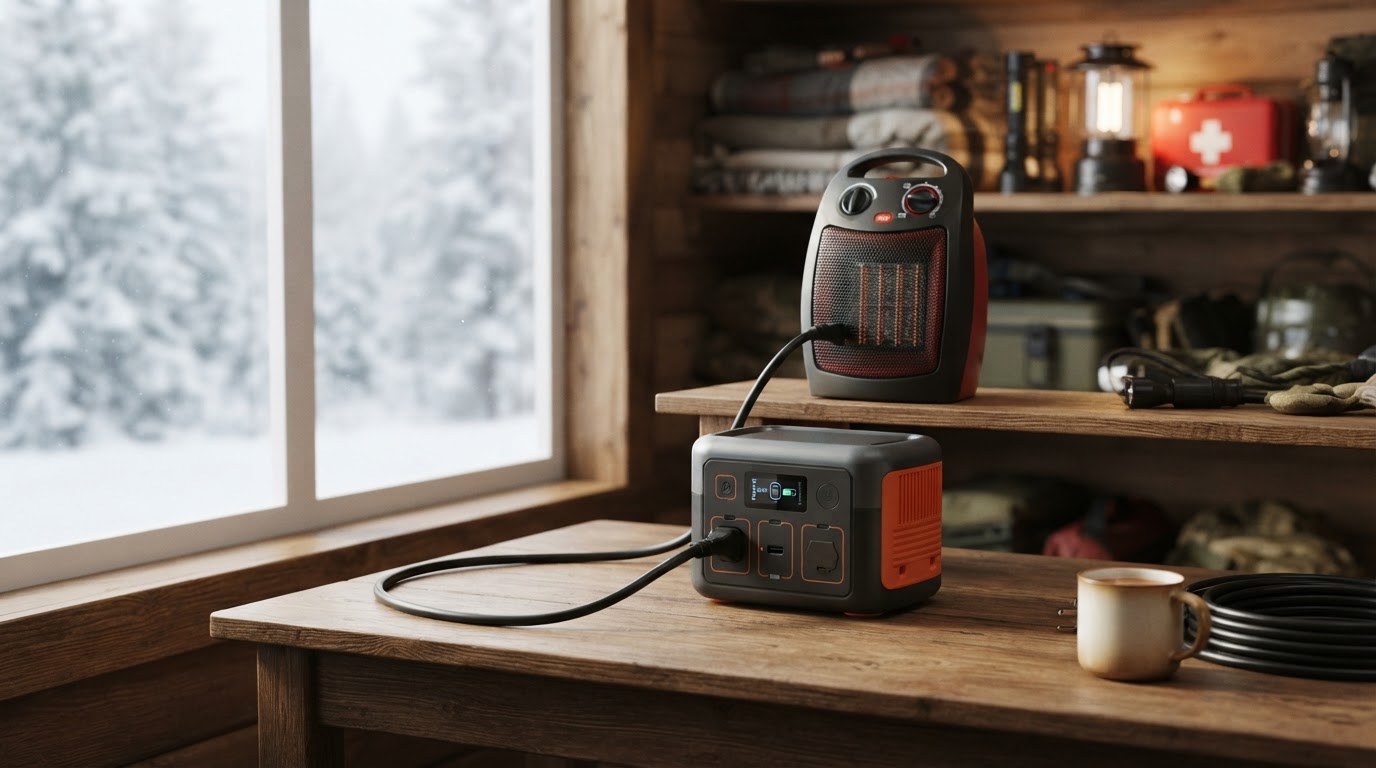
A 750W space heater sits above a 245Wh station's X-Boost ceiling, and even smaller heaters drain in minutes. The winter runtime math, and what to use instead.
This article contains affiliate links. If you buy through these links, we may earn a small commission at no extra cost to you.
A 750-watt space heater is the worst load you can hand a portable power station. On a 245Wh station like the EcoFlow RIVER 3 Portable Power Station, it will not run at all: the heater's low setting sits above the station's 600-watt X-Boost ceiling, so overload protection trips before the room gets any warmer. And even a station that could carry the load would spend its entire battery in about 17 minutes of heat.
This is the winter runtime math nobody prints on the box. Here is what heat actually costs in watt-hours, why the numbers that make a station look clever for a fridge do not transfer to heating, and what to use for warmth instead.
The math on a 245Wh station
Most homes own the same heater: the GiveBest Portable Ceramic Space Heater runs 750 watts on low and 1,500 on high. The EcoFlow RIVER 3 Portable Power Station stores 245 watt-hours, about 208 usable after the inverter's cut. Divide one by the other and the picture is grim:
| Heater setting | Draw | Runtime if it could run |
|---|---|---|
| Low | 750W | about 17 minutes |
| High | 1,500W | about 8 minutes |
Two details make it grimmer still. First, the station's AC output is rated at 300 watts, with X-Boost extending it to carry heating and motor loads up to 600 watts. A 750-watt heater sits above even that extended ceiling, so this is not a runs-but-drains-fast problem. It is a does-not-run problem. Second, even a heater that fit under the ceiling would be nearly pointless: a 400-watt personal unit would flatten the battery in about half an hour, and half an hour of 400-watt heat does not change a cold room.
Why the fridge math does not transfer
A station earns its reputation on loads that cycle. A fridge compressor runs about 35 percent of the time with the door shut, which is how 245Wh stretches into four or five hours of fridge time. A heater gets no such discount: holding a room warm in winter, it runs near-continuously, and during a cold-weather outage the element stays on. There is no duty cycle to rescue the math.
Solar cannot rescue it either. The EF EcoFlow 110W Portable Solar Panel harvests about 110 watts in perfect sun, while a running heater pulls nearly seven times that. A panel can refill the battery between uses. It cannot keep pace with the load that drains it.
What it would take to heat a room
One room, one eight-hour winter night, a 750-watt heater at near-continuous duty: about 6,000 watt-hours. That is roughly 25 of these stations. Batteries that size exist, but they are whole-home storage systems costing thousands, not something you carry in from the garage.
This is the one job where fuel wins. An indoor-rated propane or kerosene heater delivers hours of warmth from a canister that costs a few dollars, and a generator carries a multi-day outage. Both burn fuel, so both make carbon monoxide: keep the Kidde Battery-Powered Carbon Monoxide Detector in the room, follow the clearance and ventilation rules in our heater safety guide, and put the alarm where the placement guide says.
What actually works instead
Heat the person, not the room, and the battery becomes useful again:
- Layers and a sleeping bag do the room's job at zero watts. The winter storm survival guide covers the one-room setup that keeps a family warm with no power at all.
- A heated throw or vest on low pulls about 40 to 60 watts, which is four to five hours of personal heat on the station. That is the honest use of battery heat: a person-sized load, not a room-sized one. The Westinghouse Electric Heated Throw (about $40) is a 50-by-60-inch throw with six heat levels, an ETL-listed overheat shutoff, and a 2-to-10-hour auto-off.
- Hot water bottles under the sleeping bag buy hours of warmth for the cost of boiling water on whatever stove you already have. The HomeTop Classic Rubber Hot Water Bottle (about $13) is the classic rubber version, and it stays warm for hours under the covers.
- Short bursts of room heat only make sense on a much larger station. A 20-minute burst at 750 watts spends about 250 watt-hours, the entire RIVER 3, so even a bigger battery buys a few bursts, not a warm night.
The bottom line
Your station is a phone charger, a radio, a light, and a CPAP machine. It is not a heater, and no 245Wh box will ever be one. Budget heat to fuel and layers, keep a CO alarm wherever flame is, and run the fridge runtime math for the loads the station genuinely runs.
One test settles it for your own gear: plug the heater into the station while the grid is up and watch what happens. A quiet afternoon is a better time to learn this than the middle of a January blackout.
Before the next storm, put the plan on paper:
- Heater in the fuel column: indoor-rated model, spare canister, clearance measured
- CO alarm in the heated room, batteries tested
- Sleeping bag and layers staged in the one room you will close off
- Station charged and reserved for phones, radio, and CPAP
- Nothing above 600 watts ever plugged into the station
Frequently asked questions
Can a portable power station run a space heater?
Not a typical one. A 750-watt heater sits above the 600-watt X-Boost ceiling of a 245Wh station like the RIVER 3, so overload protection trips before any heat is produced. Even a heater that fit under the ceiling would flatten the battery in about half an hour.
How long would a 245Wh station run a space heater if it could?
About 17 minutes at 750 watts and about 8 minutes at 1,500 watts, on the roughly 208 usable watt-hours. No duty cycle helps, because a heater working to hold a room warm in winter runs near-continuously.
What is the best way to stay warm in an outage?
Heat the person first: layers, a sleeping bag, a hot water bottle, and a low-wattage heated throw that pulls about 40 to 60 watts, which is four to five hours of warmth on a 245Wh station. For room heat, an indoor-rated fuel heater with a battery CO alarm delivers far more warmth per dollar than battery power.