
Generator Carbon Monoxide Safety: Placement, Distance, and Symptoms
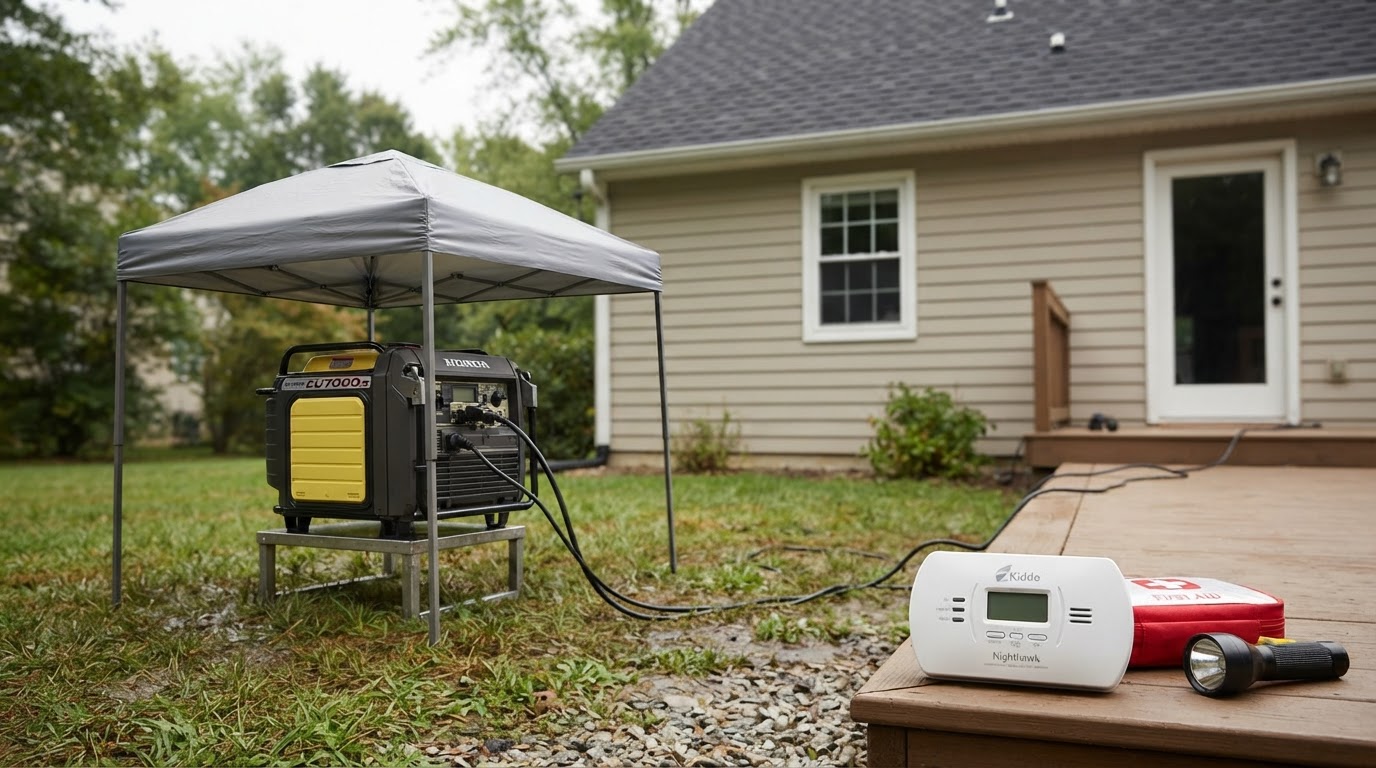
Run a generator outside, 20 feet from every door and window. The carbon monoxide symptoms to catch early, why a garage is never safe, and the rain rule.
This article contains affiliate links. If you buy through these links, we may earn a small commission at no extra cost to you.
A generator has to run outside, at least 20 feet from any door, window, or vent, with the exhaust pointed away from the house. Not in the garage with the door cracked, not on the covered porch, and not in the shed. The exhaust is carbon monoxide, which the CDC links to more than 400 deaths a year in the U.S. from non-fire sources, and it gives no warning you can smell or see. The placement rules and a working CO alarm are the whole safety system, and both take minutes to set up.
Why the exhaust is the dangerous part
A generator's exhaust is carbon monoxide: colorless, odorless, and impossible to notice before it starts hurting you. No smell, no sting in the eyes, no taste. People who are asleep can die before they ever feel a symptom.
Outages are when this bites hardest. Generators come out after storms, and the CPSC warns that portable generators are one of the leading causes of carbon monoxide deaths when they run in the wrong place. A garage is the classic mistake because it feels like the outdoors. It is not.
The placement rules
CPSC's generator guidance, condensed into what you actually have to do:
- At least 20 feet from the house, measured to any door, window, or vent.
- Exhaust pointed away from the building. Check the wind before you pull the cord. A 20-foot setback with the exhaust blowing straight back into an open window is still a CO problem.
- Outside only. Never in a garage, basement, crawlspace, shed, porch, or under a deck, even with the garage door fully open. The CPSC says opening doors and windows does not make an enclosed space safe.
- Mind the neighbors. Exhaust drifts. Point it away from their windows as well as yours.
- Never run it indoors just until the rain stops. That has its own rule below.
Some newer units advertise a CO sensor that shuts the engine down when levels climb. Treat it as a backstop, not permission to bend the rules: the manufacturers' own instructions still say those units run outdoors.
The symptoms to catch early
The CDC lists the common symptoms of carbon monoxide poisoning as headache, dizziness, weakness, nausea, vomiting, chest pain, and confusion. Higher exposure brings loss of consciousness. The early list is easy to shrug off as a long day or a bad night of sleep, which is what makes CO different from almost every other household hazard: the warning is your body failing quietly, not a smell or a sound.
If anyone in the house gets a headache or feels dizzy while a generator is running:
- Get everyone into fresh air immediately, pets included.
- Call 911 and say you suspect carbon monoxide.
- Do not go back inside for belongings, and do not re-enter to shut the generator off until responders clear the house.
- Tell the responders a generator was running so they can check the house for other hazards.
An alarm is the requirement, not an accessory
You cannot smell the danger, so a machine has to. NFPA guidance calls for CO alarms on every level of the home and outside each sleeping area. Battery-powered models keep listening when the grid is down, which is exactly when generators run. The Kidde Battery-Powered Carbon Monoxide Detector is about $20, sounds an 85 dB alert, and runs on two included AA batteries through an outage. One per floor, installed before storm season, tested monthly. Our guide to detector placement covers the rooms to skip and the setback from fuel-burning appliances.
The rain rule
Generators and water are an electrocution risk, and manufacturer instructions say never to run one in rain or wet conditions without proper protection. The wrong fix is the one people reach for in a downpour: dragging it into the garage. The right fix is a cover built for a running generator. A rain-rated tent like the Westinghouse WGenTent Generator Running Cover (about $149) encloses an open-frame unit while it runs, keeps rain off the outlet panel and muffler, and still moves enough air to keep it cool.
When a battery station is the better answer
Not every outage needs a fuel generator. For phones, a radio, a router, or a CPAP, a battery power station like the EcoFlow RIVER 3 Portable Power Station runs indoors with zero exhaust, and it recharges from a wall outlet, a car, or a solar panel. Check the current price before you budget. If you are still deciding between battery and fuel power, our home generator guide covers the wattage math and sizing tiers, and the power outage survival guide covers the first hours of an outage. If you have already bought the generator, fuel storage is its own discipline: the gasoline storage guide covers cans, stabilizer, and shelf life.
Outside, 20 feet, exhaust away, alarms on every floor. Those four habits are the difference between a generator that carries your house through an outage and one that poisons it.
Frequently asked questions
How far should a generator be from the house?
CPSC guidance is at least 20 feet from any door, window, or vent, with the exhaust pointed away from the building. Distance alone is not enough if the exhaust still blows into an open window, so check the wind direction before you start it.
Can I run a generator in the garage with the door open?
No. Carbon monoxide builds up faster than an open door can clear it, and CPSC says opening doors and windows will not make an enclosed space safe. Garages, porches, crawlspaces, and sheds are all off-limits, even for a few minutes.
What are the first symptoms of carbon monoxide poisoning?
CDC lists headache, dizziness, weakness, nausea, vomiting, chest pain, and confusion. Symptoms can feel like the flu or a bad night of sleep, and people who are asleep can die before noticing anything, which is why a working CO alarm matters more than how you feel.