
How Long Can a House Stay Warm Without Power? (2026)
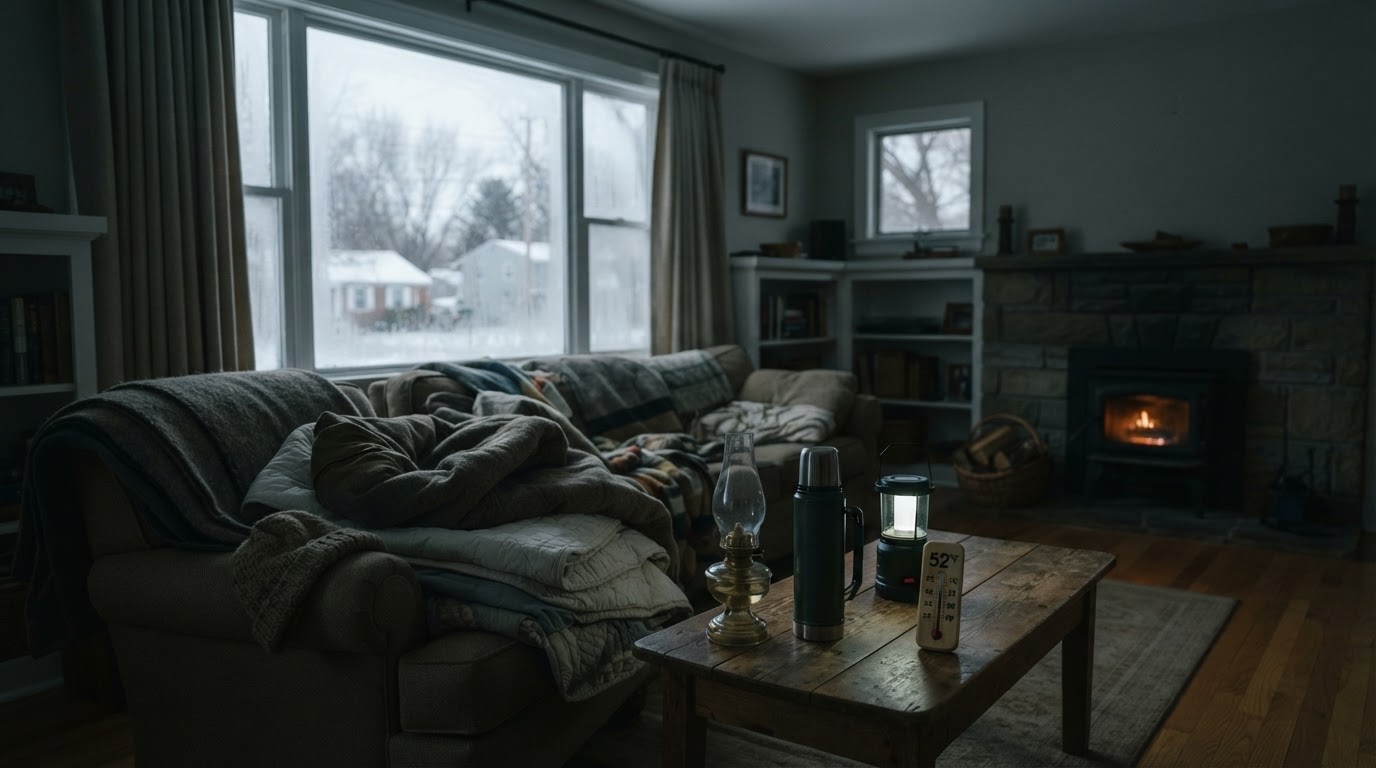
An average house stays livable 8 to 12 hours after the heat dies. What sets that clock, how to stretch it room by room, and backup heat that is safe indoors.
This article contains affiliate links. If you buy through these links, we may earn a small commission at no extra cost to you.
When the furnace quits on a January night, the house does not go cold all at once. Heating contractors usually quote 8 to 12 hours before an average house slides from comfortable to uncomfortable, with tight, well-insulated homes holding past the 24-hour mark and drafty older ones dropping into the 50s well before morning. Three things set your clock, and you can read two of them off your own house before the storm arrives.
What sets the clock
First, insulation and air leaks. Heat escapes through the attic, the walls, and every gap around windows, doors, and pipe penetrations, and the leakier the envelope the faster the slide. Energy Star estimates that air sealing plus insulation in attics, crawl spaces, and basements can cut heating and cooling costs by an average of 15 percent. If your upstairs is always cold and your energy bills always surprise you, your clock runs short.
Second, size and layout. Heat loss follows surface area, so a compact house with rooms that close off holds warmth longer than a sprawling open plan with high ceilings and a wall of glass. This is why the standard advice works: you stop heating the house and start heating one room.
Third, the gap between inside and outside. Loss runs proportional to the difference, so a house sitting at 68 with 40 outside sheds heat roughly half as fast as the same house facing 10. Wind hurries it along by stripping warmth off walls and windows, so a calm 30-degree night and a windy one are not the same outage.
The cooldown curve
The fall is front-loaded: the house sheds degrees fastest in the first hours, then slows as indoor temps sink toward outdoor ones. One home-energy calculator's model of a typical 1980s house, starting at 68 with 20 outside, lands near 62 after three hours, 57 after six, and the high 40s by hour twelve. Treat that as the shape rather than your forecast. New construction with modern insulation beats it by a wide margin, and a windy ridge-top colonial does worse.
Plumbing is usually the first casualty, not comfort. The Red Cross tells winter travelers to leave the heat set no lower than 55 degrees when they go away, which marks roughly where pipe risk begins. Once indoor temps slide into the 40s, pipes in exterior walls and crawl spaces are living on borrowed time. If your house is already cold, check the pipe section of the frozen pipe guide before anything else.
Shrink the house to one room
Pick the smallest room with a door on the side away from the wind, and move everyone there, pets included. Hang blankets over the windows and the doorway, roll towels against the door gap, and close the damper on any fireplace you are not using. Dress in full layers plus a hat, pile on sleeping bags instead of spreading out, and keep everyone in the one room overnight. Shared body heat is small but real, and one warm room beats three cooling ones.
Give the pipes the same attention. The Red Cross recommends dripping faucets and opening cabinet doors under sinks so warmer air reaches the plumbing. Know where your main water shutoff is before you need it at midnight. The winterizing guide walks the full pre-storm version of this routine.
Backup heat that is actually indoor-safe
A portable fuel heater buys real warmth where a blanket fort cannot. The Mr. Heater Portable Buddy Propane Heater (MH9BX) is indoor-rated radiant propane heat at 4,000 or 9,000 BTU, about $90, with an oxygen-depletion sensor and tip-over shutoff, giving roughly five hours on a one-pound canister. Crack a window per the manual even with the sensor. For longer stretches, the Sengoku HeatMate Portable Kerosene Heater (HMN-110) is a 10,000 BTU kerosene heater at about $184, whose 1.2-gallon tank runs up to 14 hours with no electricity at all. Both demand ventilation and a working CO alarm (next section).
What never counts: the gas oven, a grill or camp stove indoors, or a generator anywhere near the house. The CPSC rule is outside only, at least 20 feet from the house with the exhaust pointed away. A battery station cannot cover room heat: a 750-watt space heater sits above what a 245Wh station can even carry (runtime math). The full heater rules live in the winter heating safety guide.
The alarm layer
Every fuel heater in this article assumes a working carbon monoxide alarm on each floor. The CDC warning is blunt because the gas is odorless and colorless: you cannot tell it is building up. The Kidde Battery-Powered Carbon Monoxide Detector runs about $23, rides through the outage on two AA batteries, and belongs in the hallway outside that one warm room. Test it now, not when the lights are already out. Exact placement is covered in the CO placement guide.
When to leave
If the house keeps sliding despite all of this, or anyone inside is elderly, an infant, or managing a medical condition, do not tough it out to prove a point. Ready.gov says to go to a designated public shelter if your home loses power or heat during extreme cold. Charge the phone in the car, bring medications and documents, and let the house be cold without you. The winter storm survival guide covers the full no-heat plan.
Frequently asked questions
How long will a house stay warm without power?
Heating contractors usually quote 8 to 12 hours before an average house drops from comfortable to uncomfortable. Tight, well-insulated homes can hold past 24 hours, while drafty older houses may reach the 50s well before morning.
At what indoor temperature do pipes start freezing?
Risk climbs once indoor temps sink toward the 40s, especially for pipes in exterior walls and crawl spaces. The Red Cross tells winter travelers to leave the heat set no lower than 55 degrees, which marks roughly where the danger zone begins.
Can I heat my house with a gas oven during a power outage?
No. A gas oven makes carbon monoxide with no thermostat to stop it, and it was never designed to heat a room. Use an indoor-rated fuel heater with ventilation and a working CO alarm instead.