
CPR and Choking First Aid: What to Do When Someone Stops Breathing (2026)
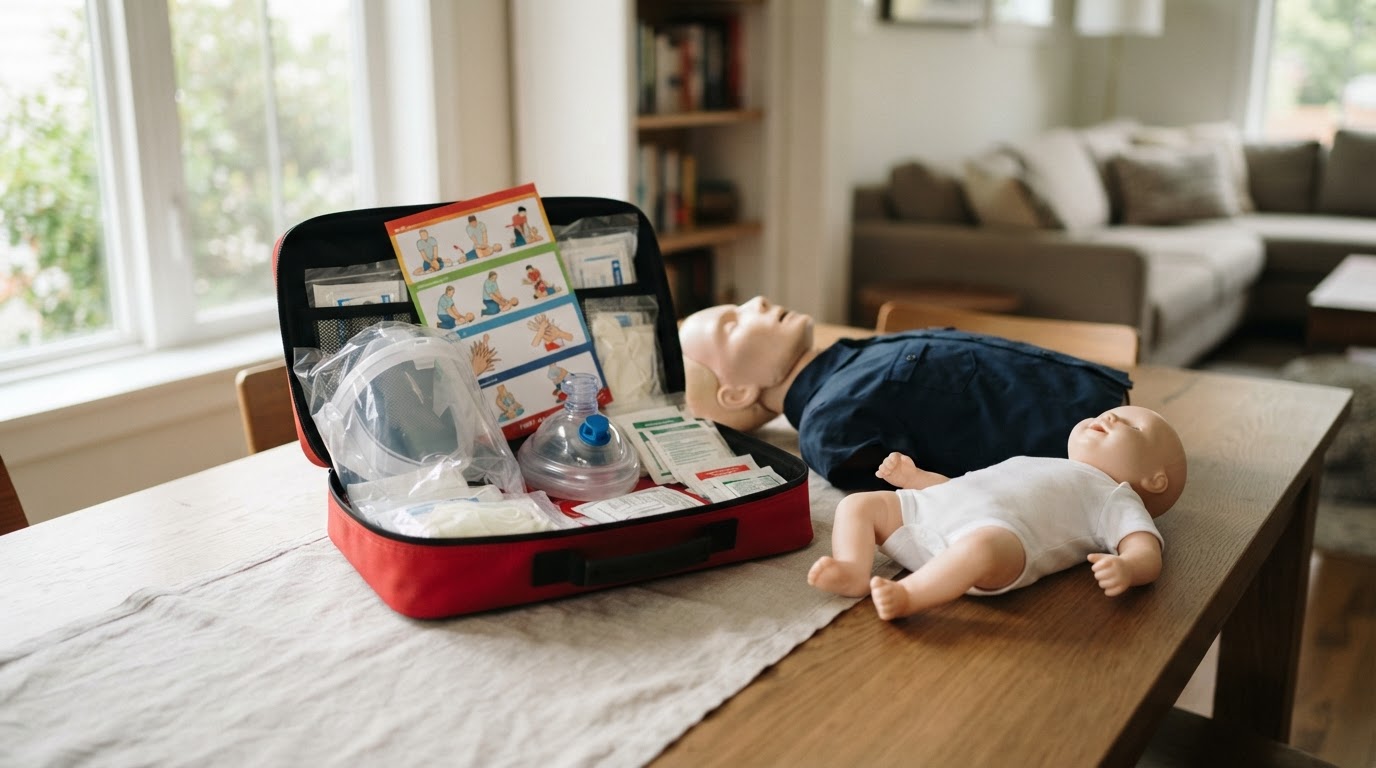
CPR and choking first aid in 2026: steps for adults and infants, compression-only CPR at 100-120 compressions a minute, and the home kit that keeps you ready.
This article contains affiliate links. If you buy through these links, we may earn a small commission at no extra cost to you.
If someone chokes, do five back blows, then five abdominal thrusts, repeated until the object comes out. If someone collapses and is not breathing, start compressions: push hard and fast in the center of the chest, 100 to 120 times a minute, until help arrives. Those two sequences are the whole course in one sentence; the details below are why they work. Read this now while you are calm, and keep it somewhere you can grab it when you are not.
Every minute a cardiac arrest goes without CPR cuts the odds of survival by about 10 percent, per the American Heart Association. Most real-world CPR happens in a kitchen, done by a family member. The version you memorize matters more than gear.
Choking: The Five-and-Five for Adults and Older Kids
A choking person cannot speak and often grabs their throat with both hands, the universal sign. The only question that matters is: "Can you speak?" If they can, they are not fully blocked; let their coughing do the work.
If they cannot speak or breathe:
- Five back blows. Stand to the side, lean them forward, and hit firmly between the shoulder blades with the heel of your hand.
- Five abdominal thrusts. Stand behind them, make a fist just above the navel, and pull sharply inward and upward.
- Alternate the two until the object comes out or they can breathe.
For pregnancy or a body too large to wrap your arms around, use chest thrusts, fist in the middle of the chest. Never use abdominal thrusts on a baby under 12 months.
If the person goes unconscious, lower them to the floor, call 911, and start CPR. Each time you open the airway for breaths, look in and sweep out the object only if you can see it. A blind sweep pushes it deeper.
Baby Choking (Under 12 Months): Back Blows, Not Abdominal Thrusts
Infants need a different sequence, because their airways are smaller and more delicate.
- Lay the baby face-down along your forearm, head lower than the chest, supporting the head and jaw.
- Give five back blows between the shoulder blades.
- Turn them face-up on your other forearm and give five chest thrusts with the heel of one hand in the middle of the chest (the two-finger version is out; the AHA retired it in its 2025 update).
- Alternate until the object comes out or the baby goes limp.
If the baby becomes unresponsive, start infant CPR and have someone call 911. Practice on a doll; it looks nothing like the adult version and panic will wipe it out.
Cardiac Arrest: Call, Then Compress
Choking has a quick fix. Cardiac arrest has a clock. When someone collapses, will not respond, and is not breathing normally (agonal gasping, those occasional noisy breaths, still counts as not breathing):
- Confirm unresponsiveness: tap and shout, check breathing for no more than 10 seconds, per AHA guidance.
- Call 911 and put it on speaker. If someone else is there, send them for the nearest AED while you start.
- Start compressions. The two common failures are starting too late and pressing too softly.
For adults, compression-only CPR works, and a 911 dispatcher will talk you through it. Push in the center of the chest: the American Heart Association's targets are at least 2 inches deep and 100 to 120 compressions a minute, the tempo of "Stayin' Alive". Let the chest fully recoil between pushes, because that recoil refills the heart. Do not stop except for an AED shock or to trade off every 2 minutes or so.
Ribs will crack. Expect it and keep going: a cracked rib heals, a stopped heart does not.
Adding Breaths: The 30:2 Ratio
If you are trained and comfortable with rescue breaths, use a 30:2 ratio, per AHA guidelines: tilt the head back, lift the chin, pinch the nose, and give just enough air to see the chest rise. Breaths matter most for drowning victims and children, whose arrests are usually respiratory first; for a sudden adult collapse, compression-only CPR is a complete response. For an infant, compress with two thumbs encircling the chest, or with the heel of one hand if you cannot wrap your hands around it, about 1.5 inches deep (roughly a third of the chest), with breaths that barely puff it. The AHA's October 2025 update retired the old two-finger technique.
The AED: Every Minute Until the Shock
An automated external defibrillator restarts a normal rhythm, and speed decides everything: the AHA's figure is that about nine in ten people who get a shock within the first minute of collapse live. Once compressions are running, send someone for it, turn it on, and follow the voice prompts. It analyzes the rhythm, only shocks if one is needed, and is built for panicking bystanders.
The Gear That Holds the Rescue
No product performs CPR for you; that is a skill, and a free class is the best purchase in this article. What a first aid kit does is put gloves, a rescue mask, and a printed reminder in reach when the moment comes, and the printed reminder matters more than people think, because trained responders still freeze without one. The ACEP First Aid Manual (DK, 5th Edition) is the take-home version of the class: the American College of Emergency Physicians' illustrated manual, kept with the kit. Pick the kit that will actually be in the room:
| Kit | Where it lives | Why it earns its spot |
|---|---|---|
| First Aid Only 298-Piece All-Purpose Kit | Home, ~$16 | Nitrile gloves, a CPR mask, and 298 pieces; cheap enough to keep by the couch and in the car |
| SurviveX Large First Aid Kit | Kitchen, ~$103 | Color-coded compartments you can find by feel; tape the class card inside the lid |
| Adventure Medical Kits Mountain Series Hiker… | Daypacks, ~$34 | About a pound with a printed first aid manual for the moment you're thinking on your feet |
Gloves protect you from blood, and these scenes are often messy. A LSIKA-Z CPR Face Shield Keychains (10-Pack) removes the hesitation most people feel about mouth-to-mouth: the one-way valve keeps their breath on their side, and a keychain version rides on your keyring. Neither replaces practicing the rates; both remove small frictions that stall a rescue.
Quick Recommendations
- Choking, adult: five back blows, five abdominal thrusts, alternate. Chest thrusts for pregnancy or larger bodies.
- Choking, baby: back blows and chest thrusts only, never abdominal thrusts.
- Cardiac arrest: push hard and fast, 100 to 120 per minute, don't stop. "Stayin' Alive" is the tempo.
- Trained? Add breaths at 30:2. For babies, two thumbs encircling the chest (or the heel of one hand), about 1.5 inches.
- Send someone for the AED the moment compressions start.
- Ribs cracking means you're doing it right. Keep going.
Spurting blood is a different emergency; our severe bleeding guide covers the tourniquet steps, and a closing airway from an allergic reaction is handled in our anaphylaxis guide. Ten minutes of practice this weekend, on the rhythm, the five-and-five, and the baby version on a doll, is the cheapest life-saving training you can do, and it is the one part of the kit nobody can buy for you.
Frequently asked questions
How fast and how deep should CPR compressions be?
Push hard and fast in the center of the chest, at least 2 inches deep at 100 to 120 compressions per minute (the American Heart Association's targets), roughly the tempo of Stayin' Alive. Let the chest fully recoil between pushes, and do not stop except for an AED shock or a rescuer swap every 2 minutes.
What is the five-and-five method for a choking adult?
First ask "Can you speak?" If they cannot, give five firm back blows between the shoulder blades, then five abdominal thrusts just above the navel, and keep alternating until the object comes out. If they go unconscious, lower them to the floor, call 911, and start CPR.
Do I need to be certified to perform CPR in an emergency?
No. Compression-only CPR from an untrained bystander still works, and a 911 dispatcher will talk you through it while Good Samaritan laws protect people who help in good faith. A free class plus ten minutes of weekend practice on the rhythm, the five-and-five, and the baby version on a doll just makes it stick under panic.
Did infant CPR technique change recently?
Yes. The AHA's October 2025 update retired the old two-finger technique. For infant compressions, use two thumbs encircling the chest, or the heel of one hand if you cannot wrap your hands around it; infant choking chest thrusts also move to the heel of one hand.