
How to Build an Emergency Prescription Supply Legally (2026)
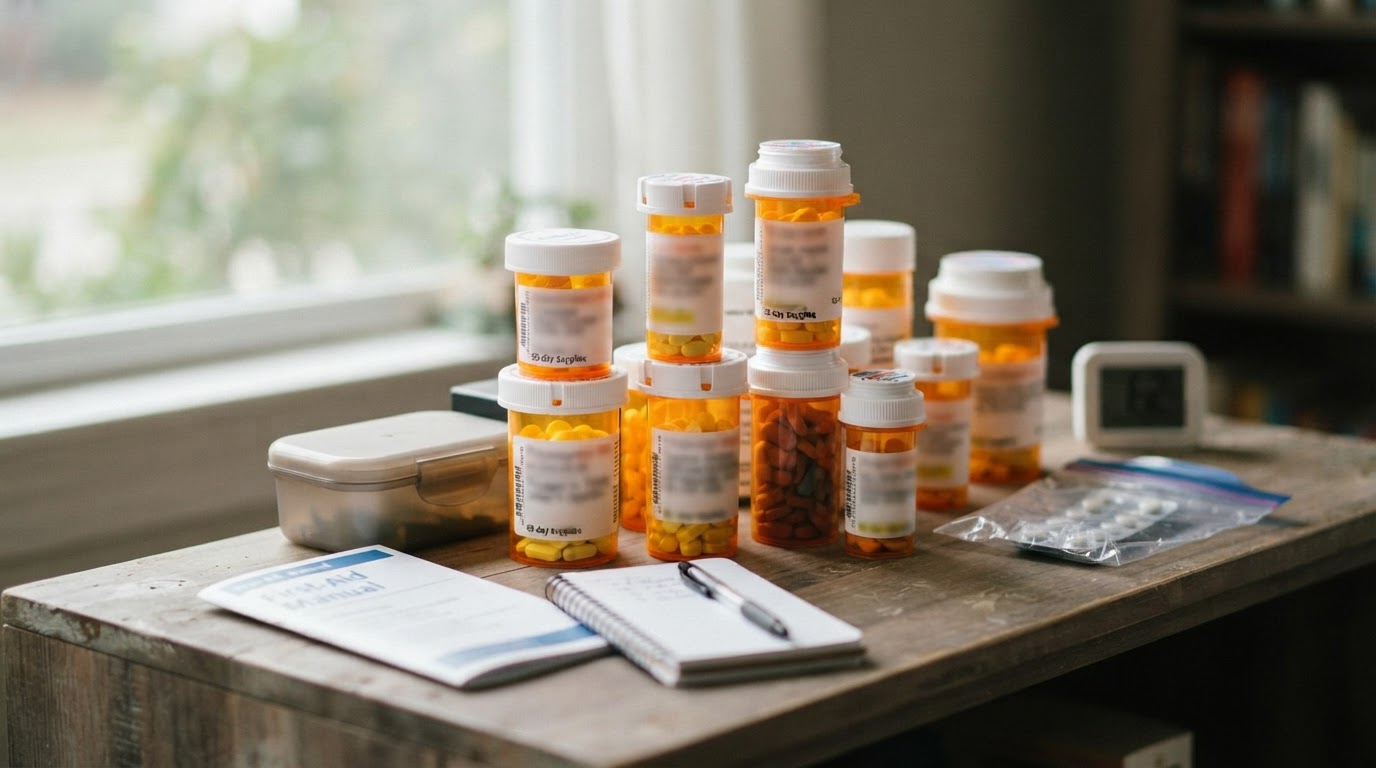
Build an emergency prescription supply legally: ask your prescriber and insurer, use approved 90-day fills, store each drug safely, and rotate before expiry.
This article contains affiliate links. If you buy through these links, we may earn a small commission at no extra cost to you.
Start with the prescriber, pharmacist, and insurance plan. Ask how much can be dispensed at once, whether a 90-day fill is available, and what the emergency-refill rules are where you live. A larger approved fill reduces the number of refill deadlines. It does not automatically put you months ahead, and paying cash does not bypass prescription or controlled-substance rules.
The safe target depends on the drug, your condition, the written prescription, insurance limits, storage needs, and state law. Build whatever overlap those rules permit, keep a current medication list in your grab-and-go document binder, and write down the backup pharmacy and after-hours number.
Ask About a 90-Day Fill
Many plans allow a two- or three-month supply of maintenance medicines through mail order or an in-network retail pharmacy. Ask the plan and pharmacist whether each prescription qualifies, what it costs, and when the next refill is allowed.
A 90-day fill makes a pharmacy closure less likely to catch you at the end of a 30-day bottle. It is still a 90-day supply, not a 90-day reserve. A small overlap may develop only if the plan permits pickup before the previous supply is exhausted. Keep filling on the approved schedule and rotate the oldest bottle first.
Use a Vacation Override for Actual Travel
Some plans approve an early fill when travel would otherwise leave you without medicine. The rules, eligible drugs, quantity, and required notice vary. Call the number on the insurance card before the trip and ask the pharmacy what documentation it needs. Treat the override as travel coverage, not a repeatable stockpiling shortcut.
Cash Prices Can Reduce Cost, Not Refill Rules
A discount card such as GoodRx may lower the cash price of a generic medicine, but the pharmacy still needs a valid prescription with quantity or refills available. Ask the prescriber whether an additional legally dispensed supply is appropriate, then compare the insurance copay with the cash price. Do not assume paying cash makes an early fill permissible.
Controlled Substances Need a Separate Plan
Controlled medicines do not all follow the same refill rule. Schedule II prescriptions cannot be refilled under federal law, while other schedules have different federal and state limits. Do not try to build a reserve by changing doses, filling under another payment method, or presenting the same prescription at multiple pharmacies.
Instead:
- Ask the prescriber and pharmacist what travel or emergency options apply to that exact medicine.
- Keep a current medication list, prescriber number, pharmacy number, and a photo of the bottle label in your emergency documents.
- If a pharmacy closes during a disaster, call the insurance plan and another in-network pharmacy. Transfer and emergency-dispensing rules depend on the drug and jurisdiction.
- Never share medicine or change the dose to stretch it without instructions from the prescriber.
Store and Rotate the Supply
Heat, moisture, light, and time can damage medicine. Follow each label's storage range; a cool, dry closet usually beats a humid bathroom or hot vehicle. A Antonki Room Thermometer and Indoor Hygrometer, 2… can flag a damp or hot room, but it does not replace the label.
- Keep the reserve in original labeled containers. The label identifies the drug, dose, prescriber, directions, and expiration date.
- Use oldest first. When a new approved fill arrives, place it behind the older bottle and use the older unexpired supply first. Do not combine different lots in one bottle.
- Keep the daily organizer separate. A AUVON Weekly Pill Organizer 2 Times a Day (AM/PM) separates one week into AM and PM compartments. A compartment that is still full after its scheduled time can reveal a missed dose; an empty one does not prove who took it or when.
- Review twice a year. Confirm that doses and prescribers still match, inspect storage conditions, and ask a pharmacist how to replace or dispose of medicine approaching expiration.
Cold-Chain Medicines Need Product-Specific Rules
Insulin, biologics, and other refrigerated medicines do not share one storage limit. Read the package insert now and keep the manufacturer and pharmacy numbers with the medicine.
- Monitor the refrigerator with AcuRite Wireless Fridge and Freezer Thermometer…, but use the medicine's label range rather than a food-safety rule.
- For insulin during an emergency, FDA guidance says many manufacturer-supplied vials and cartridges, opened or unopened, can remain between 59°F and 86°F for up to 28 days. Some products differ, so check that exact insulin's instructions.
- Keep insulin away from direct heat and sunlight, and never freeze it. If storage went outside the label range, contact the manufacturer or pharmacist for advice and monitor blood glucose closely.
- For transport, FRIO Insulin Cooling Wallet, Individual uses evaporative cooling without ice. It is not a refrigerator and does not override the medicine's labeled temperature limits.
Power loss is the scenario these rules exist for: the refrigerator stops running when the grid drops. Our power outage survival guide is the full outage playbook.
If You Run Out Anyway
Do not ration or stop a prescription on your own. Call the prescriber's after-hours line, your insurance plan, or an open pharmacy. Medicare advises that most prescriptions can be moved from one in-network pharmacy to another during a disaster, then moved back later; controlled medicines and state rules may limit that option. Bring the medication list and bottle photos from your document binder.
Start This Week
Ask whether each maintenance drug qualifies for a 90-day fill. Add prescriber, pharmacy, plan, and manufacturer numbers to the medication list. Store approved extra medicine in its original bottle, rotate the oldest unexpired supply first, and review the plan twice a year.
Frequently asked questions
Can I get extra prescription medicine before a disaster?
Sometimes. Ask whether the prescription qualifies for a 90-day fill and whether the plan allows an early refill for travel or a declared emergency. The prescriber, pharmacist, insurer, drug schedule, and state rules determine the amount.
How long does insulin last without refrigeration?
FDA emergency guidance says many insulin vials and cartridges can remain between 59°F and 86°F for up to 28 days, whether opened or unopened. Products differ, so check the package insert or manufacturer for the exact insulin, keep it away from heat and sunlight, and never freeze it.
Is it legal to keep an emergency prescription supply?
You may keep medicine that was legally dispensed to you and follow the storage and use directions on its label. Getting additional quantities still requires a valid prescription or authorized refill, and controlled-substance rules vary. Ask the pharmacist what is allowed for the exact drug.