
Stuck in an Elevator and High-Rise Emergencies: What to Do When the Power Fails
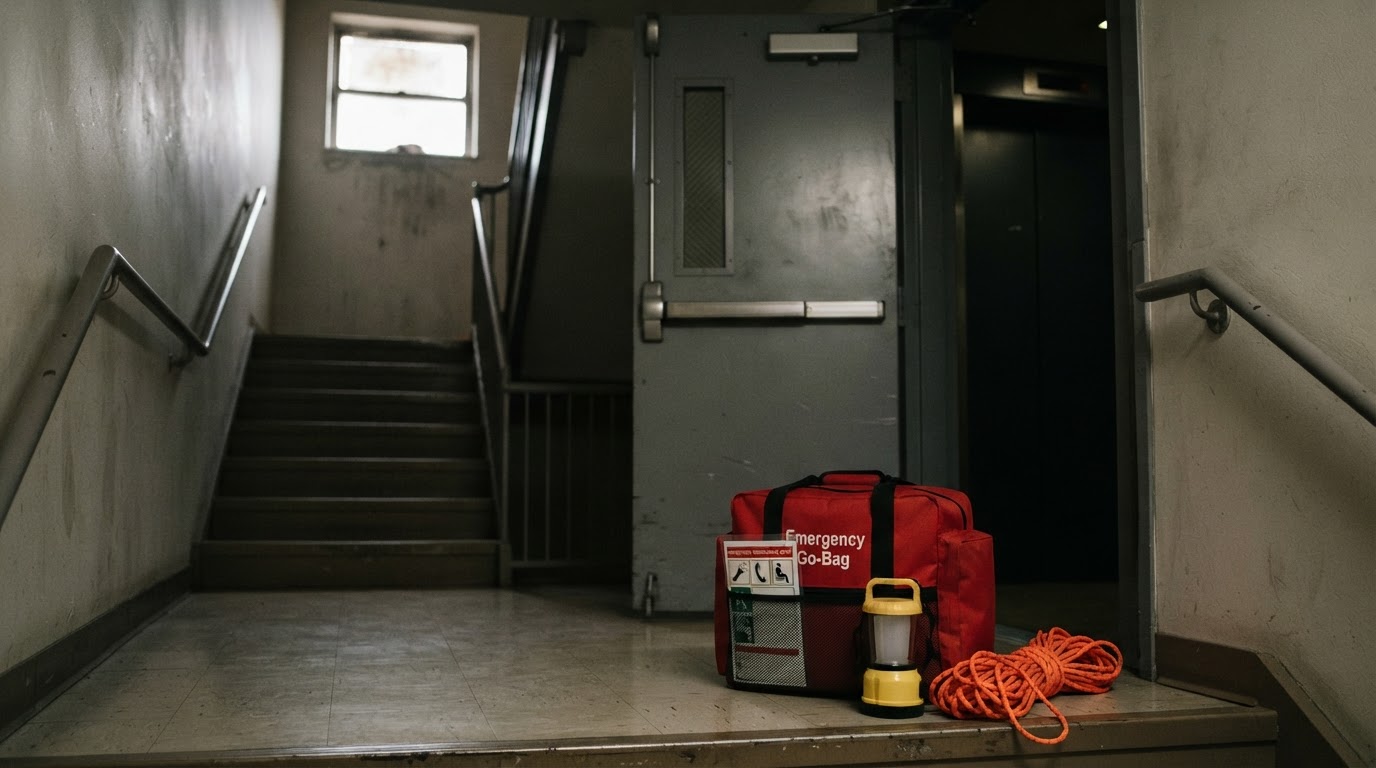
If the power fails while you are in an elevator, stay put: the car is safe and rescuers are coming. Plus the high-rise water failure nobody plans for.
This article contains affiliate links. If you buy through these links, we may earn a small commission at no extra cost to you.
If the power fails while you are riding an elevator, stay where you are. The car will not fall: mechanical safety brakes hold it in place even when the power dies, and the cab is vented rather than sealed, so the air does not run out, according to the University of Illinois Chicago's elevator entrapment guidance. Press the emergency button, tell them where you are, and wait. Climbing out on your own is the one move that turns a routine rescue into an injury.
High-rises fail in a way houses cannot: when the power goes, water stops flowing to upper floors. Those two scenarios are worth rehearsing.
If the car stops between floors
The lights may switch to a battery backup, and some buildings run a battery lowering system that brings the car to the nearest floor and opens the doors after a power loss. If yours does not, settle in.
Press the emergency button or pick up the car phone. Elevator code requires two-way communication from every car to a location staffed around the clock, so the call reaches someone who already knows the building address (ASME A17.1, Section 2.27). Your cell phone is the backup; a text can squeeze through when voice calls will not.
Then follow the one hard rule: do not force the doors, and never climb out of the car, especially when the opening lines up between floors. Elevator safety guidance is blunt about it, because people have been killed when the car moved while they were halfway through the gap. The gap is the hazard; the car is the safe side of it.
One exception: if the doors open on their own at a floor, step out carefully. The car may not be level with the landing.
What the people outside need from you
When you reach the monitoring center or 911, give them the building address, the car number, the floors you are between, how many people are with you, and any medical condition. Leave a call-back number.
Building staff coordinate the rescue; the door is opened by firefighters or an elevator technician, because prying a hoistway door without training is how people get hurt (Liftech elevator entrapment procedure). Cambridge, Massachusetts fire companies alone respond to about 200 elevator rescues a year.
While you wait, keep talking to the people in the car, and sit down if there is room. Stand clear of the doors.
Make the wait smaller
A trapped wait is boring long before it is dangerous. Put the phone in low-power mode and keep one device charged.
A flashlight and pocket radio that run on AA cells cover the dark and the quiet, and spare batteries outlast any phone. A pack like Energizer MAX AA Batteries, 24 Count (about $19) has a 10-year shelf life, so it sits in your bag until the day it matters. If the wait drags, tap on the door so anyone in the hall knows you are there.
The high-rise problem nobody plans for: water
In many city water systems, municipal pressure reaches only about the fifth floor on its own; above that, buildings rely on electric booster pumps (NY Engineers). When those pumps lose power and are not wired to the building's generator, upper floors lose water while ground-floor taps keep running (REMI Network). Showers, taps, and the toilet tank stop at once, and water can stay off for days after the lights come back.
The toilet is the part that ruins a week, and it is the easiest to solve. Pour about 1.5 to 2 gallons straight into the bowl, not the tank; most newer toilets use 1.5 gallons or less per flush. Keep a bucket or two on your floor for exactly this.
Ahead of a storm, fill the bathtub while you still have pressure, which is what New York City's emergency management office tells high-rise residents to do. That water is for flushing and washing, not drinking. For drinking water, store a few days' worth on your own floor; hauling jugs up eight flights of stairs is slow and miserable. Our guides to apartment water storage and the real two-week water budget cover the containers and the math.
Stairwells and areas of refuge
Once the elevators are out, the stairwell is both the way down and the protected place to be. High-rise stairwells are fire-rated exits, and their doors are fire doors meant to stay closed. In a blackout the stairs are pitch dark: carry a flashlight, keep one hand on the rail, and count floors. Do not prop a stairwell door.
If you cannot use stairs at all, many multi-story buildings are required to include an area of refuge next to the exit stairway, a protected space with two-way communication where you can wait for firefighters (International Building Code, Section 1009.3.3). Fully sprinklered buildings can be exempt, so ask your building manager where yours is. It is usually beside the stairs.
For a long stay in a dark apartment or a refuge area, a small power station covers the basics: the EcoFlow RIVER 3 Portable Power Station stores 245Wh and recharges from a wall, a car, or a solar panel, enough to run a lamp and keep phones topped up.
Keep the building able to reach you
In an outage the router dies first, and in a high-rise that matters: building notices and the elevator service company reach you by phone or email. A small standby UPS keeps the router and modem alive through brownouts and short outages; the CyberPower ST425 Standby UPS Battery Backup (about $60) runs both for hours, not days.
When cell networks congest, a battery radio keeps the updates coming. The Midland ER310 Emergency Radio (about $80) tunes NOAA weather radio, runs on a hand crank or solar, and doubles as a flashlight. A written family contact plan is the other half; ours is at the family emergency communication plan.
The short version
- Trapped in a car: press the emergency button, use your cell as backup, stay inside. Never climb out between floors.
- Give rescuers the car number, the floors, how many people, and any medical issue.
- High floors lose water when the booster pumps lose power. Store water on your own floor and flush with 1.5 to 2 gallons poured into the bowl.
- Stairwells are dark and their doors are fire doors: flashlight, handrail, doors closed.
- Keep the router on a UPS and a battery radio nearby. The building can only reach you if your line is alive.
Frequently asked questions
Should I try to climb out if the elevator is stuck between floors?
No. Elevator-industry safety guidance is explicit that riders should never try to exit a stalled car, because the car can move while a passenger is only halfway through the gap. The car itself is the safe place: mechanical safety brakes hold it in position even in a power failure.
Why did my upper-floor apartment lose water when the power went out?
Municipal pressure reaches only about the fifth floor in many city water systems, so high-rises use electric booster pumps to push water higher. When those pumps lose power and are not on the building generator, upper floors lose water while ground-floor taps keep running.
How do I flush a toilet when the water is off?
Pour water straight into the bowl, not the tank. About 1.5 to 2 gallons poured in quickly triggers the flush, and most newer toilets use 1.5 gallons or less per flush. Keep a couple of buckets or jugs on your floor for exactly this.