
What to Do in a Chemical Emergency: Get Inside, Seal a Room, Wait for the All-Clear
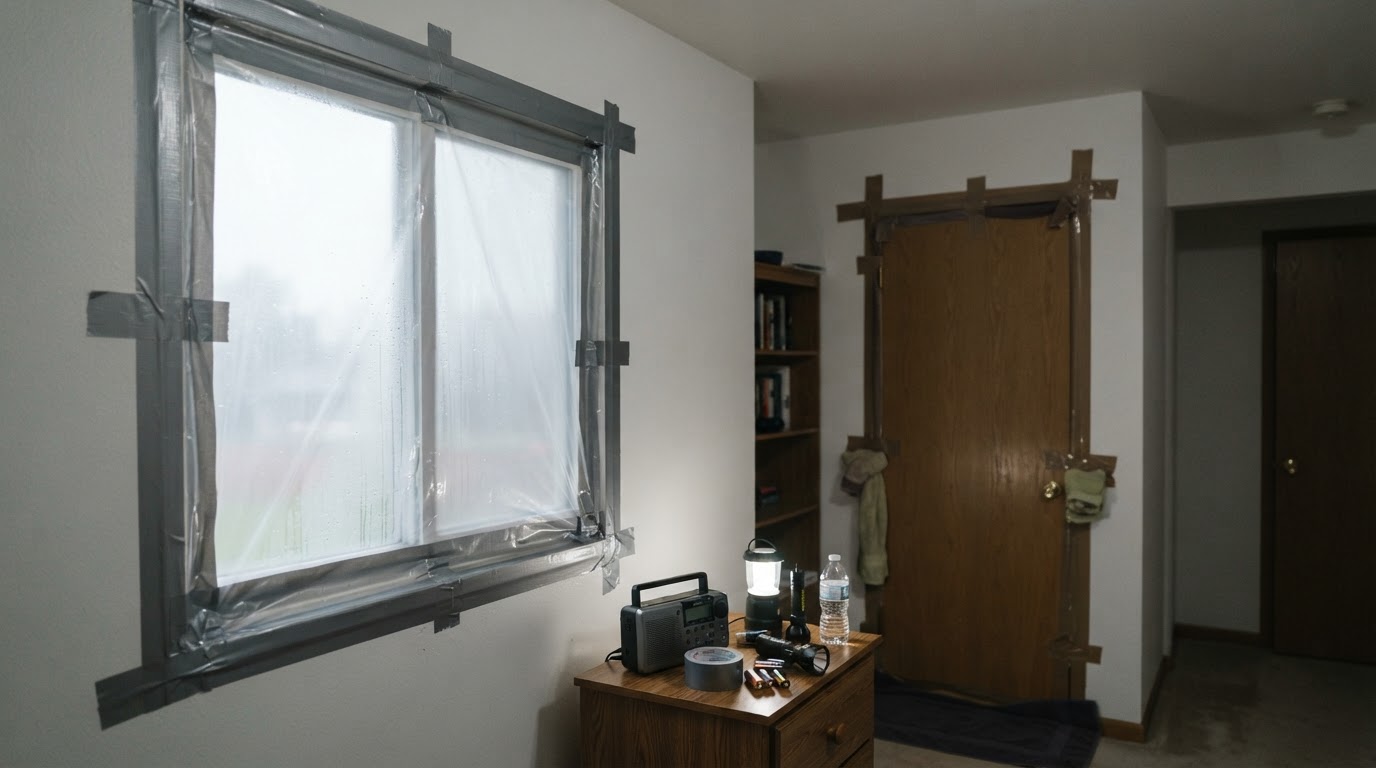
A chemical release near you: when to shelter in place and when to evacuate, how to seal one room against the outside air, and what to do if you were exposed.
This article contains affiliate links. If you buy through these links, we may earn a small commission at no extra cost to you.
There is no refinery required for a chemical emergency to reach your street. It can arrive as a train derailment, a tanker spill on the highway, or a leak at a plant in the next town. The EPA says the federal government receives an average of 12 hazardous substance release reports a day, and every response starts the same way: officials decide whether the neighborhood shelters or leaves, and residents follow the call.
Quick answer: If officials say shelter in place: go inside, bring pets, close and lock windows and doors, shut off the furnace, AC, and fans, and take everyone to one interior room you can seal. If they say evacuate, leave by the route they name. Do not go outside to help or drive to a school until officials say the danger has passed.
How the warning reaches you
Chemical emergencies use the same alert pipes as everything else: the wireless alert on your phone, the emergency alert system on TV and radio, and local officials. CDC guidance: listen for the instruction (shelter or evacuate) and follow police, fire, or emergency management, because the right answer depends on the chemical, the wind, and where you stand. One trap: some toxic chemicals are odorless, according to Ready.gov, so the absence of a smell proves nothing. The alert system is the sensor, not your nose.
Shelter in place: the fast drill
When the instruction is to shelter, you are sealing your building against outside air. Per CDC and FEMA guidance, the steps run in this order:
- Go inside and bring pets. If you are already indoors, stay.
- Close and lock all windows and doors, turn off the furnace, AC, and all fans, and close the fireplace damper.
- Grab go-kits, medications, and chargers, then move to your safe room.
- Turn on the radio and wait for the all-clear.
The safe room is up and in, not down
The room that works has few or no windows, sits away from outside walls, and has a water source if possible. CDC adds the counterintuitive part for chemical events: go as high in the building as you can. Many chemical vapors sink, so an upper-floor interior room beats a basement. That is the opposite of tornado or radiological sheltering, where low is better.
Sealing it: film, tape, and a little prep
Ready.gov treats a sealed room as pre-planned equipment, not a scramble: the sheeting and duct tape belong in your emergency kit before the emergency. FEMA's guidance: cut the sheeting (2 to 4 mil) several inches wider than each window, door, and vent, label each piece, and store it flat. A 10x25-foot roll of 4-mil clear film like the Frost King P1025 Polyethylene Sheeting, 4 mil, Clear (about $17) is enough to pre-cut covers for a room's windows, door, and vents, with film left over for spares and mistakes. For the tape half, a heavy-duty duct tape like the Gorilla Duct Tape, Black, 1.88 in x 35 yd (about $13) has a double-thick adhesive that grips glass, painted trim, and metal, and one 35-yard roll covers a room's windows, door gaps, and vents with enough left over for repairs. In the moment: tape film over windows and vents, seal door gaps, and lay damp towels along the bases of the doors.
Then stay off the phone except for a real emergency; texts move through congested networks better than calls. Do not air out the room or leave until officials say the danger has passed. A battery or hand-crank NOAA radio like the Midland ER310 Emergency Radio (about $80) keeps the all-clear coming when cell service does not. If you want a ready-made kit, a window insulation film kit like the Duck Brand Indoor 10-Window Shrink Film Insulator… (about $23) supplies film sized for windows plus tape; it is not purpose-cut for the job, but it doubles as winter window insulation.
If you are caught outside
FEMA's hazmat guidance: move upstream, uphill, and upwind of the release, travel crosswind (so the wind hits your side, not your face), and get inside the nearest building. Cars and trucks are not airtight enough to protect you from most chemicals (CDC), so treat a vehicle as a waypoint to the next building, not as shelter. Once inside, close it up the same way and find the radio.
What not to do
- Do not drive to a school or a loved one. CDC says people may already be sheltered where they are, and moving them mid-event adds risk. Schools run their own plans; wait for instructions.
- Do not leave the shelter to help someone else until authorities say it is safe (Ready.gov).
- Do not air out the room or run fans; the seal is the point, which is why FEMA says all fans off.
- Do not trust your nose. Some chemicals are odorless; others fade as you adapt.
- Do not touch puddles, powders, or spills outdoors, and keep pets away.
If you were exposed, and after the all-clear
CDC's order for exposure: get away, get the chemical off your body, get help. Take off the outer layer of clothing (cut it off rather than pulling it over your head), wash with lots of soap and water, rinse eyes for 10 to 15 minutes if they sting or your vision blurs, bag the clothing, and call Poison Control at 800-222-1222, 911, or head to the nearest hospital.
The all-clear comes from police, fire, or other local officials, and it can take hours or longer; CDC advises being ready to stay put for hours, possibly days. When it comes, follow their instructions for going outside and ventilating, and keep the radio on. If a gas-like smell is coming from inside your home rather than outside, that is a different problem: see what to do if you smell gas.
Prep it in ten minutes
Pick the room and cut and label the sheeting before anything happens; FEMA's guidance is to pre-measure every opening. Charge and test the radio, and learn your community's alert channels with your family communication plan. Ask what actually moves through your area: Ready.gov notes that many communities have a Local Emergency Planning Committee, and its chemical inventories are public on request through local emergency management.
One gear note for after the event: if cleanup puts you near soot, ash, or dust, a fitted P100 respirator like the GVS Elipse SPR457 P100 Respirator (about $50) seals better than a loose N95. Neither stops chemical vapors, and neither is permission to go outside early; the mask is for the work after the all-clear.
Sources: CDC Chemical Emergencies shelter-in-place, evacuation, and decontamination guidance; Ready.gov hazardous materials and sealing-a-room guidance; FEMA shelter-in-place guidance for chemical hazards; EPA hazardous substance release reporting data.
Frequently asked questions
What should I do if I am outside when a chemical release happens?
Move away from the release, ideally upstream, uphill, and upwind of it, and travel crosswind so the wind hits your side rather than your face. Get inside the nearest building, close and lock the windows and doors, turn off the fans and air conditioning, and wait for official instructions. Vehicles are not airtight enough to protect you from most chemicals (CDC and FEMA guidance), so treat a car or truck as a waypoint, not a shelter.
How do I seal a room against a chemical release?
Use one interior room with few or no windows, as high in the building as you can get, since many chemical vapors sink. Tape pre-cut plastic sheeting (2 to 4 mil) over the windows and vents, seal the door gaps, and lay damp towels along the bases of the doors. Ready.gov treats this as pre-planned equipment: the sheeting and duct tape belong in your emergency kit before the emergency, cut and labeled for each opening.
How will I know when it is safe to come out?
The all-clear comes from police, fire, or other local officials, and it can take hours or longer. CDC guidance says to be ready to stay put for a few hours, possibly a few days, and to keep the radio on for instructions about going outside and ventilating the building. Do not leave the shelter to help others until authorities say it is safe.