
Mold after a flood: the 48-hour window, what a dehumidifier cannot fix, and when to call a pro
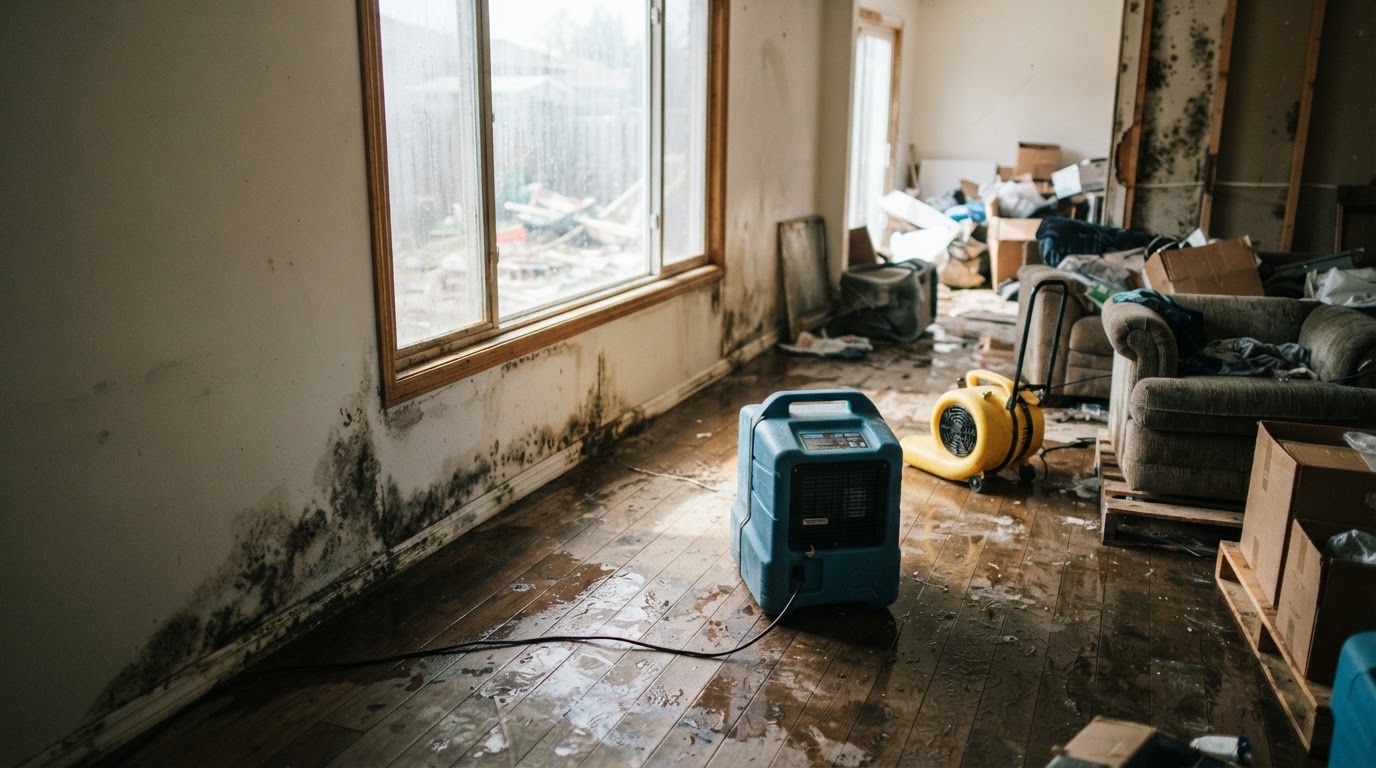
Mold gets a 24 to 48 hour head start after a flood. What drying saves, what it cannot fix, the order to disinfect in, and when the job needs a certified crew.
This article contains affiliate links. If you buy through these links, we may earn a small commission at no extra cost to you.
The dehumidifier is not the fix. It is one tool in a sequence, and if you run it while soaked drywall, insulation, and carpet pad sit in the room, you are paying to dry the air around mold food.
EPA guidance gives wet materials 24 to 48 hours to dry before mold begins growing. Inside that window, extraction and airflow can save the structure. Past it, drying stops being the goal and removal starts.
Our flood recovery guide covers the first 72 hours, what to toss, and the claims process. This guide covers the layer after it: what drying can and cannot save, the order to disinfect in, and where the do-it-yourself job ends.
The 48-hour window, read honestly
The window is real, and it is shorter than it sounds. The clock starts when the water stops rising, not when you get back to the house.
Porous materials rarely make the deadline. Drywall wicks water up past the visible line, insulation holds it inside the wall cavity, and carpet pad is a sponge that almost never dries fully. That is why the recovery rule is blunt: saturated drywall, insulation, padding, mattresses, and upholstery come out rather than dry.
What the window does protect is the expensive part: framing, subfloor, concrete, and solid wood. Get air moving on those within a day or two and most of them survive. Miss the window and mold grows inside the structure, where no surface cleaner can reach it.
What a dehumidifier can and cannot fix
Start with what it is good at. A dehumidifier pulls moisture out of the air, which keeps the drying gradient pointed the right way so wet framing and concrete can give up their water. Run it continuously, drain it through a hose so nobody is emptying a bucket every few hours, and keep windows closed in the space you are drying. The Midea 22 Pint Dehumidifier (1,500 sq ft) covers a floor at 1,500 square feet, drains by hose, and runs about $193.
Now the limits. It cannot extract standing water, so that job goes first; a wet/dry vac handles the soggy-carpet pass before the dehumidifier has anything to pull. It cannot dry the inside of a saturated wall cavity faster than mold colonizes it. It cannot save porous material that stayed wet, and it cannot remove mold that has already grown. EPA is explicit that dead mold can still cause allergic reactions, so killing it is not enough. It has to be removed.
Keep indoor humidity low while you work. EPA's home guidance suggests staying under 60 percent, ideally between 30 and 50, which is the range airflow and a dehumidifier can hold in a gutted room.
The remediation order: strip, vacuum, wash, disinfect
When drying is not going to be enough, the order matters as much as the chemistry.
- Strip and bag. Cut drywall 12 inches above the waterline, pull insulation and carpet pad, and double-bag everything before carrying it through the house. Removal first stops the rest of the job from fighting a re-seeding source.
- HEPA vacuum before anything gets wet. Dry mold spores resuspend when you sweep or scrub. A vacuum with a HEPA filter pulls them out of the air instead of pushing them around; rent one if you do not own one.
- Wash with detergent and water. Bleach does not clean. Soil and mold residue have to come off the surface first, and soapy water does that part.
- Disinfect what can be disinfected. For hard, non-porous surfaces, the standard mix is 1 cup of household bleach per gallon of water, never mixed with ammonia, with the room ventilated and skin covered. Two cautions from EPA: a disinfectant is not a substitute for cleaning, and dead mold still has to be removed, so this step finishes the job rather than replacing it.
- Dry for real, then verify. Airflow, a dehumidifier, and days of patience. Do not paint, seal, or hang new drywall until the framing reads dry on a moisture meter. Sealing over damp material traps the problem behind a fresh wall.
When the job belongs to a certified crew
EPA's home guidance draws the line at about 10 square feet, roughly a 3-foot by 3-foot patch. Under that, a careful homeowner with proper gear can usually handle the job. Over it, the professional playbook is the honest answer: containment, HEPA air scrubbers, negative pressure, and disposal that keeps spores out of the rest of the house.
Call a pro regardless of size when mold is inside the HVAC system, when the water was sewage or storm surge rather than a clean supply line, or when nobody can find where the moisture is coming from. A sewage backup is treated as a biohazard for good reason.
Then there is the buyer's side of the inspector problem. Some companies sell both the assessment and the removal, and an assessment that always ends in a full gut-out deserves a second opinion. Ask for moisture readings and a written scope of work, and get two quotes before signing anything large. Keep that scope and every receipt, because remediation documentation is what an insurance claim runs on; our claims guide covers the paperwork side.
Gear for the work
Removal is dirty work, and the gear is not optional. PVC boots like the CLC Climate Gear R230 Over-The-Sock PVC Rain Boot go over any shoes and keep contaminated water off your skin. A NIOSH-approved respirator like the 3M Aura N95 Particulate Respirator 9205+ is the minimum for disturbing moldy material, along with gloves and eye protection. Seal the work area off from living space, and run a HEPA purifier like the Levoit Core 300 Air Purifier in the rooms you actually sleep in. Filtration helps, but it does not substitute for getting the mold out.
The short version
Extract standing water. Strip saturated porous material inside the 24 to 48 hour window. HEPA vacuum, wash, then disinfect what is left. Dry the structure for days, not hours, and verify with a moisture meter before you rebuild. Under 10 square feet is a homeowner job with the right gear; larger, hidden, or sewage-fed mold belongs to a certified crew. When the work is done, find and fix the moisture source, because mold only needs one more leak to start the clock again.
Frequently asked questions
Can I skip removing wet drywall if I run a dehumidifier long enough?
No. A dehumidifier manages the air, not the materials. Saturated drywall, insulation, and carpet pad hold water inside where a dehumidifier cannot reach, and EPA guidance says materials that are not dried within 24 to 48 hours usually grow mold. Those materials come out.
How much mold can I clean up myself?
EPA guidance puts the do-it-yourself line at about 10 square feet, roughly a 3-foot by 3-foot patch. Beyond that, or when the mold is inside HVAC or followed sewage water, it belongs to a certified remediation crew.
Does bleach kill mold for good?
Not by itself. Bleach can disinfect a clean, hard surface, but EPA notes that disinfectants are not a substitute for cleaning and that dead mold still has to be removed. Wash with detergent and water first, then use 1 cup of bleach per gallon if you disinfect, and never mix it with ammonia.