
Flood Insurance and Documenting Damage: The 2026 Claims Guide (NFIP vs Private)
Flood insurance 101 for homeowners and renters: what NFIP and private policies actually cover, the 30-day wait, and how to photo-document damage for claims.
This article contains affiliate links. If you buy through these links, we may earn a small commission at no extra cost to you.
One inch of floodwater does about $25,000 in damage to an average home, according to FEMA. Most owners learn after the water leaves that homeowners insurance covers none of it. A separate flood policy bought before the rain and a photo habit you start today are what make the claim pay.
This is the money companion to our other flood guides. Our flood safety guide covers evacuation and the flood recovery guide walks the first 72 hours, mold, and scams. Below is what flood insurance pays, how to buy, and how to document so an adjuster can say yes.
What flood insurance covers
Standard homeowners excludes surface water, overflow, and surge. You need a flood policy on top, and most owners have not bought one. FEMA still sees more than 20 percent of claims from outside mapped high-risk zones, yet only a small share of owners there carry coverage.
Two ways to buy:
NFIP (federal). Available in any participating community. You choose building and contents separately. For single-family homes NFIP caps building at $250,000 and contents at $100,000. Basement coverage is narrow, finished walls and personal items below grade are tightly limited, and NFIP does not pay additional living expenses. Premiums follow Risk Rating 2.0, which prices by distance to water, elevation, rebuild cost, and flood frequency. Most land near $700 to $900 a year.
Private. Sold by private carriers, sometimes bundled with homeowners. Private plans can offer higher building limits, often include loss-of-use dollars, and may cover basements and replacement cost more generously. Underwriting is stricter, so quote both. If a federally backed mortgage requires NFIP, a qualifying private policy can usually satisfy the lender, but get that in writing before you cancel NFIP.
Neither covers what people assume. Sheds, fences, and decks have narrow limits, cars belong under auto comprehensive, and landscaping is excluded.
Wind is a different claim: tornado and hail damage sit on your homeowners policy, not this one, and rain that enters through a wind-opened roof is usually treated as wind damage, not flood. The documentation workflow below works for both. Our tornado damage claims guide covers the wind side.
The waiting period that decides if you are covered
Flood policies do not start the day you pay. NFIP has a 30-day wait from application to effective date, with only narrow exceptions for loan closings and map changes. Private carriers usually impose 10 to 14 days, sometimes 30. No carrier sells coverage during a named storm already aimed at your county. Buy in dry weather. If a lender says you sit in a Special Flood Hazard Area, pay at closing and get the exception in writing.
Three terms to know:
Elevation Certificate. Surveyed elevation relative to base flood elevation. Not always required under Risk Rating 2.0, but carriers use it to price grandfathered policies, dispute a zone, or credit mitigation like flood vents.
Increased Cost of Compliance (ICC). An NFIP add-on in most policies up to $30,000 that pays to bring a substantially damaged home up to code. Private handles it as ordinance-or-law at varying limits.
Grandfathering. If your home met the map when built and the map later changed, grandfathered rating can keep the older zone, but only with continuous coverage. One lapse resets you.
What renters should know
Renters can buy flood insurance and it is often the cheapest policy in the building. NFIP sells contents-only at the same $100,000 limit. Private renters policies bundle contents with loss-of-use. A landlord's building policy does not cover your furniture. In low-to-moderate zones a renters flood policy often costs under $200 a year.
Buying checklist
Get these answers on the declarations page:
- Building, contents, or both, at what limits and deductibles?
- NFIP or private, and what is the effective date after the wait?
- How does the policy treat basements and enclosures below the lowest floor?
- Replacement cost or actual cash value, and for which items?
- ICC or ordinance-or-law included, and at what limit?
- Loss of use or additional living expenses included, and for how long?
- What does the carrier require at claim time?
- What mitigation credits apply? Flood vents, elevated utilities, and relocated mechanicals can lower premiums.
How to document damage so the claim pays
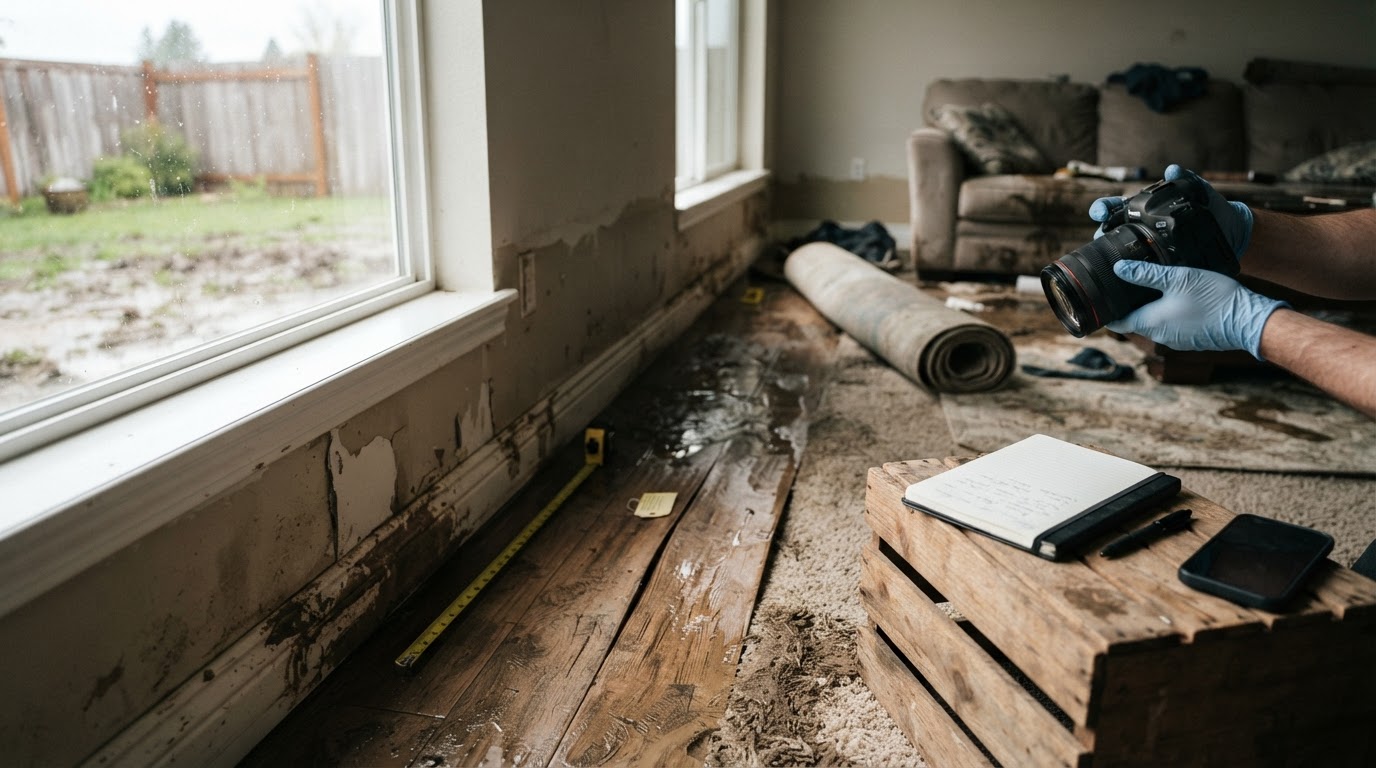
Clean up before you photograph and you will lose money. Adjusters pay what you can prove was there. Your phone, a notebook, and power to keep them alive are the most valuable tools in the house. A EcoFlow RIVER 3 Portable Power Station keeps phones charged when the grid is down so you can shoot before moving anything, and a SentrySafe 1210 Fireproof Box is where ownership paperwork should already be waiting.
Before the flood: the 20-minute video. Walk every room with continuous video. Open every closet, drawer, and appliance. Hold 3 to 5 seconds on brands and serials.
After the flood: the order that protects the claim.
- Call the insurer before you remove anything. Get their standard in writing or log the call with time, name, and reference number.
- Shoot video before you touch anything. Every room floor to ceiling, waterline visible, then close-ups with the waterline behind each item.
- Build the inventory. One line per item: room, item, brand and model, purchase date, price, serial, condition. Photograph receipts; bank statements count when receipts are gone.
- Do not discard items until the carrier says you can. If you must toss for health, photograph and log first.
- Keep every recovery receipt: rentals, pumps, cleaning supplies, hotels, meals.
- Track every call. Date, time, who you spoke with, what was promised, reference number. This log wins appeals.
You can file for FEMA even if you carry flood insurance. The full recovery sequence is in our flood recovery guide, and the kit to stage before the next warning is in the flood emergency kit.
When the first offer is too low
Ask for the line-item estimate, then get two contractor quotes.
Quick recommendations
- If you do not have flood insurance, buy it this week. NFIP takes 30 days. Private often takes 10 to 14.
- Quote both NFIP and private. Compare building versus contents, basements, loss of use, and replacement cost, not just the premium.
- Make the 20-minute video now. Every closet and appliance, brands and serials, with a cloud copy.
- Put paper in a fireproof box and photos in the cloud. A SentrySafe 1210 Fireproof Box for originals on the highest shelf, plus phone photos in storage.
- After a flood, photograph before you clean. Video first, inventory second, removal last, and keep the EcoFlow RIVER 3 Portable Power Station charged so your phone lasts to do it.