
Solar Storms and Blackouts: What to Actually Prepare For
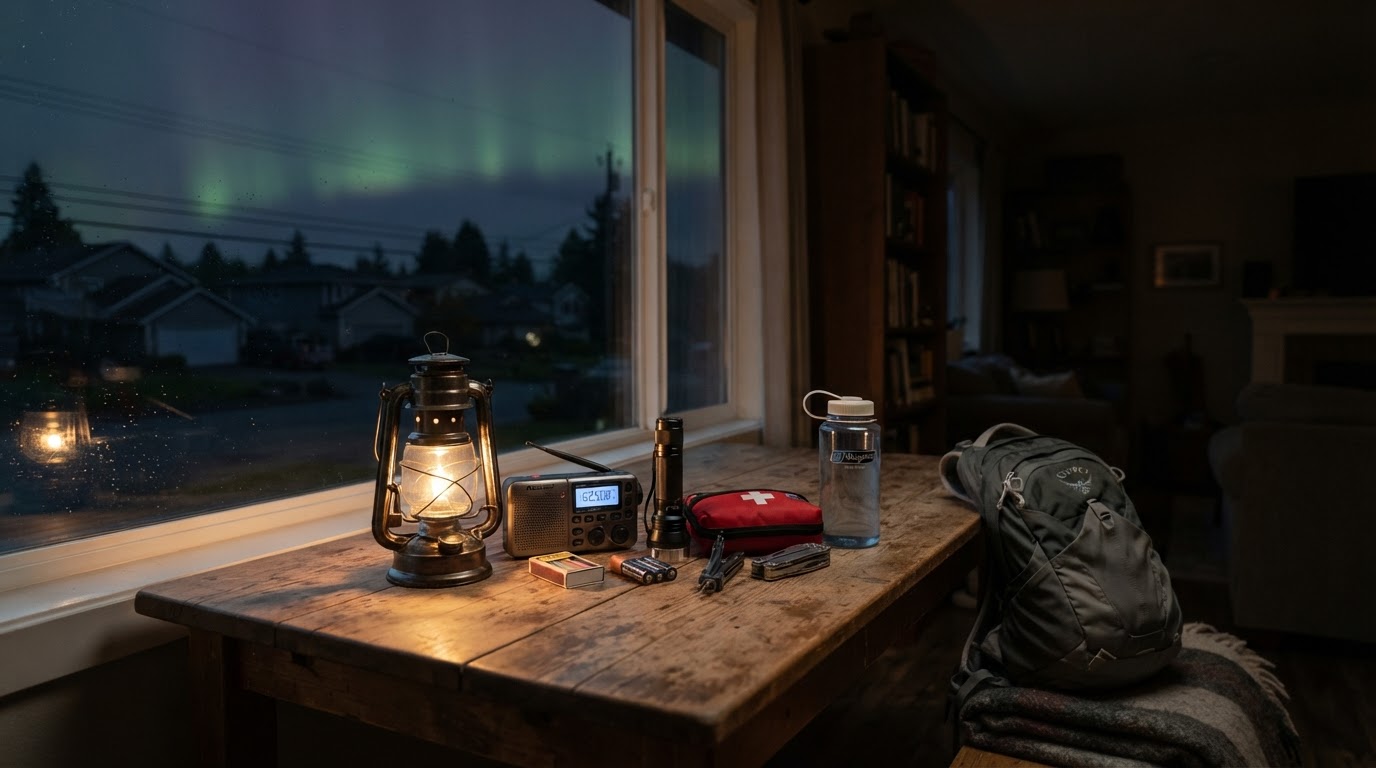
A severe solar storm threatens the power grid, not your body. How NOAA rates geomagnetic storms, what Quebec 1989 teaches, and the outage kit that covers it.
This article contains affiliate links. If you buy through these links, we may earn a small commission at no extra cost to you.
A big solar storm will not hurt you. It might, however, turn off your lights for days. That distinction is the whole plan: prepare for a long power outage with a communications backup, and you are prepared for the worst space weather can plausibly do.
What a geomagnetic storm actually is
The sun constantly blows charged particles past Earth. When a big eruption sends a billion-ton cloud of them our way, the impact squeezes Earth's magnetic field and drives electric currents through the ground. NOAA's Space Weather Prediction Center rates the resulting storms G1 (minor) through G5 (extreme), and G5 is the level where grid operators start taking protective action.
The particles take one to three days to cross the gap, according to NASA and NOAA tracking, which is why forecasters can issue geomagnetic-storm watches while the cloud is still en route and update them as it closes in. Watch for those watches the way you watch a hurricane cone: a G1 or G2 means aurora and little else, while a G4 or G5 watch is your cue to top up devices and dig out the radio.
What has really happened before
The benchmark is the 1859 Carrington Event, the largest geomagnetic storm in recorded history. It set telegraph offices sparking and let people across the northeastern US read newspapers by aurora light, per NOAA's historical account. A repeat today would hit a far more wired world, and a National Academies analysis cited by NOAA put the worst-case cost near $2 trillion.
The modern proof that grids are the weak point came on March 13, 1989. A severe storm tripped Hydro-Quebec's transmission system in under 90 seconds and left six million people without power for nine hours or more. The utility has since hardened its grid with recalibrated protection, real-time monitoring, and procedures that cut power flows during magnetic disturbances, and later intense storms have not repeated the failure.
The most recent test was May 2024, the first G5 storm in over two decades. Auroras reached deep into the southern US, GPS and HF radio saw disruptions, and grid effects stayed minor. Warnings worked, operators acted, and life went on. That is the realistic best case for the next one too.
What would break, and what would not
NOAA's account of past storms keeps pointing at the same vulnerable targets: long conductors. Transmission lines pick up geomagnetically induced currents that can overheat extra-high-voltage transformers, pipelines suffer accelerated corrosion, and ionosphere changes degrade HF radio and GPS accuracy. Satellites can take damage or lose orientation.
What does not break: you. The particles never reach the surface in a form that affects health, so there is no sheltering protocol and no protective gear to buy. Phones, cars, and home electronics are unlikely to fry, because the damaging currents need kilometers of conductor to build up. Cell service can still degrade if tower backup power runs out or GPS timing wobbles, which is an outage problem with an outage solution, not a reason to wrap gadgets in foil.
Prepare like it is a long outage
If your house can ride out a week without the grid, a solar storm adds exactly one task: paying attention to the forecast. Start from the power outage survival guide and make sure these pieces are in place:
- Light and power: a lantern or flashlight in every room, plus a power bank you keep charged. The Anker Power Bank 10,000mAh USB-C (about $26) holds several phone charges, and the Energizer HC-550 Magnetic Flashlight (AA) (about $23) sticks to a fridge or breaker panel so it is findable in the dark.
- Information without the internet: a weather radio that receives NOAA alerts and runs on crank, solar, or batteries. The Midland ER310 Emergency Radio covers AM, FM, and NOAA weather bands with a hand crank and solar panel, so forecasts keep coming even if cell towers go quiet. Our best emergency radios roundup compares the options.
- Food and water: the standard outage baseline from what to do when the grid goes down, three days of ready-to-eat food and a gallon of water per person per day.
- An unplug plan: know which electronics you would disconnect during a G4 or G5 watch, especially anything expensive and sensitive. Our surge and brownout guide covers the same habit for terrestrial grid events.
Paper matters more than usual here. If GPS and maps apps glitch, a printed contact list and a Rand McNally 2027 Road Atlas keep working. Keep some cash for card readers that go dark.
During a severe storm watch
When NOAA posts a G4 or G5 watch, treat it like a storm warning for the grid. Charge everything, unplug the expensive and sensitive gear, fill the car, and check that the radio works. Utilities may deliberately cut or reroute power to protect transformers, Hydro-Quebec's post-1989 procedures do exactly that, so a precautionary outage during the storm is a sign the system is working, not failing.
Then mostly wait. Keep the radio on for utility announcements, conserve phone battery, and avoid unnecessary driving if traffic signals are out. When the watch expires and the grid held, plug back in and stand down.
Solar storms sound exotic, but the preparation is gloriously boring: charged batteries, stored water, a radio, and a forecast habit. Build that once and every blackout, solar or otherwise, gets a little quieter.
Frequently asked questions
Can a solar storm hurt me directly?
No. The charged particles never reach the ground in any form that affects human health. The risk is entirely to infrastructure: power grids, GPS, HF radio, and satellites.
Should I buy a Faraday cage or bag for a solar storm?
No. Past storms damaged long conductors like transmission lines and pipelines, not phones or cars. Spend the money on outage basics: light, backup power, and a radio.
How much warning will we get before a big solar storm?
Usually one to three days. NOAA tracks eruptions leaving the sun and issues geomagnetic-storm watches while the material is still en route, then refines the forecast as it approaches.
Will my phone and car still work?
Very likely yes. Cell networks can degrade if GPS timing drifts or backup generators at towers run dry, so keep a car charger and a power bank topped up rather than assuming the worst.