
Stay Cool Without AC: How to Keep One Room Survivable in a Summer Blackout (2026)
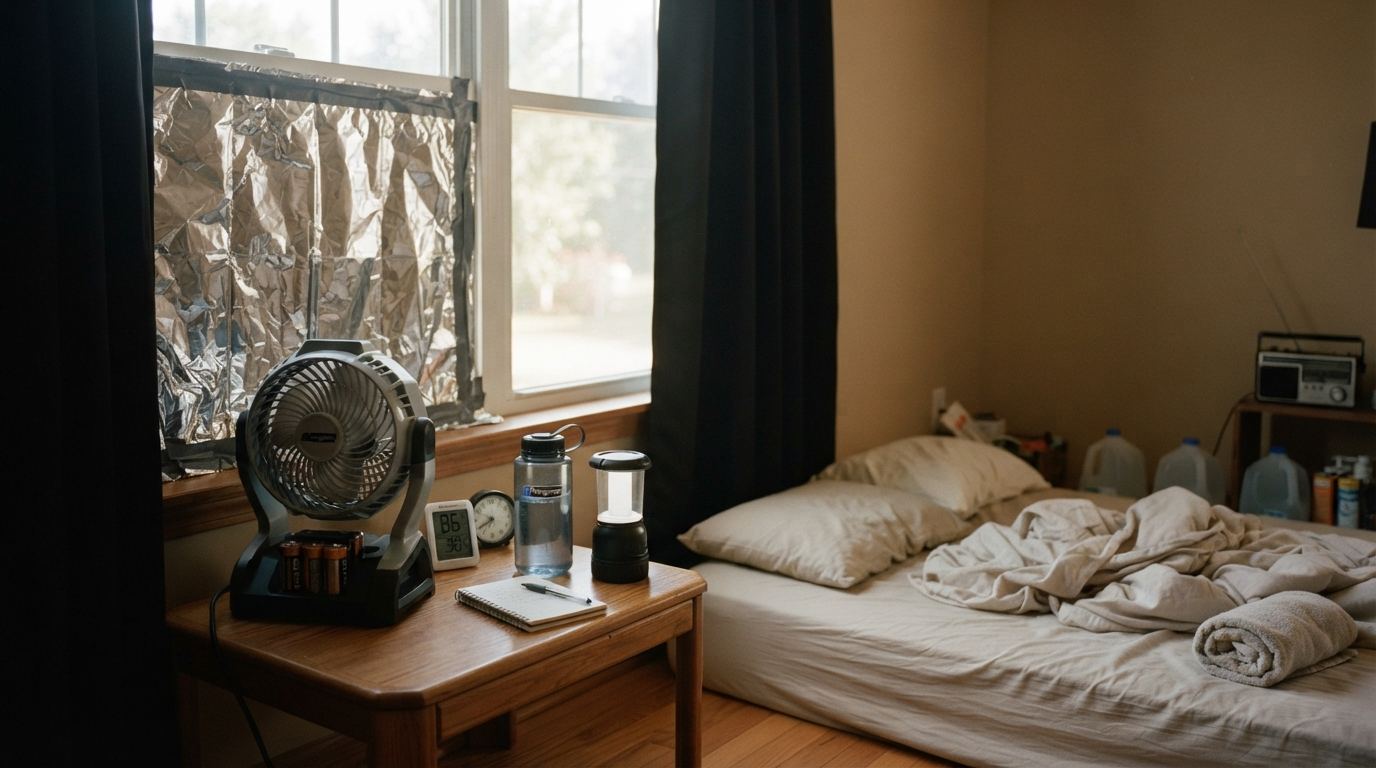
Stay cool without AC in a summer blackout: keep one room survivable with cross-ventilation, reflective barriers, battery fan run-time math, and when to leave.
This article contains affiliate links. If you buy through these links, we may earn a small commission at no extra cost to you.
When the AC dies in a summer blackout, don't try to cool the house. Pick one room and keep it survivable until the grid or the temperature drops. Close every sun-facing blind, crack two opposite windows for a cross-draft at night, and point a small fan at the people in the room. Wet cloths and steady water cover the rest.
This is the cooling side of an outage, not the first-aid side. If someone is confused, stops sweating, or has hot dry skin above 104°F, that's heat stroke: call 911 and start cooling. Our heat exhaustion vs heat stroke guide covers how to tell the two apart. What follows is how to keep the room from getting there.
Pick the Survivable Room
Choose the lowest, darkest room you can tolerate for a day. Heat rises, so an upstairs bedroom is the worst place to wait out an afternoon; a north-facing living room or basement family room is usually 5 to 10 degrees cooler with no work.
Shrink the box you have to cool. Shut doors to unused rooms, close blinds on east and south windows, and hang a blanket over any window that gets direct sun and has no blind. One 150-square-foot room is a project. A whole house in August is not.
Put a thermometer like the Antonki Room Thermometer and Indoor Hygrometer, 2… (about $9 for two) in that room. Seeing 82°F vs 92°F tells you whether your tricks are working and when it's time to move to a cooling center.
Window Strategy: Sealed by Day, Open at Night
The instinct is to throw every window open for fresh air. During a heat dome that just cooks the house faster.
By day, keep sun-facing windows closed and covered. Direct sun through glass is a heater you invited in. On the worst windows tape a reflective emergency blanket like the SOL 90% Heat Reflective Emergency Blanket (about $19) or aluminum foil to the inside of the glass, shiny side out. It looks rough and it works: foil on cardboard beats a bare south window by several degrees.
At night, open for a cross-draft. When the outside temperature finally drops below the inside temperature, often after 9 p.m., open two windows on opposite sides of the room, or a window plus a hallway window with the interior door open. Even a 2-mph draft changes how your skin sheds heat. If the air is still, put a small battery fan in one window pulling out, with another cracked for makeup air.
Close everything again by mid-morning before the sun reheats the walls.
The Fan Math That Changes the Plan
A fan doesn't make air colder. It moves air across skin so sweat can evaporate, which is how your body dumps heat. That works until the air is hotter than skin, roughly above 95°F, at which point a fan just pushes hot air at you and speeds dehydration. Above that line, move to shade or a cooler room.
When the grid is down, a fan is also a power question, and a small battery answers it. The EcoFlow RIVER 3 Portable Power Station holds 245Wh; it runs about $249 at the current listing. On that battery a 25-watt box fan runs close to 10 hours, a 10-watt table fan closer to 20, and a 5-watt USB clip fan for roughly two days. If you don't already own a fan, the one that fits this job is the AMACOOL 10 Inch Foldable Rechargeable Oscillating…, a 10-inch oscillating model with a built-in 20,000mAh battery that charges by USB-C from the station and runs for up to 72 hours on a full charge. Point the fan at people, not the ceiling. Air across a damp bandana cools a person; air circling an empty room does not.
Heat waves also strain the water system, and boil advisories land right when you need to drink. If the tap goes under advisory or pressure drops, the Sawyer Squeeze Water Filtration System (about $46, filters roughly 100,000 gallons) lets you keep hydrating from a stored jug without waiting on a stove you can't run.
Cool the Body, Not the House
Once the room is as dark and drafty as you can make it, shift from cooling air to cooling skin:
- Wet the pulse points. A bandana around the neck, wrists, and ankles pulls heat fast. Re-wet every 20 minutes or drape it in front of the fan.
- Sleep low. The ground floor is cooler than the second floor by a real margin.
- Drink on a schedule. About 8 ounces every 15 to 20 minutes while active in the heat, before you feel thirsty.
- Lose extra layers. Loose, light clothing and a damp sheet beat blankets.
A cool evening shower helps if you still have pressure. If not, a basin and a washcloth on the back of the neck and forearms does most of the same work.
Know When to Leave
No room trick makes a 105°F heat index safe for everyone, especially older adults, young children, and anyone on medicines that blunt sweating. Heavy sweating and dizziness can still turn around at home in 30 minutes, but confusion or hot dry skin means you are past that window. Cool fast and call for help.
Stay tuned to warnings even when the power is out. Cell sites have backup power, but its duration varies, and an extended outage can leave cell service unavailable. A weather radio does not depend on that local network. The Midland ER310 Emergency Radio runs 72+ hours on its battery and wakes you with loud NOAA alerts; keep it in the survivable room with the fan. The broader outage sequence lives in our power outage survival guide for 2026.
Your One-Room Checklist
- Survivable room picked: lowest, north-facing, doors closed to the rest of the house
- Blinds closed on east and south windows; reflective barrier on the worst sun
- Two windows for a night cross-draft, plus a small fan ready
- Battery station charged (EcoFlow RIVER 3: ~10 hours on a 25W fan, ~20 on a 10W)
- Water plan: stored jugs plus a filter (Sawyer Squeeze) for advisories
- Radio in the room (Midland ER310) with batteries stored beside it
- Wet bandanas and a basin for evening cool-down
- Thermometer in the room so you can see 82°F vs 92°F and decide when to move
You won't make a house comfortable without AC in a heat wave. You can make one room survivable until the power comes back or the sun goes down.