
Day 5 Without Power: What Matters, Costs, and Weighs
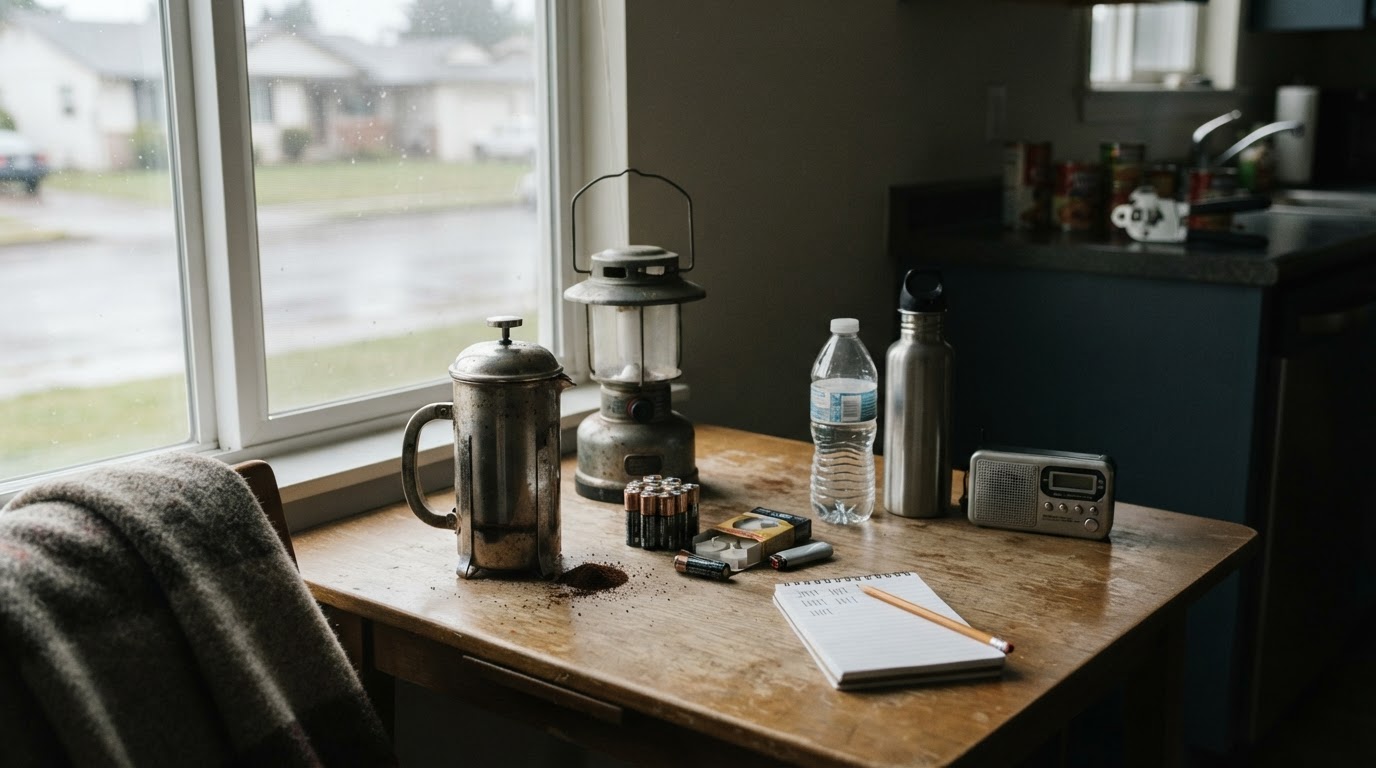
By day 5 without power the small gaps get expensive. Here is what held, what failed, and the true cost and weight of every fix that actually mattered.
This article contains affiliate links. If you buy through these links, we may earn a small commission at no extra cost to you.
By day 5 the novelty is gone. Fridge on day 1, water on day 2, then keeping phones alive and food safe. This planning timeline uses published specifications, food-safety guidance, and example costs and weights so you can judge what earns space in your closet. It is not a report of a physical outage or product test.
A 245Wh station plus a folding panel can cover the essentials, a small fan can make sleep possible, and a thermometer can settle the food-safety question faster than guesswork. Grid-tied balcony solar does not provide backup without a battery, and a half tank of gas can avoid a fuel stop during an outage.
Hour 0: what failed first
Use this sample: a power cut at 2:14 p.m. on a Thursday in late August, with no storm, just a substation fault. Lights out, router dead, fridge quiet.
The first hour shows what you actually prepared:
- Phones at 60 to 80 percent. No charged power bank within reach.
- Fridge at 38F. Closed, it buys about four hours before dairy leaves the safe zone.
- No flashlight where you could find it. Candles in the drawer are not the same.
- The balcony microinverter quit within 90 seconds. Grid-tied building solar without a battery is a bill reducer, not backup.
Light where the person is the hour-0 priority. A headlamp keeps both hands free, while a small radio with a built-in light can help locate the breaker, station, and thermometer. The Midland ER310 Emergency Radio costs about $80, weighs under a pound, and receives NOAA on 162.550 MHz when cell data is unreliable.
Day 1: food and cold
Day 1 is the fridge. Every opening costs cold. One person opens, grabs everything for the next meal, closes. A wireless thermometer ends the guessing. Fridge 36 to 40F is safe, freezer 0F or below is safe. Above 40F for more than two hours, cook or toss. In a worked example, keep the freezer shut until dinner and use the refrigerator food first.
The EcoFlow RIVER 3 Portable Power Station is 245Wh and about 7.8 lb. Its current listing runs about $249. It cannot run a fridge through the night. A 120W fridge cycles near 35 percent, so average draw is about 42W. On 245Wh you get four to five hours of compressor time, roughly half a day in a real kitchen. Reserve those hours for the refrigerator and thermometer rather than assuming the station can cover every load.
Day 2: water and the half-tank rule
If city water stays on but pressure sags, treat it as a warning. Fill the tub for flushing, keep two 7-gallon jugs for drinking, and reserve one basin to wash and one to rinse. About half a gallon per person can cover basic cleaning without a shower.
Weight teaches fast. Water is 8.34 pounds per gallon. Two full 7-gallon jugs are about 117 pounds. You do not carry them far, so fill them before you need them. Two filled jugs can turn day 2 into a household task instead of a store run.
The half-tank rule is about more than range. Keeping the car above half can avoid the worst fuel line when pumps lose power. Fill at half instead of waiting for the warning light.
Day 3: comms, heat, and the recharge window
Day 3 is when morale cracks. Phones are low, the router has been dead since hour 0, and cell data comes in bursts. A weather radio can provide steady information on a short schedule. The Midland runs for days on its stated battery capacity and can recharge from the station over USB. The crank is backup, not a plan.
Heat is the other problem. A third-floor room in late August can reach 86F inside, and still air feels worse at night. The AMACOOL 10 Inch Foldable Rechargeable Oscillating… is a 10-inch folding fan with a 20,000mAh battery and USB-C. The current listing has no featured offer, so check the live price. Its listing claims up to 72 hours of cooling on a full charge. The 245Wh station can recharge it about three times or run a 10W fan directly for about 20 hours after loss. A closed bedroom with a small window opening still needs judgment about smoke, security, and outdoor temperature.
Phones can recharge on a schedule, one at lunch and one at dinner, to 80 percent. The EF EcoFlow 110W Portable Solar Panel is about $259, 7.3 lb folded, and IP68. Its 110W rating is an upper limit; haze, shade, and panel angle reduce the input. At 40W, refilling the station takes about six hours before losses. Building solar gives no outage power unless the system has a battery and islanding capability. The core system is about 19.7 lb and fits in one duffel. The panel is about $259; the station runs about $249 at the current listing.
Day 5: keep, cut, or add
By day 5 in this example, power returns at 8:40 p.m. The routine is simple: check temperatures, charge in the sun window, keep one room cool at night, and listen to the radio at 7 a.m. and 7 p.m.
What actually mattered, by how often we reached for it:
- Light and info first. Radio plus a headlamp would have covered hour 0.
- Fridge thermometer. Ended the safe-or-toss debate, stopped door opening.
- Fan. Heat breaks sleep and sleep breaks decisions. A 5W fan is not luxury.
- Station plus panel as a pair. Either alone is half a system.
- Half tank and jugs filled early. Habits, not gear, beat any last-minute run.
What matters less depends on the household, but a big cooler, extra canned food, or the bucket toilet may rank below light, information, water, and temperature control. Managed carefully, a fridge can cover the first part of an outage.
What would you add?
One house, one outage, one August is only an example. Your day 5 shifts with kids, medicines that need cold, or a well that stops when the pump does. The planning pattern is hour 0 for light and information, day 1 for cold storage, day 2 for water, day 3 for communication and heat, and day 5 for routine.
If you have lived through a multi-day outage, what made your list and what would you cut? Start this week. One jug, one thermometer, half a tank, and a plan to keep one room cool beats a perfect kit you never buy.
For the math behind the power numbers, see our portable power station fridge runtime and our stay cool without power. For water, the real two-week water budget has the bleach math and apartment layout.