
How Long Will a Portable Power Station Run a Fridge? Runtime Estimates for 2026
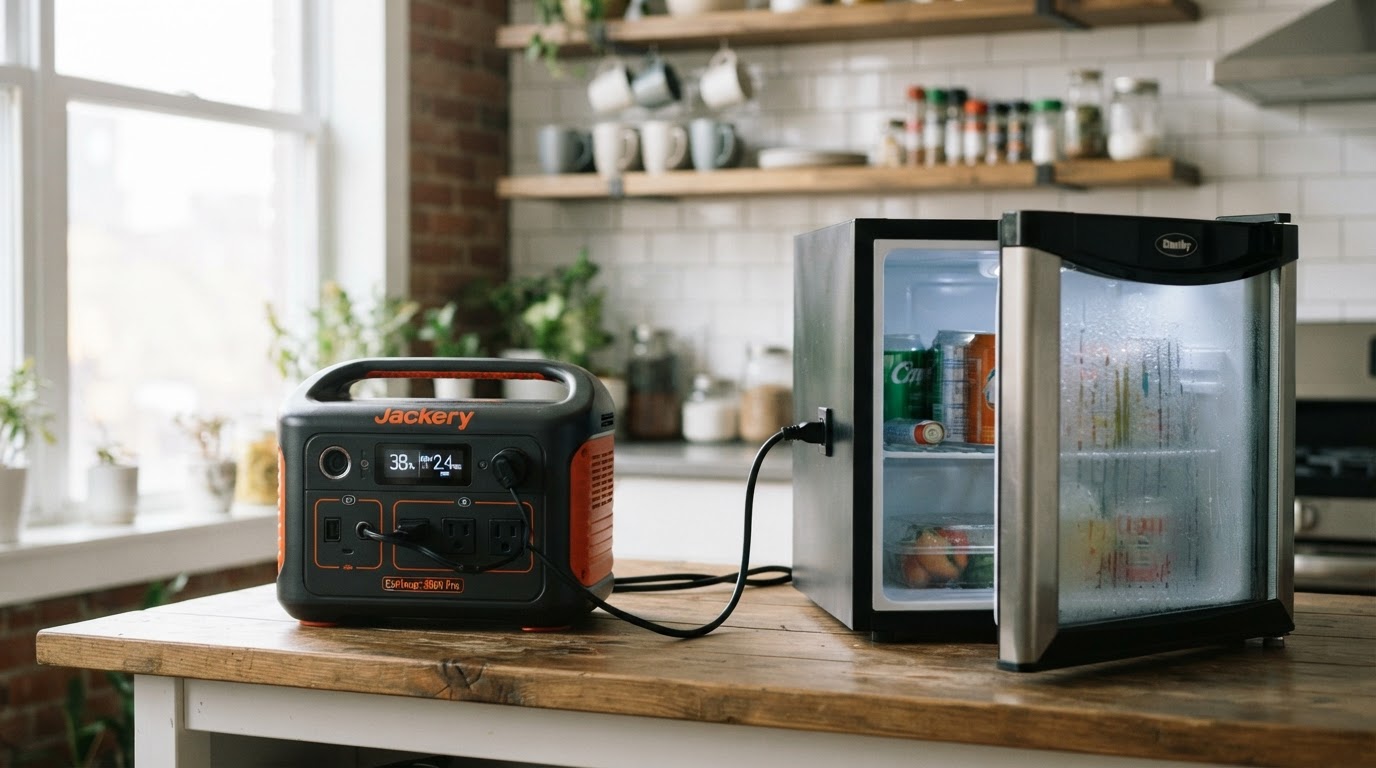
How long will a portable power station run a fridge? A 120W fridge on 245Wh runs about 4 to 5 hours at 35 percent duty. Real runtime table and worksheet inside.
This article contains affiliate links. If you buy through these links, we may earn a small commission at no extra cost to you.
A 120-watt fridge on a 245Wh portable power station runs about 4 to 5 hours of compressor time, which stretches to roughly half a day in a real kitchen because fridges cycle on only about 35 percent of the time. The rest is the math to check your own fridge and decide whether solar can keep up.
We compared 12 stations using published capacity and load specifications. The table applies the same calculation to the station most homes buy, the EcoFlow RIVER 3 Portable Power Station at 245Wh, plus a worksheet to size any station.
The One Formula
Watt-hours tell you how long a station can supply power. Watts tell you how fast a device pulls it. Usable capacity is about 85 percent of the printed number because the inverter eats the rest.
Runtime in hours is about (capacity in Wh times 0.85) divided by watts.
A 245Wh station has roughly 208 usable watt-hours. A 15Wh phone charge gives about 13 full charges. A 30-watt CPAP gives about 7 hours. A 1,500-watt heater will not start on a 600-watt inverter at all. Advertised capacity is also optimistic by 25 to 50 percent, so plan for the low end.
Estimated Runtimes on 245Wh (208 Usable)
Planning numbers at room temperature, not promises.
| Device | Draw when running | What you get |
|---|---|---|
| Phone, per charge | about 15Wh | about 13 charges |
| Router plus modem | about 15W | about 13 to 14 hours |
| 10W LED lamp | 10W | about 20 hours |
| 10-inch rechargeable fan | 5 to 10W | 20 to 40 hours |
| CPAP, no humidifier | about 30W | about 6 to 7 hours |
| CPAP with humidifier | 60 to 70W | about 3 hours |
| Laptop | about 50W | about 4 hours |
| Mini fridge, running | 50 to 60W | about 4 hours |
| Full-size fridge, running | 100 to 150W | about 1.5 to 2 hours |
| Full-size fridge, cycling at 35 percent | 120W average | about 4 to 5 hours before empty |
| Chest freezer, cycling | 80 to 120W when running | about 3 to 6 hours |
A full-size fridge draws 100 to 150 watts when the compressor is on, but the compressor is on only about a third of the time with the door shut. On 245Wh you get roughly 90 to 120 minutes of actual compressor run, which spreads to 4 to 5 hours before the battery is flat. It will not keep a full fridge cold for days. It will buy you one careful day in bursts.
Why Duty Cycle Makes or Breaks the Math
In a 70-degree kitchen with the door closed, a modern fridge runs about 35 percent of each hour. Open the door or put it in a hot garage and that climbs to 50 or 60 percent. A cool basement drops it toward 25.
Take the watts on the label or a kill-a-watt reading, multiply by 0.35, and use that as average watts. A plug-in meter like the P3 P4400 Kill A Watt Electricity Usage Monitor runs about $31 and measures the real draw of anything you plug into it, so the same method works for every load on your must-run list. A 120-watt fridge times 0.35 is 42 average watts, and 208 divided by 42 is about 5 hours. Use 0.5 if you want to be conservative. Better to plan for less runtime than to learn the battery died at 2 a.m.
An alarm helps you act on that math. The AcuRite Wireless Fridge and Freezer Thermometer… beeps when the fridge crosses 40 degrees so you know when the 2-hour safety clock starts. For that clock, see how long food lasts without power.
The Worksheet: Size Any Station
Add at average draw, not label draw.
- Pick the must-run list. One night: fridge 42 average watts, router 15, one LED strip 5, two phones 2 each, radio on standby 1. Total about 67 average watts.
- Decide how long. Eight hours is 67 times 8, about 536Wh. A single 245Wh station covers less than half.
- Run in shifts. Power the fridge 30 minutes each hour, then turn the station off and keep doors shut. That cuts average draw roughly in half.
- Check the inverter. A fridge that spikes to 300 watts may trip a 300-watt inverter. The RIVER 3 outputs 300 watts continuous (X-Boost to 600 watts), so one full-size fridge starts fine. Two at once may not.
- Subtract the optimism tax. Take your total and plan for 70 percent.
Tape it to the station. You will not want to do math in an outage.
Can Solar Keep Up?
The EF EcoFlow 110W Portable Solar Panel is a 110-watt folding panel built to pair with the RIVER 3. In ideal sun it refills the 245Wh station in about 3 hours of full output. On a real yard with haze and angle, count on a full day from empty. That still runs the fridge in bursts and keeps phones and a modem alive.
Cooling loads compete for the same battery. A 25-watt box fan wants 10 hours, which is the whole station. Run the AMACOOL 10 Inch Foldable Rechargeable Oscillating… off its own 20,000mAh battery on low and save the station for the fridge. Our stay cool without power guide has the one-room setup that keeps that choice from becoming food versus sleep.
How to Stretch a Small Station
Keep doors shut. Move milk and leftovers you open often into a cooler with ice so the big doors stay closed. Run the station to the fridge 30 to 45 minutes, unplug, and let the box coast. Repeat. The burst pattern is how a small battery reaches a full day, and the thermometer tells you when to run the next burst.
Charge whenever you have wall, car, or sun. The RIVER 3 refills from a wall outlet in about an hour and slowly from a car 12-volt socket. Know when the battery is the wrong tool: three days of full fridge and freezer is a generator job (our refrigerator generator sizing guide covers the class to buy). For that trade-off, see our best portable power stations and the wider sequence in our power outage survival guide.
What to Put on the Shelf
- Measure the fridge: label watts times 0.35, write average on tape on the door
- Fill the worksheet: must-run watts, hours needed, 70 percent honest budget
- Station charged: 100 percent, inverter starts the fridge, cables reach
- Thermometer in place: alarm set to 40 degrees
- Solar setup checked: 110W panel shows input watts, cord reaches the station
- Fan charged so cooling does not steal fridge hours
- Cooler for frequent items, burst schedule written down
A station does not need to run everything to be worth owning. It needs to run the right things at the right time, and the math above tells you what those are before the lights go out.
Frequently asked questions
How long will a portable power station run a full-size fridge?
A 120-watt fridge cycles on only about 35 percent of each hour with the door shut, so it averages roughly 42 watts. A 245Wh station has about 208 usable watt-hours, which is 4 to 5 hours before the battery is flat. In a hot garage the duty cycle climbs toward 50 to 60 percent and those hours shrink.
Why does a power station die sooner than its advertised capacity suggests?
The printed number gets cut twice. The inverter leaves about 85 percent of the capacity usable, and advertised capacity itself runs 25 to 50 percent optimistic in real use. Our worksheet budgets only about 70 percent of the label, and sizing by average draw rather than label watts keeps the estimate honest.
How do I stretch a small station through an outage without spoiling food?
Keep the doors shut, move milk and leftovers into a cooler with ice, and run the station in 30-to-45-minute bursts instead of continuously, letting the box coast in between. A wireless fridge thermometer that alarms at 40 degrees tells you exactly when the two-hour safety clock starts.