
What to Do If You Drive Into Civil Unrest: A 2026 Guide
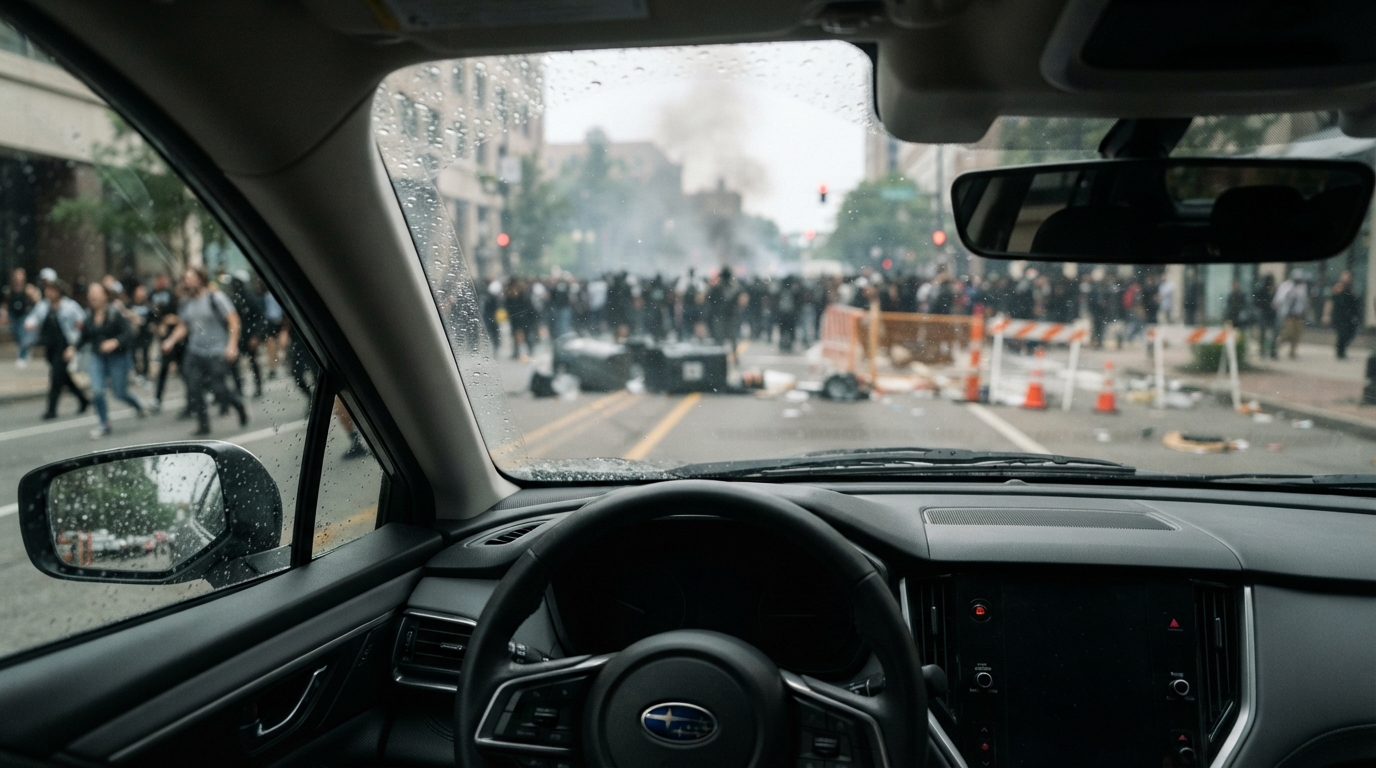
Driving into civil unrest: how to spot trouble early, turn around safely, handle a surrounding crowd, and escape a car you cannot keep. Practical 2026 guidance.
This article contains affiliate links. If you buy through these links, we may earn a small commission at no extra cost to you.
If you drive into civil unrest, the goal is simple: leave with the car you still have. Turn around at the first sign of trouble, keep doors locked and windows up if a crowd finds you anyway, move only at walking pace while you clear the area, and never get out to argue. Cars are replaceable; decisions made in the next thirty seconds decide most of what follows.
Most people meet unrest on the road by accident. A protest route shifts, an arterial fills between you and home, or you exit downtown at the wrong hour on the wrong night. Our civil unrest safety guide covers what to do on foot and our shelter-in-place guide covers staying home through it. This is the playbook for behind the wheel.
Spot It Early Enough to Turn Around
Unrest announces itself before it closes the road. Treat these as your cue to change course now, not to slow down and look:
- A march that stops traffic and holds intersections longer than one light cycle.
- Sound changes: glass breaking, firecrackers that may not be firecrackers, a single loud surge of shouting moving toward you.
- People running toward your direction, especially looking back over their shoulders. Move the way they are moving, then turn off at the first side street.
- Groups drifting across lanes rather than using crosswalks. Traffic control has broken down at that point.
The turn itself matters more than speed. Signal early, make it boring, and take the first right onto a smaller street away from the crowd's center of gravity. A U-turn through a thinning crowd invites someone to step into your path; three calm right turns get you around a block and gone. Do not stop to film. Dashcam footage of unrest is worthless next to the minutes it costs you.
Route Habits That Keep You Out of It
The cheapest time to deal with unrest is the week before it happens:
- Keep the tank above half. Fuel stations near any disturbance close fast, and you do not want your commute home depending on one pump in a tense neighborhood.
- Sign up for city and county alerts. Announced demonstrations, parade routes, and curfew orders arrive through local alert systems hours or days ahead.
- Know which two routes home avoid downtown entirely, and treat announced-protest days as days those arterials do not exist.
- After dark, weight changes. Most unrest escalates in the evening. If an event is scheduled for Saturday afternoon, be wherever you plan to sleep by late afternoon.
If the Crowd Surrounds Your Car
Sometimes there is nowhere to go because the crowd is already everywhere: cars stopped nose to tail, people filling the gaps. The rules here are strict.
Stay inside. Doors locked, windows up, engine running. An open window or an unlocked door converts a bad moment into a personal one. Put hazards on so drivers behind you understand why nothing is moving, then wait for a gap.
When a path opens, creep. Walking pace, about 3 mph, both hands on the wheel, eyes forward. Never rev, lurch, or lean on the horn to make people move faster. A car that moves predictably gets treated like weather; a car that lunges gets treated like a threat, and crowds have long memories and short tempers. If someone pounds the hood or the glass, keep doing exactly what you were doing. Do not open the door or roll anything down to talk.
Dial 911 even if you can only hold the line. Give the nearest cross street. Cell networks near large gatherings choke quickly, so send a text to someone outside the area too; short messages sometimes get through when calls will not.
If Glass Breaks or You Must Leave the Car
Side windows are tempered glass, so they fail all at once into small pieces. Windshields are laminated and usually stay intact even when cracked, which makes the windshield your best wall. If a side window goes and the situation turns physical, leaving fast beats defending the car.
Leave your seatbelt on until the last second, then cut it and go. This is why a belt cutter belongs where your hand already rests: a RESQME Original Emergency Keychain Car Escape Tool on the keychain puts a spring-loaded glass breaker and a seatbelt blade under your thumb in one motion, and it costs about $10. Strike a corner of a side window, not the center, clear the frame with one pass, and exit on the side away from the crowd. Leave everything. Walk with the flow of people leaving, not against it, and keep your hands visible if police are forming lines.
| Situation | Do | Do not |
|---|---|---|
| Trouble visible ahead | Turn off at the first side street | Slow down to watch or film |
| Crowd surrounds the car | Stay in, locked, creep at walking pace | Rev, honk, or open a window |
| Rock hits the glass | Check mirrors, keep moving calmly | Stop and get out to confront anyone |
| Side window breaks, threat grows | Cut the belt, break a corner, exit away from the crowd | Stay and defend the car |
The Gear That Earns Its Spot in the Car
Three items cover the realistic failures. The escape tool above handles belts and glass. A NOCO Boost GB40 1000A Jump Starter jump starter means a battery that died during two hours of idling with hazards on becomes a one-minute fix instead of an hour standing beside an open hood in a neighborhood you want to leave; it also charges a phone from its own pack. And a Anker Power Bank 10,000mAh USB-C keeps the phone alive through a long detour, since navigation plus streaming alerts is what drains a battery fastest on a day like this. Together they cost well under $150 and live in a glove box year-round.
The Bottom Line
Driving into unrest feels chaotic from inside it, but every good outcome runs on the same three moves: spot early and turn, stay sealed in the car and move slowly, and abandon the car without hesitation if keeping it stops being safe. Set the route habits now, put the escape tool on your keys, and let the car go if the day demands it. You are not protecting the car. You are protecting the drive home.