
Civil Unrest and Riots: How to Stay Safe at Home and on the Street
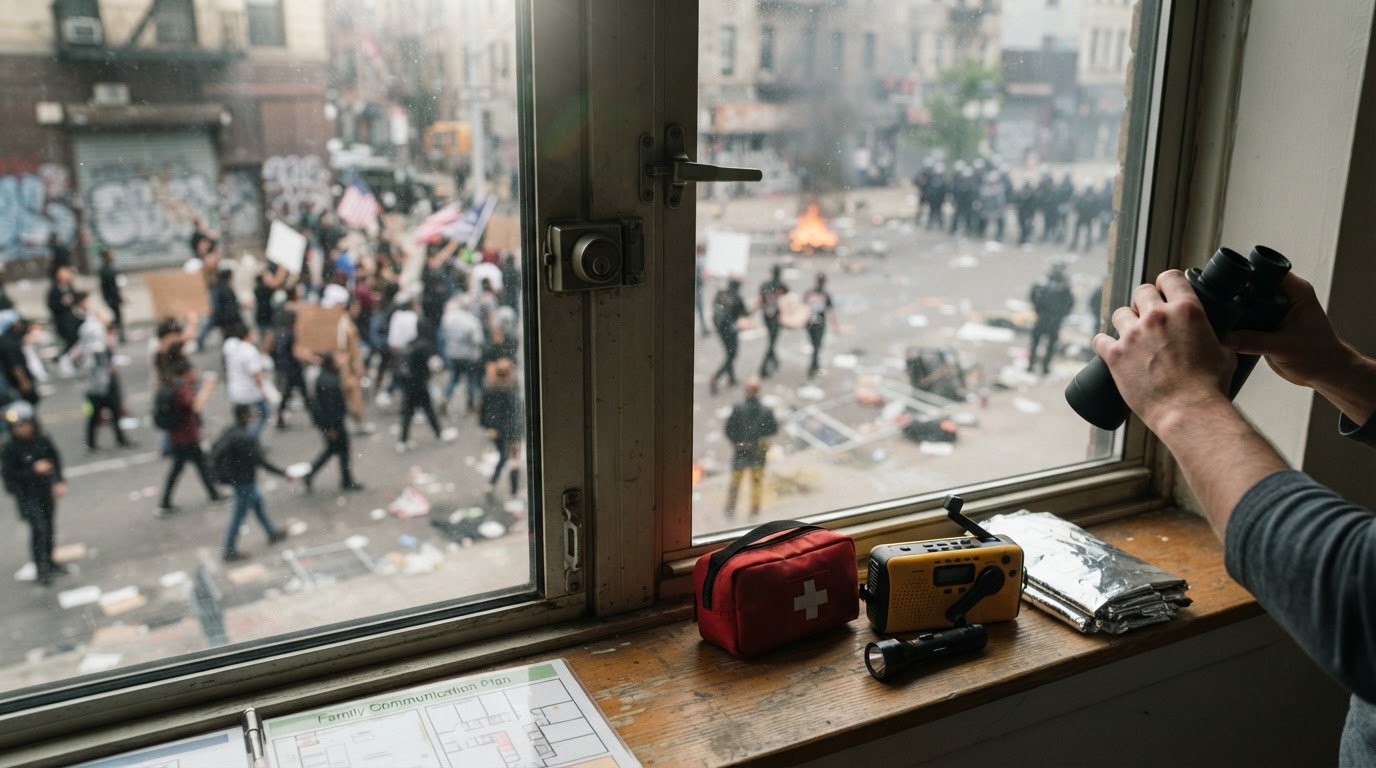
Practical civil unrest safety tips for 2026: secure your home, stay safe on the street and in crowds, and keep your family connected during protests and riots.
This article contains affiliate links. If you buy through these links, we may earn a small commission at no extra cost to you.
If civil unrest starts nearby, leave the area early if you can do so safely. If you cannot, get inside, lock the doors, move away from windows, and follow official alerts. Skip the sidewalk spectating. A charged phone, a small go bag, and a battery or crank radio cover the first few hours better than watching or confronting a crowd.
What Is Civil Unrest Safety?
Civil unrest safety is the set of precautions you take before, during, and after large-scale public demonstrations or riots. It covers four areas: securing your home, staying safe on the street, staying in communication with family, and managing the aftermath. Most of these measures are cheap and overlap with other preparedness.
Staying Safe at Home During Unrest
Your home is your best shelter during civil unrest, but only if you prepare it.
- Stay inside. Don't go outside to watch. Balconies and porches put you in sight lines. Stay behind locked doors.
- Get away from windows. Interior rooms (bathrooms, hallways, closets) are your refuge.
- Lock up and close the blinds. Lock doors and windows, close the blinds, and keep indoor lighting out of sight. Follow local guidance on exterior lights rather than advertising that anyone is home or away.
- Document valuables now. Walk through every room with your phone and upload the video to cloud storage. Insurance claims go faster with dated evidence of what you owned.
- Know your gas shutoff. Locate the valve, keep the correct tool nearby, and read your utility's instructions. Do not shut off gas preemptively. If you smell gas or hear it escaping, leave and call the utility from a safe location.
- Keep a go bag by the door. You may have minutes to leave, not hours. Our bug-out bag on a budget guide builds one for about $89 with current prices.
- Keep exits clear. Store boxes and bikes away from front and back doors.
Staying Safe on the Street
If you're outside when tensions rise, your decisions in the first few minutes matter most. Your ego doesn't matter, your exit does.
| Situation | At Home | On the Street |
|---|---|---|
| Unrest starts nearby | Stay inside, interior room, blinds closed | Move away immediately, toward exits |
| Tensions rise | Lock everything, stay low | Leave the area, don't watch or film |
| Phone | Keep charged, silent | Keep stowed and silent |
| Authorities | Follow official orders, curfews | Follow instructions, hands visible |
| Documentation | Photo/video valuables for insurance | No photos of people or crowds |
| Exit plan | Clear paths, go bag by the door | Know 2+ routes out before entering |
Street rules:
- Avoid protest zones entirely. Detours of a few blocks cost minutes and buy a lot of safety. Go around the perimeter, never through the center.
- Stay situationally aware. No headphones, no staring at your phone. Watch intersections, parked cars, and groups ahead. Scan for exits every time you stop.
- Stow your phone. A visible phone on a crowded street is a target for theft. Step into a doorway to check directions.
- Move diagonally with the crowd flow, toward the edge. Fighting the flow head-on is how people get trampled. Keep your knees bent and arms up, and don't get pinned against walls.
- Leave if tensions rise. Shouting, shoving, glass breaking: any of these means go now. Don't gather to watch.
- Cooperate with officials. Follow instructions, keep your hands visible, don't argue.
- In a vehicle, stay inside with doors locked and windows up. Never drive through crowds. If you have to move during unrest, the driving through civil unrest guide covers routes, checkpoints, and what to do if a crowd surrounds your car.
Communication Plans During Civil Unrest
When networks are congested, families without a plan panic; families with a plan act.
- Write a family plan. Decide in advance: who goes where, who picks up children, and where the meeting point is if home becomes unsafe. Write it on a card in every wallet.
- Pick an out-of-area contact. A relative in another state everyone can call to check in. Local lines jam fast; long-distance calls often still go through.
- Text over call. Texts use less bandwidth and get through when calls fail. Send one short message, not minute-by-minute narration.
- Use official alerts. Sign up for city and county alert systems (reverse 911, emergency texts) and know the local emergency radio station.
- Don't rely on social media rumors. Verify curfews, road closures, and threats against official sources before acting.
- Keep a radio handy. A battery or crank AM/FM/NOAA radio is useful when cell service fails. The Midland ER310 Emergency Radio is the household pick, with NOAA alerts, an SOS beacon, a flashlight, and replaceable-AA backup. For a car or backpack, RunningSnail MD-090 Emergency Radio adds AM/FM/NOAA, hand-crank charging, a flashlight, and USB charging for about $36. If an outage cuts power too, EcoFlow RIVER 3 Portable Power Station provides 245Wh for phones and radios and recharges from a wall outlet, car, or solar panel. Our emergency radio guide compares options.
For broader conflict-readiness, see our civilian conflict preparedness guide.
After the Unrest: Curfews and Recovery
The danger doesn't end when the news cameras leave.
- Respect curfews. Curfews run for several days after unrest. Even if the streets look calm, being out during curfew can mean trouble. Plan shopping during allowed hours.
- Check on neighbors. Elderly and disabled neighbors are most at risk, especially if power is out. Knock, ask if they need water, medication, or a phone charge.
- Document damage. Photograph everything before cleanup. Keep receipts for repairs; adjusters want a paper trail. Pre-existing documentation speeds claims.
- Report damage to authorities. File a report with local police and your city. Claims often start with those reports.
- Expect service disruption. Public transit, schools, and businesses may stay closed for days.
- Watch for secondary hazards. Broken glass, downed lines, and damaged buildings stay dangerous after the crowd leaves.
Quick Recommendations
- Best single prep: Write the family plan and out-of-area contact today, 20 minutes that protect against every scenario.
- Best home prep: Photograph and back up your valuables, locate the gas valve, and keep the utility's shutoff instructions nearby.
- Best gear prep: A battery or crank radio and a ready budget bug-out bag by the door.
- Most important habit: Stay out of protest zones entirely.
- Aftermath rule: Curfews first, neighbors second, documentation third.
A locked house, a clear exit, a family plan, and a charged radio cover most scenarios, all set up in a weekend. For related power and communication failures, also read our power outage survival guide.
Frequently asked questions
What should I do if civil unrest starts near me?
Leave the area early and calmly if you safely can, unrest is most dangerous in the first hours at flashpoints. If you cannot leave, get inside, lock up, move away from windows and exterior walls, and keep lighting low. Do not confront anyone or film from your doorstep.
What do I do if I'm caught in a crowd that's turning dangerous?
Move diagonally with the crowd's flow toward the edge, never push directly against it. Falling and trampling is the main risk. Once at the edge, step into a doorway or side street, then route home avoiding the flashpoint.
Should I shelter in place or leave during civil unrest?
Shelter in place unless your specific location is threatened: unrest is localized and usually passes in days. Leaving means traffic chokepoints and unfamiliar hotels. Leave early only if you are directly in a flashpoint zone or your home has been identified as a target.
How do I stay safe if I accidentally walk into a protest?
Turn around calmly and walk out the way you came. Do not run through the crowd, do not film, and do not argue with anyone. Once clear, cross the street or take a side street and avoid returning to the area for the rest of the day.
Should I keep cash or supplies at home for civil unrest?
A small amount of cash (ATMs and card readers can be down or crowded) plus your normal preparedness supplies: water, food, medications, and a battery or crank radio. That is enough. Unrest rarely lasts more than a few days, so a full stockpile is not required.
What is the safest way to drive through or near an affected area?
Avoid the area entirely if you can. If you are already driving, stay in your car with doors locked and windows up, keep moving slowly toward a safe route, and never roll down your window or get out to confront anyone. If police stop traffic, follow their directions with your hands visible.