
How to Shelter in Place During Conflict: A Civilian Guide 2026
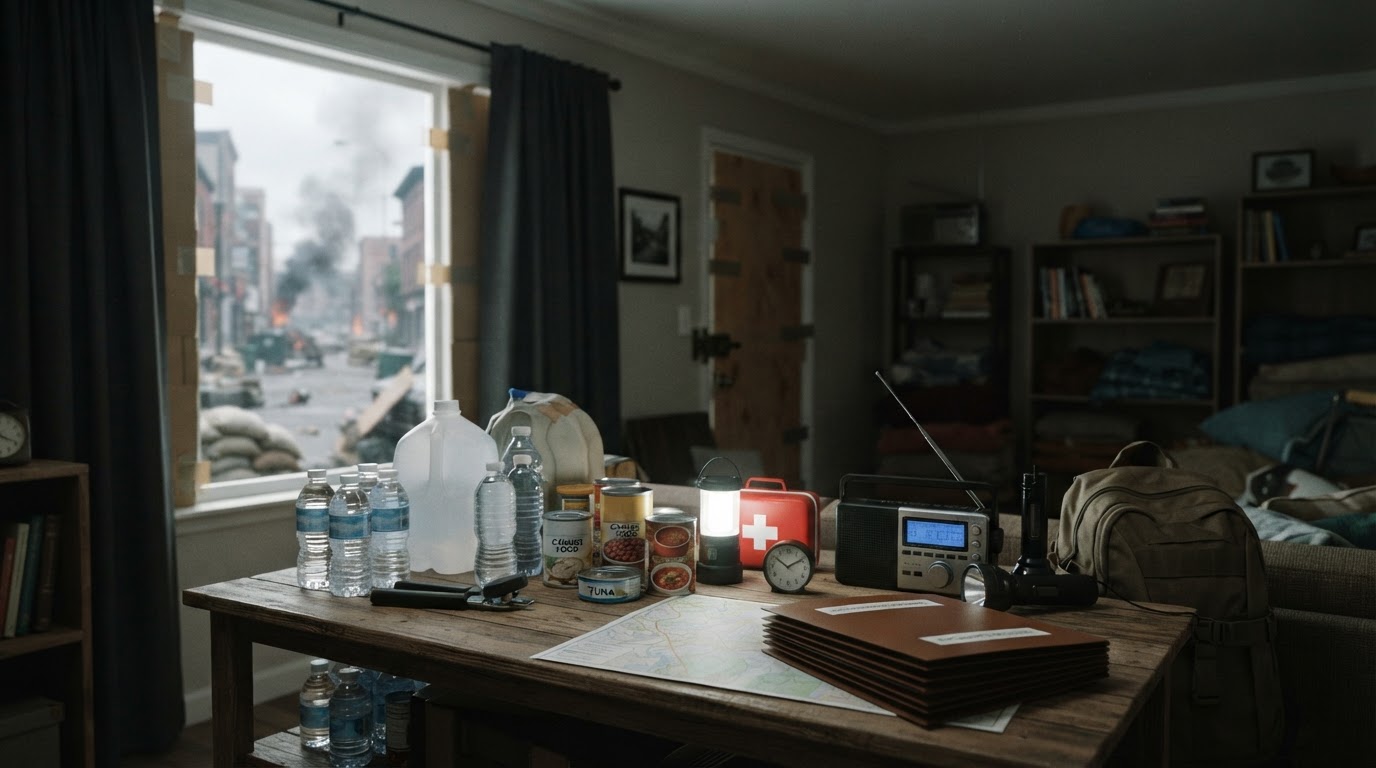
How to shelter in place during war or civil unrest: secure your home, store water and power, protect documents, and stay in contact when cell service fails.
This article contains affiliate links. If you buy through these links, we may earn a small commission at no extra cost to you.
When officials say shelter in place, they mean stay put until the all-clear, not figure it out under stress. With Red Sea shipping disrupted and states standing up rapid-response units for civil disturbances, the order is no longer a Cold War memory. A home that carries a family for a week takes an afternoon.
The short answer: pick one interior windowless room as your shelter core, keep two weeks of water and food plus a charged power station within reach, store passports and cash in a fireproof box, and make sure your family can talk when cell service fails.
Key takeaways:
- Shelter in place is the default during nearby unrest, airspace alerts, or infrastructure attacks. Leaving without orders is usually riskier.
- FEMA's baseline (1 gallon per person per day for two weeks) sizes everything else.
- If a sustained shelter-in-place order ties to a declared federal disaster, FEMA's Individuals and Households Program may help with temporary housing and replacement essentials; the apply-and-document walkthrough is in our FEMA disaster assistance guide.
What Shelter in Place Means
Shelter in place means staying inside a hardened part of your home while a threat outside passes. Unlike evacuation, you trade mobility for protection: walls, distance from glass, stored supplies, and information discipline. Ready.gov says the same in every scenario: lock doors and windows, move to an interior room, monitor official channels, do not leave until authorities say so. Our civil unrest guide covers street and home safety and our civilian conflict guide covers supply buffers; this guide turns those pieces into one shelter room.
Harden the Envelope
Do this before any alert.
- Lock and obscure. Lock all exterior doors and windows, close blinds, keep exterior lights on; a closed, lit house reads as occupied. Do not board windows without pre-cut plywood and an advisory.
- Pick the core now. Best is a large closet, bathroom, or inner hall with no exterior walls or windows. Otherwise use the room with the fewest windows and stage a mattress there.
- Know utilities. Find the gas shutoff (our earthquake gas shut-off guide shows the quarter-turn wrench method), water shutoff, and main breaker. Label with tape and test by hand. Shut gas only when told; isolate water yourself if pressure drops.
- Keep two exits clear. Keep two paths to an exterior door, go bag by one; if the order flips you move in minutes. See ultimate bug-out bag checklist.
Water, Food, and Power in the Core
Water is the limiter. FEMA and the Red Cross say 1 gallon per person per day (half drinking, half cooking and hygiene) for two weeks; for four people that is 56 gallons. Keep 3 gallons per person inside the core; store the rest in stackable containers.
Food is simple. Two weeks of shelf-stable food you already eat (rice, beans, canned soups, peanut butter, crackers) plus a manual opener, dates on the box.
Power keeps information alive. Outages are the most common conflict-adjacent disruption. A station that recharges from wall, car, or solar keeps phones, radio, CPAP, and lights running for days. The EcoFlow RIVER 3 Portable Power Station is what we stage in the core: 245Wh, 20 hours for a 10W LED strip or several phone charges, safe indoors unlike a generator. Keep it above 80 percent in the room.
| Need | Target for 4 | Location |
|---|---|---|
| Water | 56 gal (2 wks) | 12 gal in core, rest nearby |
| Food | ~168k calories | Core closet, rotate 6 mo |
| Power | 245Wh station + banks | Inside core |
| Light | Headlamp + 10W LED | Core |
Protect Documents Where Fire Cannot Reach
Keep one physical copy in your go bag and one digital set in the cloud, and give the physical set a fireproof home.
Passports, deeds, birth certificates, insurance papers, and small-bill cash all burn within minutes. A UL-classified box rated to 1550°F for 30 minutes buys firefighters time. The SentrySafe 1210 Fireproof Box is the standard: 0.18 cu ft, key lock, letter-size, about $27. Set it on the floor of an interior closet with passports, titles, a contact sheet, a USB drive with scans, and $300 to $500 in small bills. Rescan everything yearly to a password-protected cloud folder. If you must leave, move the envelope and drive.
Stay Coordinated Without Cell Service
Cell service can become congested or drop; during Hurricane Ian 63 percent of towers in the path failed.
One radio listens out. A NOAA Weather Radio with SAME alerts receives shelter, evacuation, and all-clear orders with no infrastructure. The Midland ER310 Emergency Radio is the pick: 72+ hours per charge, AM/FM/NOAA, hand crank, 85 dB alert. Keep it on 162.550 MHz in the core.
A pair talks inside the household. When members are on different floors or one steps out, GMRS keeps you linked. The Midland GXT1000VP4 GMRS Two-Way Radio Pair is a 50-channel GMRS pair with 142 privacy codes and NOAA; expect 1 to 2 miles in a built area. Program a family channel, label the radios, practice once. Keep both charged from the station and tape the contact sheet inside the core door.
When to Stay and When to Go
Shelter ends three ways: an official all-clear, an official evacuation order, or a direct threat to the building such as fire. Rumors, sirens, or a neighbor leaving are not triggers. Check two official sources (county alerts and a NOAA broadcast) before moving. If both say stay, stay. If either says go, go.
Leaving is the right call when you are in a flashpoint zone, your home has been identified as a target, or an evacuation order names your area. It is the wrong call when unrest is elsewhere or after a curfew starts. Our evacuating during civil unrest guide covers leave-early triggers, exit routes, and checkpoint rules.
Shelter-in-Place Checklist
- Core room chosen, mattress or blankets staged
- Doors and windows locked, blinds closed, lights on
- Gas, water, breaker labeled and tested
- Two exits clear, go bag by door
- Water: 3 gal per person in core, two weeks nearby
- Food: two weeks shelf-stable, opener, dates on box
- Power station above 80 percent, in core
- Radio on 162.550 MHz with alert on, crank tested
- GMRS pair on family channel and code
- Fireproof box with passports, cash, USB; cloud copies current
- Contact sheet inside core door, drill done this month
A shelter room is not a bunker. It is one interior room, honestly stocked, that lets a household wait out the hours when staying put is safest. Build it this weekend; supply math lives in our food and water storage guide.