
Military Conflict Preparedness: What Civilians Should Actually Do
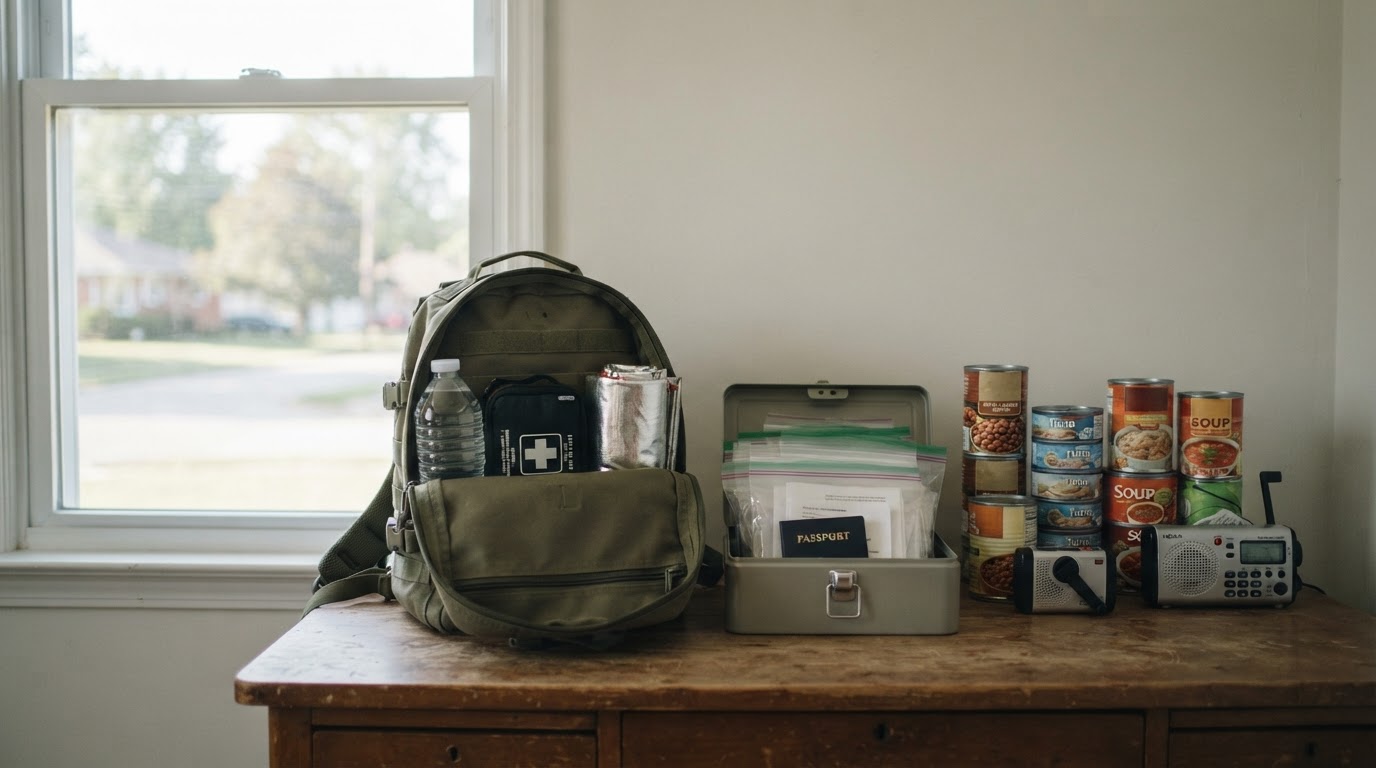
Practical conflict preparedness for civilians: two-week supply buffers, document backups, go bags, and official info channels for supply-chain shocks.
This article contains affiliate links. If you buy through these links, we may earn a small commission at no extra cost to you.
The US–Iran conflict is approaching its sixth month. As of early August 2026, fighting has expanded into shipping lanes: Houthi attacks have disrupted Red Sea traffic, UK petrol prices have climbed to their highest level since the conflict began, and the diplomatic path remains uncertain.
Conflict-driven price and supply shocks are now routine. Fuel, shipping, and the goods on those ships all react. Households with buffers absorb those reactions more easily than households that run lean. This guide covers the household baseline: supply buffers, documents, a go bag, information discipline, and backup power.
What It Looks Like on a Normal Day
Conflict preparedness barely looks like preparation. It's ordinary household planning that happens to be resilient: a stocked pantry, a full tank, copies of your documents, a plan your family has talked through once.
Conflicts rarely arrive with consumer warnings. They show up as a price on a pump, a delay on a container ship, or a shortfall on a store shelf. The FEMA baseline is two weeks of food and water, the same rule that applies to every emergency. If a conflict-related disruption escalates into a declared federal disaster, FEMA's Individuals and Households Program may cover temporary housing and replacement essentials; the walkthrough is in our FEMA disaster assistance guide.
If you keep an earthquake or hurricane kit, you are most of the way there. The conflict-specific adjustment: disruptions can last weeks and affect medicine and phone service in ways a 72-hour kit doesn't anticipate.
Start With Supply Buffers
Conflicts abroad move through global markets before they touch your neighborhood. Supply buffers insulate you from those ripple effects.
- Food and water (two weeks): The baseline. A filter like the Sawyer Squeeze Water Filtration System turns lakes, rivers, and rain barrels into drinking water once stored water runs out. Our food and water storage guide covers rotation schedules and per-person needs.
- Medications: When supply chains strain, prescription and OTC medicines tighten first. Keep a 30-day buffer of regular prescriptions (most pharmacies allow refills before the due date), plus a month of OTC basics: pain relievers like Amazon Basic Care Ibuprofen 200mg (500 Tablets), antacids such as Rugby Regular Strength Antacid Chewable Tablets…, allergy meds like Member's Mark Diphenhydramine 25 mg (600 Tablets), and a stocked first aid kit.
- Fuel: Gasoline and diesel prices are the most visible conflict ripple. Keep cars at least half full, and budget for price swings.
- Cash: 2–3 weeks of typical spending in small bills. Card networks can degrade in extended disruptions.
Put Your Documents Where You Can Reach Them
If travel, borders, or banking are affected, your documents are the difference between moving quickly and being stuck. One physical copy in a waterproof folder in your go bag; one set of digital copies in the cloud. Redo annually.
- Identity and travel: Passports valid for the foreseeable future, birth certificates, driver's licenses, visas or residency records.
- Financial: Bank and credit card contact numbers, mortgage/rent paperwork, and a note on where your cash reserves live.
- Insurance: Home, renters, auto, health, and life policies, with agent numbers.
- Household: Medical records, vaccination history, prescription lists with dosages.
Build a Go Bag and a Family Plan
Most conflict scenarios don't require evacuating. Shipping disruptions and price shocks can make you want to travel at an unpredictable moment.
A go bag is a pre-packed overnight-plus kit: clothes, hygiene items, cash, document copies, a water filter, snacks, a phone charger. Our ultimate bug out bag checklist has the full list.
Four questions for the family plan, agreed on once and reviewed yearly:
- Where do we meet if separated and phones are down? (One local spot, one outside the area.)
- How do we communicate if networks are congested or unavailable? (Out-of-town contact; long-distance lines often work when local ones don't.)
- Who grabs what in a hurry? (Go bag, documents, pets, medication lists.)
- Triggers: pre-agreed conditions that shift you from "stay" to "go."
A plan in one head isn't a plan.
Stay Informed, From Official Channels Only
Misinformation, old video passed off as new, and fabrication multiply during war coverage. The part you can prepare for in five minutes.
- Bookmark official sources: Your national emergency advisory site, national weather service, local civil defense or emergency management, reputable wire services.
- Audit your news diet: Verify anything dramatic with at least one official or primary source before acting.
- Radio as the fallback: When networks are congested or unavailable and power is out, broadcast radio is a reliable channel. The Midland ER310 Emergency Radio receives official alerts without any infrastructure beyond its own battery.
Backup Power and Communication
Disruptions are usually infrastructure strain: rolling power outages, congested phone networks, fuel deliveries prioritized away from civilians.
- Emergency radio: information and alerts. The Midland ER310 Emergency Radio runs 72+ hours on a charge.
- Portable power station: phones, medical devices like CPAP, small appliances. The EcoFlow RIVER 3 Portable Power Station is a 245Wh unit recharging from wall, car, or solar. See our power outage survival guide for sizing.
- Charging discipline: Keep phones above 80% when tensions are elevated.
- Paper backup: A printed list of key numbers in your go bag costs nothing and needs no network.
What NOT to Do
Preparedness has a failure mode: doing the wrong things in a panic.
- Don't panic-buy. Buy a two-week buffer before headlines turn scary.
- Don't stockpile fuel. Storage is regulated and dangerous unsafely; spike buying is what makes prices worse.
- Don't act on unverified rumors. Fake evacuation orders and manipulated footage multiply during conflicts. Verify through official channels.
- Don't make irreversible financial moves in panic. Selling assets or locking in commitments during a news spike is a classic mistake.
- Don't stockpile weapons. Firearms complicate insurance, transport, and legal exposure. The civilian baseline is supplies, documents, information, and communication. If you want a home-defense posture without a firearm, home defense without a firearm covers door hardening, lighting, and alarms.
Quick Recommendations
- Start here: Two weeks of food and water, medications with a 30-day buffer, cars at half tank, cash for 2–3 weeks. Covers 80% of the realistic risk.
- One afternoon project: Scan your documents, upload to a cloud folder, put a physical copy in a waterproof folder in your go bag.
- Buy these first:
- Midland ER310 Emergency Radio, information and alerts when networks fail
- EcoFlow RIVER 3 Portable Power Station, multi-day backup power
- Sawyer Squeeze Water Filtration System, clean water when stored water runs out
- Write the family plan down, with meeting points, an out-of-town contact, and triggers, and review it yearly.
Nobody knows how the conflict unfolds. Reported fact: conflicts abroad raise prices, strain shipping, and stress supply chains. Households with modest buffers absorb those shocks calmly while households without them scramble. The prep is cheap, legal, and useful in every other emergency too.
Frequently asked questions
What should civilians actually stockpile for a war-related supply shock?
Two weeks of what you already use: food you normally eat, water (a gallon per person per day), prescription refills pushed to the front, fuel kept above half a tank, and cash in small bills. Buffers beat bunkers.
Should I buy fuel and food now before prices spike?
Build the buffer at normal prices instead of panic-buying at spiked ones. Steady top-ups every shopping trip achieve the same resilience without contributing to local shortages.
How do I get reliable information during an international crisis?
Official channels only: National Weather Service, FEMA, state emergency management, and your utility or water authority for local impacts. Treat social-media war reports as unverified until confirmed by two established outlets.