
Best Home Generators for Power Outages (2026): Inverter vs Standby, Sized Right
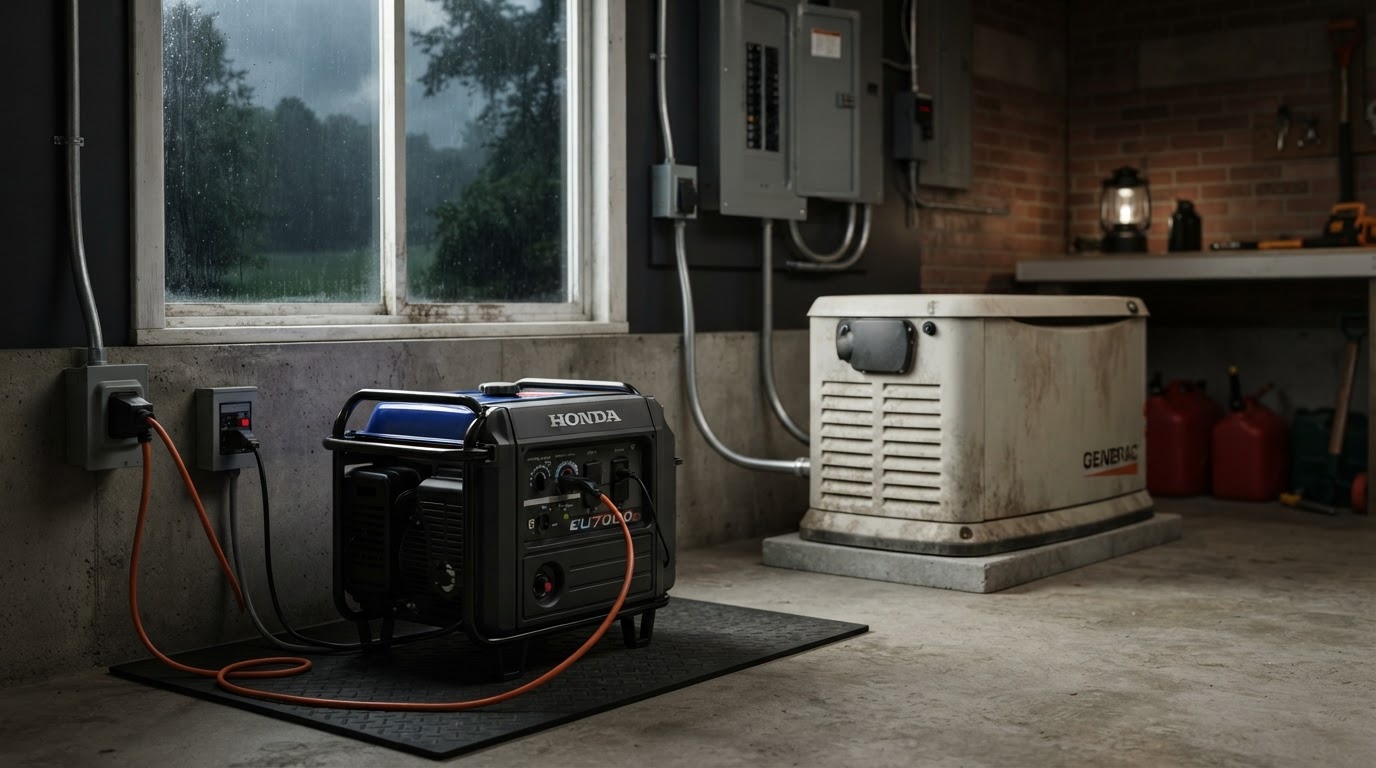
The best home generators for outages in 2026: inverter picks for essentials, standby for whole-house, real wattage math, and the safety rules that matter.
This article contains affiliate links. If you buy through these links, we may earn a small commission at no extra cost to you.
A generator is the only consumer product that keeps an entire house alive through a multi-day outage, and it's also the one that kills its owners when used carelessly. This guide covers which generator fits which home, what size you actually need, and the carbon-monoxide rules that are non-negotiable.
Quick orientation: a battery power station covers hours-to-a-day of essentials with zero fumes. Our portable power station guide covers those. A fuel generator is for multi-day outages, heavy loads (well pumps, full fridges, window AC), and whole-house coverage. Many prepared households own both: battery for the first night, generator for the long haul.
Quick Picks
| Scenario | Pick | Why |
|---|---|---|
| Fridge + lights + phones | WEN 56360i 3600-Watt Portable Inverter Generator (~$498) | Clean power for electronics, quiet, sips fuel |
| Well pump + fridge + some AC | Westinghouse 9500-Watt open-frame (~$1,100) | Real starting watts for motor loads |
| Whole-house, automatic | Generac 10kW–24kW standby ($5,000–$7,500 installed) | Starts on outage detection |
The Wattage Math (Do This Before Shopping)
Undersizing is the most common mistake. Every appliance has two numbers: running watts and starting watts (motors draw 2–3× their running rating for a second). Size to the starting total:
| Load | Running W | Starting W |
|---|---|---|
| Full-size refrigerator | 700 | 2,200 |
| Sump pump | 800 | 2,000 |
| Central AC (3-ton) | 3,500 | 8,000+ |
| Window AC (12k BTU) | 900 | 2,700 |
| Well pump (1/2 hp) | 1,000 | 2,400 |
| LED lighting (whole house) | 150 | 150 |
| Phone/laptop charging | 100 | 100 |
Most households land in one of three tiers: ~2,000–3,500W (essentials), ~7,000–9,500W (most of the house minus central AC), or 14,000W+ standby (everything, automatic). Sizing the plan around refrigeration? Our generator size for a refrigerator guide works the compressor surge math for a fridge, a freezer, or both.
Tier 1: Inverter Generators (Essentials, Quiet, Clean)
Inverters produce clean sine-wave power safe for laptops and medical devices, throttle down to sip fuel at light loads, and run conversation-quiet.
Best value: WEN DF875i / GN400i class (~$350–600). 3,000–4,000 surge watts handles fridge + freezer + lights + devices. Expect 6–8 hours per tank at moderate load. Tank size sets that number, and our generator runtime guide has the burn-rate math. The WEN 56360i 3600-Watt Portable Inverter Generator is the pick today: 2,900 running watts, parallel terminals let a second unit double capacity.
Premium pick: Honda EU3000iS, about $2,399. The benchmark for reliability and noise (roughly 58 dB at load). If you'll store it for years between uses, this is the one that starts: the Honda EU3000iS 3,000-Watt Inverter Generator is a 3,000-watt inverter (2,800 running) with CO-MINDER shutdown and up to 19.6 hours of run time on a 3.4-gallon tank.
Tier 2: Open-Frame / Large Portable (Whole-House-Minus-AC)
Best value: Westinghouse WGen9500DF class (~$1,000–1,300). The Westinghouse WGen9500DFc 12500W Dual Fuel Generator: 9,500 running / 12,500 surge watts, dual-fuel (gasoline or propane), transfer-switch outlet, remote start. Runs a well pump, full kitchen, lights, and a window AC.
Tradeoffs: 70 dB, weekly exercise runs, oil changes every 50–100 hours, and real fuel logistics (see the storage rules below).
Tier 3: Standby Generators (Automatic Whole-House)
An air-cooled standby unit wired through an automatic transfer switch detects the outage, starts itself, and switches the house over in about 30 seconds, whether you're home or not. Runs on natural gas or a large LP tank, so runtime is measured in weeks.
Costs: $5,000–$7,500 installed for 10kW–24kW air-cooled, plus annual maintenance (~$200–400 service visit). The right answer for households with medical dependencies, wells as sole water source, or anyone away from home often. Oversized for apartment-scale problems.
Fuel Storage and the Carburetor Problem
Gasoline degrades in 30–90 days untreated; stale gas is the #1 reason generators fail to start during the actual emergency:
- Store no more than 15–20 gallons (legal limits are lower in many jurisdictions), in approved cans, in a detached shed. The Midwest Can 5610 5-Gallon Gas Can, 2-Pack two-pack: CARB-compliant plastic, a flame-mitigation spout screen, and an auto-stop nozzle.
- Add fuel stabilizer (STA-BIL Fuel Stabilizer, 32 oz) at fill-up; stabilized gasoline stays fresh up to twelve months. Rotate stock into your car monthly and refill.
- Run the carburetor dry after each use, or use the fuel shutoff. Gummed carburetors are a $150 repair.
- Propane side-steps all of this: tanks store for decades. A Flame King YSN230 20-LB Steel Propane Tank with… holds about 4.7 gallons with a built-in gauge.
- For the full routine (which cans, stabilizer doses, shelf life, and where to keep it all), see our gasoline storage guide for generators.
Safety: The Non-Negotiables
Carbon monoxide from a portable generator can kill through an open window in minutes:
- Outside only. Minimum 20 feet from any door, window, or vent.
- Exhaust pointing away from the house.
- Battery CO alarms in the house are mandatory. A Kidde Battery-Powered Carbon Monoxide Detector costs less than a dinner out and is the difference between a headache and a funeral.
- Never refuel a hot or running generator.
- In rain, run it under a canopy designed for generators. A rain-rated running cover like the Westinghouse WGenTent Generator Running Cover encloses an open-frame unit while it runs, keeps rain off the outlet panel and muffler, and still moves enough air.
Installation Reality Check
Portable units need no permits but shouldn't be back-fed through a dryer outlet (it can electrocute line workers, illegal in most codes). If you want generator power through house circuits, have an electrician install a manual transfer switch (~$400–800 installed); otherwise run extension cords directly to the loads you care about. The switch itself is the part you supply: a Reliance Controls ProTran 2 like the Reliance Controls ProTran 2 Manual Transfer Switch… (30 amps, six circuits, rated 7,500 watts) runs about $299, and the rest of that $400–800 is the electrician's labor and wiring. Cord gauge matters more than brand: thin 16-gauge cords drop voltage over a long run, which makes refrigerator and freezer compressors run hot. A 12-gauge outdoor-rated cord like the Plugtul 12-Gauge Outdoor Extension Cord, 50 ft carries a full 15 amps across 50 feet.
Standby units require permits and a licensed installer, budget the electrical and gas work in the price, and confirm warranty terms require professional installation.
The Honest Recommendation
For most households: a 3,000–4,500W inverter plus 10 gallons of stabilized gasoline covers the outages that actually happen for under $600. Step up to the 9,500W dual-fuel class if you're on a well, or straight to standby if someone in the house depends on powered medical equipment. Test-run it quarterly under half load.
Frequently asked questions
What size generator do I need to run a refrigerator and freezer?
A modern fridge/freezer combo needs about 2,200 starting watts and 1,400 combined running watts, a 3,000–3,500W inverter handles it with headroom for lights and phone charging.
Can I run a generator in the rain?
Only under a purpose-built generator tent or canopy rated for wet use. Never in a garage, on a covered porch, or indoors. Carbon monoxide accumulates silently and kills quickly.
How long can a generator run continuously?
Inverters run 6–12 hours per tank at moderate load; large portables run 8–12 hours at half load. Standby units on natural gas run indefinitely with scheduled oil-change shutdowns every 50–200 hours.