
What to Do Right After a Car Accident: First 15 Minutes, Evidence, and the Police Report
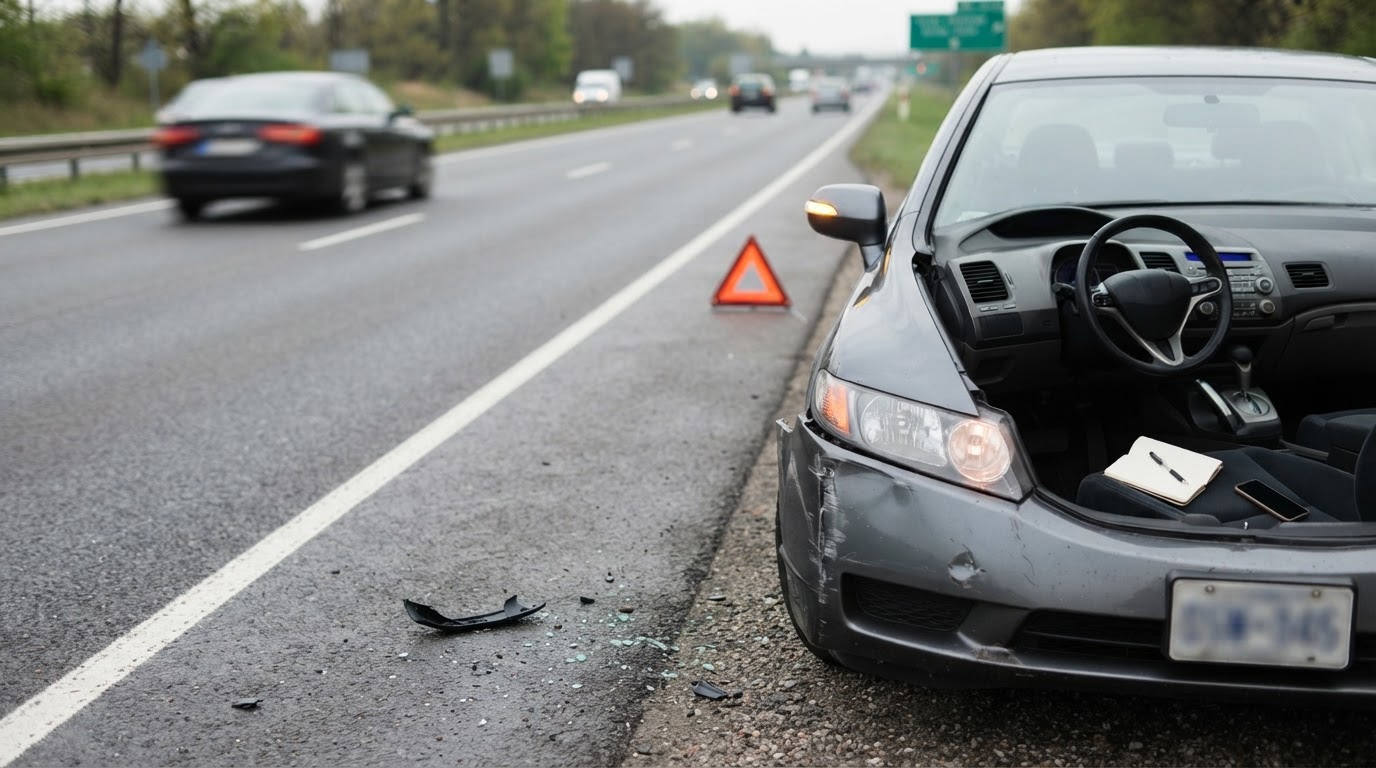
Car accident first steps: shut the engine, get out of traffic, call 911, document before you move, exchange without admitting fault, then decide drive or tow.
This article contains affiliate links. If you buy through these links, we may earn a small commission at no extra cost to you.
The first 15 minutes after a crash decide whether the claim goes smoothly or gets fought for two years. A driver who stays calm, gets the car off the road if it is safe to do so, calls 911 even for a parking-lot bump, and photographs the scene before anyone moves a vehicle usually gets the claim paid. A driver who says "I'm so sorry, that was my fault" on the sidewalk usually fights the same claim for months. This is the order that works.
Safety First, People Second, Paperwork Last
Cut the ignition the moment you can. A running engine after a front-end collision can pump gasoline onto a hot manifold, and a hybrid can move silently if the high-voltage system thinks you are still driving. Set your hazards before you open the door. If the car is in a travel lane and you can safely move it onto the shoulder, do it; if it is on a divided highway, leave it where it is unless it is leaking fuel and you can walk back to it. Get yourself and your passengers out of the traffic lane and onto the shoulder, behind a jersey barrier if there is one.
Check the people before the cars. The stop-severe-bleeding guide covers what to do when someone is spurting or pooling blood, but the first rule is the same as on the trail: scene safety first, then airway, then the wound. If anyone hit their head, do not move them unless the car is on fire. Call 911 and stay on the line.
Call 911 Even for Minor Damage
A police report is what your adjuster will ask for first, even if everyone is fine and both cars still drive. In many jurisdictions the reporting threshold is $1,000 in damage, and most repairs cross that line, but the rule of thumb is simpler: if you want a clean claim, you want a report. The dispatcher will tell you whether an officer is coming or whether to file at a station later; either way, write down the incident number before you hang up.
Take your warning triangles out of the trunk. A CARTMAN Foldable Warning Triangles, DOT-Approved… setup 30, 60, and 90 feet behind your car gives the driver behind you three chances to see you and slow down. Set them before you start photographing, not after, because you want the triangles in the wide photos of the scene.
Photograph Everything Before Anyone Moves
Wide shots first, details second. Stand back far enough to fit both bumpers, the lane lines, and the skid marks in one frame, then take four wide shots, one from each corner of the scene. License plates next, both cars, close enough that the plate numbers are readable. Then the cars themselves: every panel that touched, every panel that did not, with a coin or your phone next to the damage for scale. The road: skid marks, debris field, signal phase if you are at an intersection, weather, sun glare, anything that helps the adjuster reconstruct what happened.
If the crash involved a fuel leak or a ruptured tank, smell for gasoline and step away if you can. The gas leak guide covers when to evacuate the scene entirely.
Exchange Information Without Admitting Fault
Driver's license, insurance card, phone number, plate number, year/make/model. If there are witnesses, get their names and phone numbers; they are worth more than the police report when the other driver changes their story a week later. Be polite, be brief, and do not discuss how the crash happened. Do not say "I'm sorry" or "I didn't see you" or "that was my fault" even casually, even if you think it was. Insurance companies take any of those phrases as admissions, and you do not know yet what the police report will say.
Tell your insurer within 24 hours. Most policies require notice "as soon as practicable," and a phone call the next morning counts. If the other driver is at fault, you file under their property-and-casualty policy, and yours may still cover the medical under med-pay or PIP depending on your state.
Drive or Tow: The Honest Decision
Any of these means the car goes on a flatbed, not on the road. Visible fluid leak under the engine bay. Any airbag deployed, because the sensors that fired the bag are not designed to deploy a second time in a future crash. Steering wobble or pulling to one side, which usually means a bent control arm. Warning lights on the dash that were not on before the crash. Smoke or sharp chemical smell from the engine bay. If you can start the car and it idles smoothly, the steering is straight, and nothing is leaking, you can drive it, but check tire pressure before you leave. The EPAuto 12V Portable Air Compressor plugs into the cigarette lighter, reads the gauge off the same cord, and tops up a soft tire to spec in a few minutes; a flat from the crash is a common surprise that turns a drivable car into a tow.
If the other driver's battery is dead from the impact and you can safely cross traffic to help, a NOCO Boost GB40 1000A Jump Starter jump starter is the cleaner answer than jumper cables, because it is spark-proof and you do not have to position two cars nose-to-nose in a live lane.
After You Get Home
Save the photos, the police report number, and the other driver's insurance card scan to the Anker Power Bank 10,000mAh USB-C-backed folder on your phone and to a cloud drive. Photograph any injuries the next day; bruises and seatbelt welts show up after the adrenaline wears off, and they help the medical portion of the claim. If a rental car is not in your policy, ask the other insurer about loss-of-use coverage before you pay out of pocket.
The best car emergency kit covers what to keep in the trunk so this checklist is not a scramble: triangles, inflator, jump starter, power bank, flashlight, and a printed accident-report form so you are not writing on a napkin at the scene.