
Wildfire Insurance Claims: What Homeowners Policies Pay After a Fire
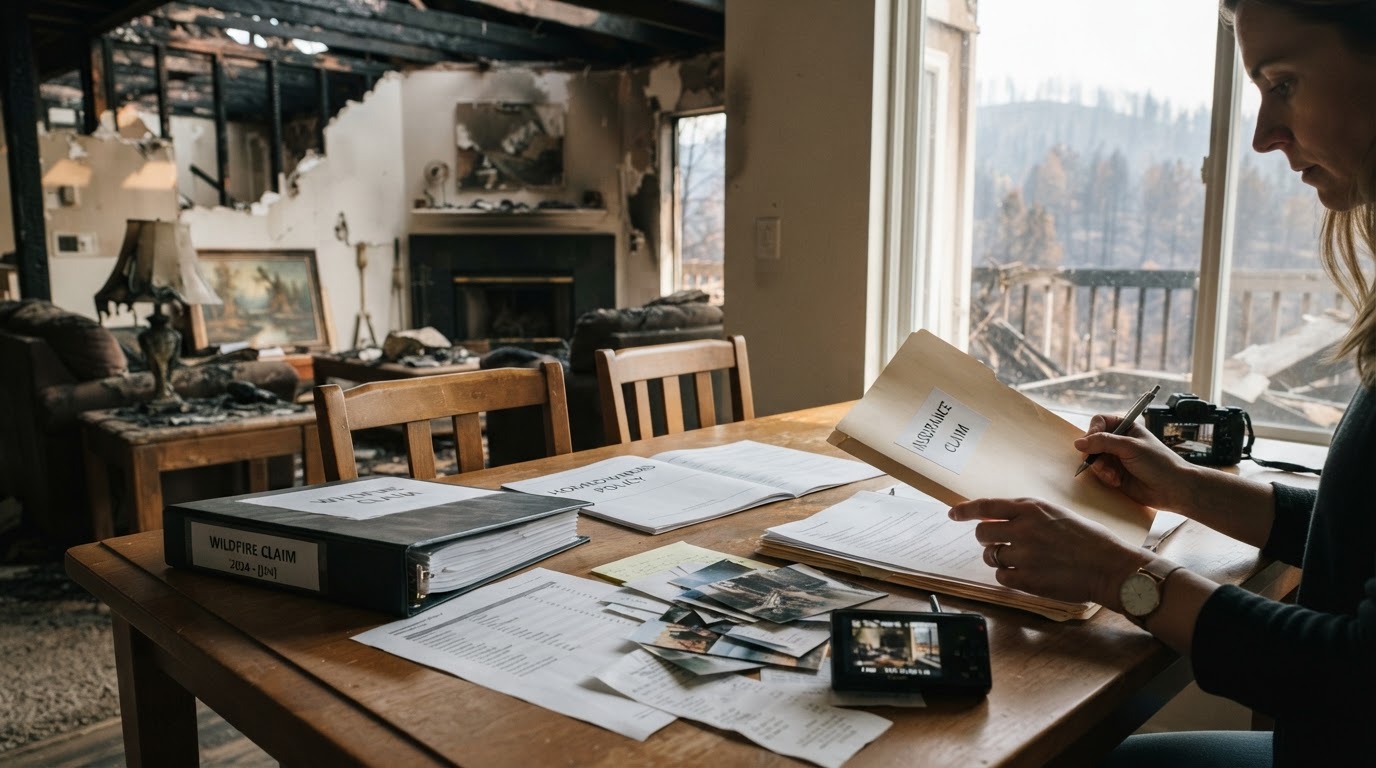
Does homeowners insurance cover wildfire damage? Yes, for fire and smoke. What a payout includes, the underinsurance trap, and the documentation a claim needs.
This article contains affiliate links. If you buy through these links, we may earn a small commission at no extra cost to you.
The direct answer: standard homeowners policies such as HO-3 typically cover wildfire damage from flames, smoke, soot, and ash, according to the National Association of Insurance Commissioners. Payment still depends on the policy's limits, deductible, exclusions, and documented loss. Renters policies generally cover belongings and loss of use, not the landlord's building. The hard part is arithmetic, caps, and proof.
This is the wildfire leg of our claims family: the flood insurance guide covers rising water, the tornado claims guide covers wind, and the earthquake claims guide covers shaking. Below is what a wildfire claim pays, where the limits bite, and the evidence that settles it.
What wildfire insurance covers
- Standard homeowners policies typically cover fire and smoke damage. High-risk properties may rely on residual-market or standalone fire coverage with different terms, so read the policy.
- An official evacuation order may trigger additional living expense coverage under some policies, but conditions vary. Check the civil-authority and loss-of-use terms.
- A licensed car is generally handled by auto insurance; fire damage is usually covered only if the auto policy includes comprehensive coverage.
- Renters policies generally cover belongings and loss of use; the building itself is the landlord's claim.
What the policy actually pays
- Dwelling (Coverage A): repair or rebuild up to the applicable policy limit.
- Other structures: the Insurance Information Institute says coverage is generally about 10 percent of the dwelling limit for fences, sheds, and detached garages.
- Contents: Triple-I says personal-property coverage is generally 50 to 70 percent of the dwelling limit. Payment may start at actual cash value unless the policy includes replacement-cost coverage.
- ALE: hotel, meals, laundry, pet boarding, and other costs above normal spending when a covered loss makes the home unsafe. The declarations page and policy set the dollar and time limits.
- Deductible: some carriers apply a separate wildfire deductible, sometimes a percentage of the insured value rather than a flat amount. Two percent on a $400,000 home is $8,000 before coverage starts, so find that line now.
The underinsurance trap
The dwelling limit is the base ceiling unless an extended- or guaranteed-replacement-cost provision applies. A rebuild can cost more than the policy limit after a large fire drives up labor and material costs. Ask your agent to compare the limit with a current local reconstruction estimate and explain whether extra replacement-cost coverage is available. Some states offer residual-market plans for properties that cannot find voluntary coverage. Availability and terms vary; California's FAIR Plan is one example, not a national rule.
Document like the adjuster is coming
Claims are paid on evidence, so work in this order:
- Notify the insurer promptly, then save the claim number and its instructions in writing.
- Once local authorities say it is safe to enter, photograph and video before cleanup: every room, closet, appliance serial plate, and the debris field with the house in frame. Our wildfire re-entry guide sequences the safe homecoming.
- Build a room-by-room inventory with item, brand, model, year, and price. No receipts? Credit card statements and photos do heavy lifting.
- Keep every receipt, from hotel nights to the tarp you bought at 2 a.m. Emergency repairs that stop further damage may be covered when documented; check the insurer's instructions before spending...[truncated]
- Do not discard damaged items unless they pose a health or safety hazard. Photograph them first and ask the insurer how to proceed.
Keep originals together in a document bag that adds heat and splash resistance, such as DocSafe Fireproof Document Bag (~$19.98), or use the UL-rated SentrySafe 1210 Fireproof Box fire chest (~$27). Store scans offsite and on a Samsung BAR Plus 128GB USB 3.1 Flash Drive (~$50), then sort the inventory and receipts in a Sooez Accordion File Organizer with Zipper… (~$13).
Deadlines, low offers, second opinions
- In California, after receiving proof of claim, an insurer generally must accept or deny the claim within 40 calendar days. If it needs more time, it must give written notice and repeat that notice every 30 days until it decides (Cal. Code Regs. tit. 10, section 2695.7(b), (c)(1)). Other states' deadlines differ.
- A first offer is a starting point. Ask for the line-item estimate and the policy language behind each deduction, then submit contractor quotes and appeal in writing.
- Watch the suit-limitation clause, often one year from the loss, and ask whether your state paused deadlines after a declared disaster.
- Public adjusters commonly charge a percentage of the settlement, but fees and caps vary by state. Read the contract and your state insurance department's rules. Start with free help from the department's consumer services office and United Policyholders, a nonprofit with per-disaster claim guides.
How FEMA may supplement insurance
FEMA cannot duplicate insurance payments. File the insurance claim promptly and apply once FEMA opens assistance for your disaster. FEMA says it may help with eligible uninsured or underinsured losses, exhausted additional-living-expense coverage, or a delayed claim, subject to the program rules and that disaster's deadline. Our FEMA disaster assistance guide walks through the application and appeal.
The one-page version
- Declarations page: dwelling limit, contents percentage, ALE limit, deductible type
- A walk-and-talk video of the whole home, uploaded offsite
- Claim number and insurer instructions saved in writing
- Photos before cleanup, receipts for every dollar
- A written appeal with contractor quotes if the first offer is low
Before a fire, review the declarations page and keep a current home inventory. After one, photograph the damage, save every receipt, and follow the insurer's claim instructions. Start with the declarations page this weekend.