
How to Prep for a Public Safety Power Shutoff (2026)
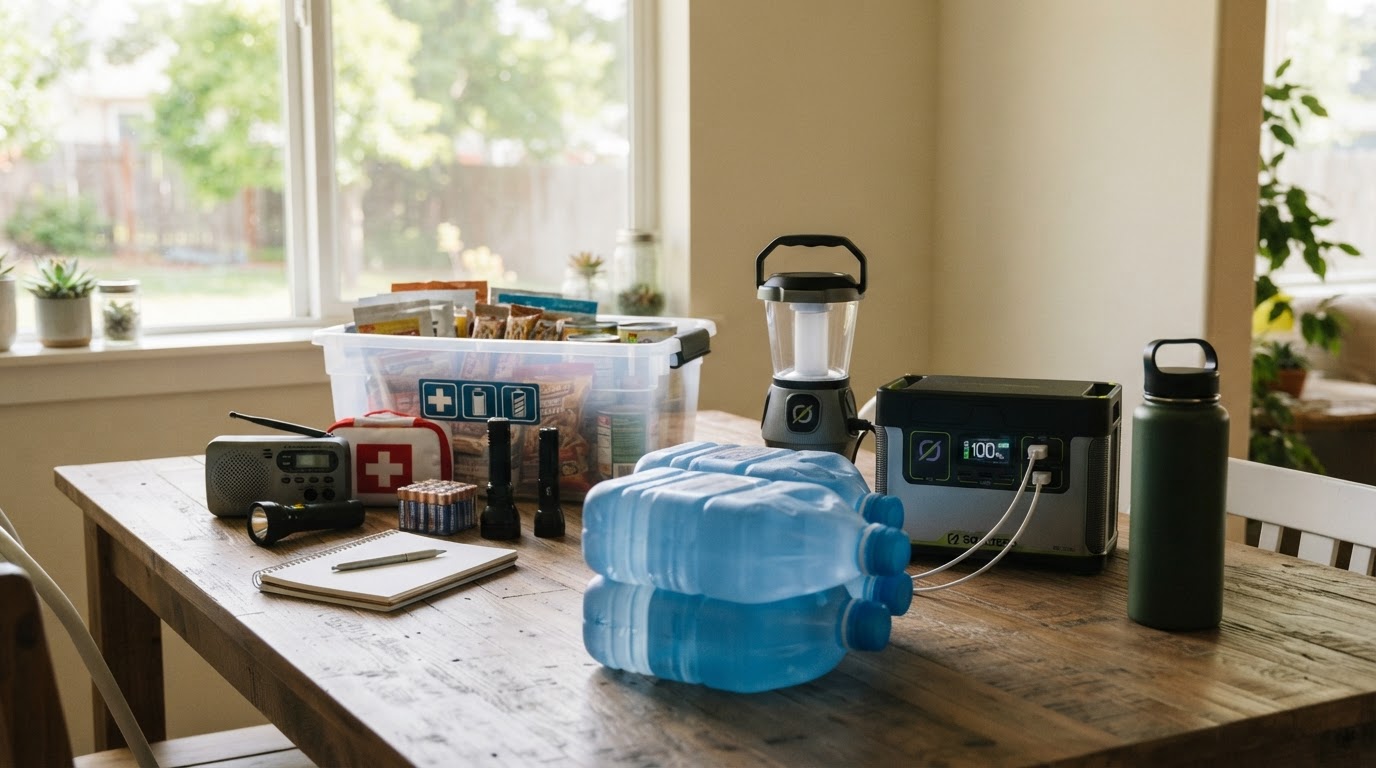
Public Safety Power Shutoffs can keep your power off for days. Use the notice window to charge, pre-cool, stock water, and plan. Full checklist inside.
This article contains affiliate links. If you buy through these links, we may earn a small commission at no extra cost to you.
A public safety power shutoff (PSPS) is the utility switching your power off on purpose, before fire weather can turn a wind-damaged line into a wildfire. You usually get a day or two of notice, and that window is the whole point. In order: charge everything, stock water, pre-cool the house, plan the food, set up comms. Do those five and a shutoff becomes a long weekend, not an emergency.
What a PSPS Is and Why It Happens
Fire weather means three things at once: strong wind, low humidity, dry vegetation. When those line up, a tree limb brushing a power line can throw a spark into ready-to-burn fuel. Utilities answer by de-energizing whole circuits before the wind arrives, so the line has no current to arc. In 2019, Pacific Gas & Electric shut off power to about 2.5 million customers at its shutoff peak. This is not a rare curiosity; it is an established tool of fire season.
A PSPS is not a breakdown. It is a calculated decision, and fighting it wastes your best asset, the notice. Restoration is the slow part: crews patrol every mile of de-energized line before they can safely flip the power back on. That is why estimates slip, why a "12-hour" shutoff becomes two days, and why you should plan for the longest timeline the utility mentions, not the shortest.
The Notice: What to Watch and Where It Comes From
Shutoff alerts go out by text, email, and automated phone call, but only if you are signed up. Find your utility's wildfire or PSPS page during calm weather and add every family member's number. Utilities also publish maps by zip code showing which neighborhoods are under consideration, so you can watch your area days before any decision.
The other early warning is the weather itself. A red flag warning is the forecasters' way of saying "shutoff weather," and utilities routinely announce possible shutoffs that lock in as the wind forecast firms up. Treat a possible shutoff as real and start the checklist. Preparing for a shutoff that never comes costs an hour; skipping one that does costs days without power.
The 24-Hour Checklist
Work through these in order. They take about an hour total.
1. Charge everything. Phones, laptops, power banks, radios, rechargeable fans. The layer between your wall outlets and your devices is a battery station: a EcoFlow RIVER 3 Portable Power Station (245Wh) runs phones and a radio for days, keeps a CPAP going through the night, and recharges from your car's 12V outlet if the shutoff drags on. Charge it the day the notice lands, not the morning it goes dark.
2. Stock water. Fill every jug, pitcher, and pot, and fill the bathtub for flushing if you have one. The math of how much to keep on hand is in our two-week water budget guide. On a well, this is the whole story: no power means no pump, so stored water covers drinking, cooking, and flushing for the entire shutoff.
3. Pre-cool the house. Run the air conditioning hard while the grid still works, then close blinds and curtains to keep the cool in. Your house is a thermal battery; fill it early. Put a AMACOOL 10 Inch Foldable Rechargeable Oscillating… on its charger now and run it later off its own battery; it folds flat for storage. The room-by-room cooling method lives in our stay cool without power guide.
4. Deal with the food. Freeze a couple of water bottles today: they hold the fridge cold when the power dies and give you drinking water later. Know the fridge and freezer timelines before you need them in our how long does food last without power guide. Cook what will spoil first, or move it to the freezer while it still runs.
5. Set up comms. A Midland ER310 Emergency Radio NOAA radio (72-plus hour battery) keeps weather and shutoff updates coming when the cell network is congested, which it may be. Stock Energizer MAX AA Batteries, 24 Count batteries beside it; a pack has a 10-year shelf life, so it can just sit there. Text instead of calling; texts often get through congested towers more reliably. Plan to check on any neighbor without a phone.
6. Handle medical needs. Refill prescriptions before the shutoff; pharmacy registers and their internet die too. If anyone uses a CPAP or other powered medical device, match it with a battery plan and test it before fire season. Keep insulin and other temperature-sensitive medicine in the fridge until the power goes, then in a cooler with the frozen bottles.
7. Get cash and gas. Fill the car tank and take out cash. ATMs, card readers, and gas pumps all need power, and lines at the stations that still work get long fast.
8. Know your generator rules. If you own a gas generator, it runs outdoors only, at least 20 feet from doors and windows, with a battery-powered CO alarm like the Kidde Battery-Powered Carbon Monoxide Detector (about $23) nearby. Carbon monoxide kills more people in outages than the outage does. A battery station covers most households without the fuel dance, but if a generator is your setup, the rules are not optional.
When the Power Actually Goes Out
Treat the shutoff like any other outage: keep the fridge closed, use one light at a time, conserve device battery. Our power outage survival guide is the full playbook, and our emergency lighting guide covers running a dark house without candles. The one PSPS twist is the timeline: expect it to stretch, because crews restore lines only after the wind dies and every mile is inspected. If you see a downed line, treat it as live, report it to the utility, and call 911 if it is sparking or blocking a road.
When the Power Comes Back
Restore the battery: refreeze the water bottles, recharge the station, the fan, and the radio, restock the AA drawer, refill the jugs. Fire weather runs into fall, and one shutoff is usually not the season's only one. The household that treats the all-clear as setup for the next round is the one that stops noticing shutoffs at all.
Frequently asked questions
How much notice do I get before a public safety power shutoff?
Usually a day or two, sometimes less. Utilities aim to warn customers 24 to 48 hours ahead by text, email, and phone, then follow up when the shutoff starts. Sign up for your utility alert list before fire season, because the notice is the whole point of a PSPS: it turns an unplanned outage into a planned one.
Will my cell phone still work during a shutoff?
Probably, but expect congestion. Cell towers carry backup batteries, yet everyone on your block reaches for their phone at once, so calls drop and data crawls. Texts use far less bandwidth and usually get through when calls do not. Keep your phone on low power and let the NOAA radio carry the alerts.
Do PSPS shutoffs happen outside California?
The name is California's, but the practice is spreading. Utilities in other fire-prone states now do the same calculation: when wind, heat, and dry fuel line up, they de-energize lines before they can spark. Check your utility's wildfire or outage page to see if you are in a shutoff zone.
Do I need to unplug electronics before a shutoff?
No, and leave breakers on. PSPS is a controlled de-energization, so the surge risk that comes with unplanned outages mostly does not apply, and an untouched panel means your house comes back the moment the utility restores the line. Protect anything sensitive with a surge strip.
Will my chest freezer stay frozen for two days?
A full freezer holds food safely for about 48 hours with the door shut, and a half-full one roughly half that. That is why the checklist says to freeze water bottles and cook what will spoil first: know the timelines before the power dies.
Can I use my car to power the house?
Only through a proper inverter rated for the load, never by dangling cables into the house. The cleaner route for most households is a battery station recharged from the car's 12V outlet, which is exactly what it is designed for.