
Wildfire Smoke Safety: How to Protect Your Family and Home
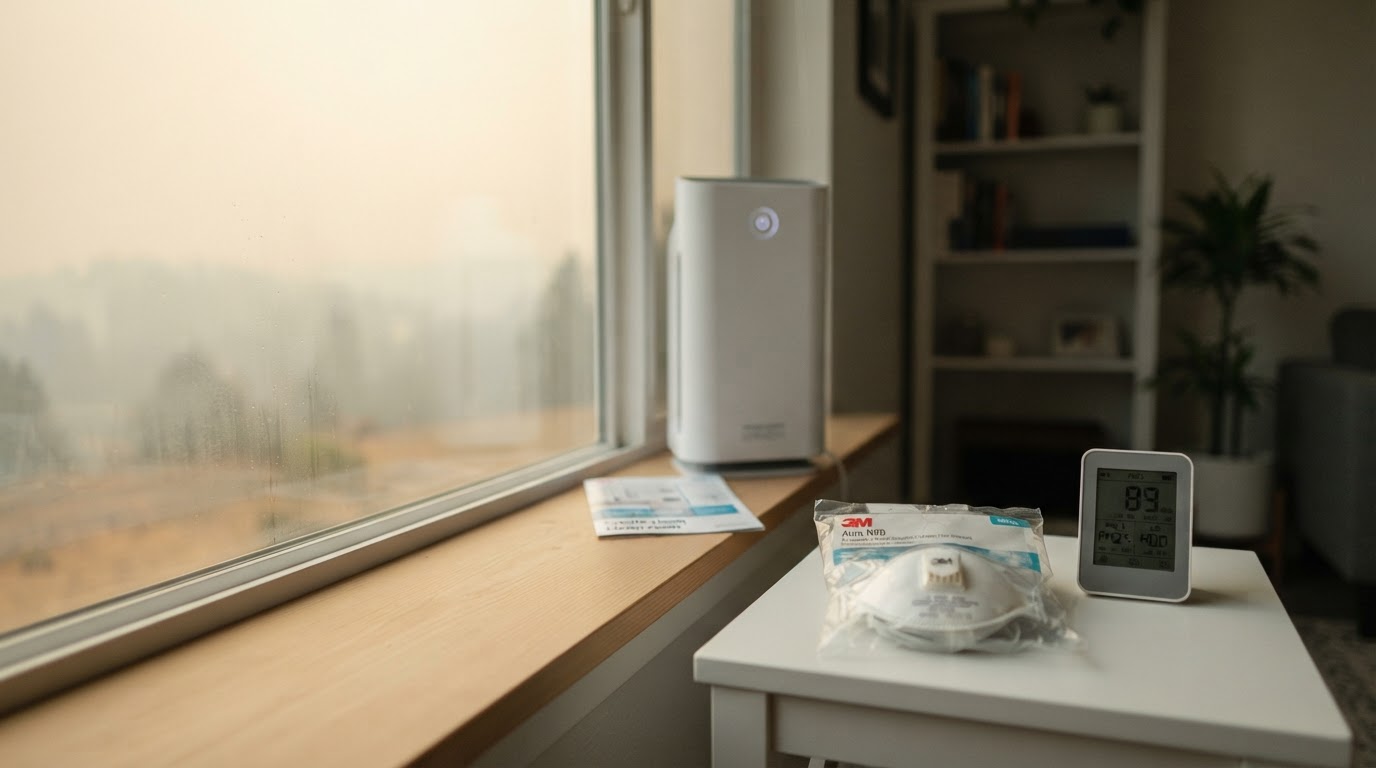
Wildfire smoke can reach you hundreds of miles from the flames. Learn to read AQI levels, choose N95 masks and HEPA purifiers, and build a clean-air room.
This article contains affiliate links. If you buy through these links, we may earn a small commission at no extra cost to you.
Wildfire smoke can send people to emergency departments hundreds of miles from the flames. Check the AQI every morning and night, move everyone into cleaner indoor air once it reaches unhealthy levels, run a HEPA purifier in one small room, and wear a well-sealed N95 when you must spend time outside in smoke.
What the AQI Levels Mean
The Air Quality Index (AQI) is your smoke dashboard. Apps like AirNow, IQAir, and local weather services publish it; smoke AQI can swing from "moderate" to "hazardous" in an afternoon, so check it twice a day during fire season. Here's what each level means:
| AQI | Category | Who's at risk | What to do |
|---|---|---|---|
| 0–50 | Good | No one | Normal outdoor activity |
| 51–100 | Moderate | Very sensitive people | Sensitive groups cut prolonged exertion |
| 101–150 | Unhealthy for Sensitive | Children, elderly, pregnant, anyone with heart/lung disease | Sensitive groups stay indoors; everyone else limits exertion |
| 151–200 | Unhealthy | Everyone | Everyone reduces outdoor time; wear an N95 outdoors; sensitive groups stay inside |
| 201–300 | Very Unhealthy | Everyone | Stay indoors; keep windows closed; run air purifiers |
| 301–500 | Hazardous | Everyone | Stay inside with a clean-air room; consider evacuating |
N95 Masks: What Works and What Doesn't
Cloth masks and bandanas do not filter wildfire smoke, and surgical masks leak at the edges. A well-fitting NIOSH-approved N95 filters at least 95% of airborne particles. The 3M Aura N95 Particulate Respirator 9205+ is a 3-panel flat-fold model; check the seal on every face before relying on it.
Correct N95 use: place it over nose and mouth, pinch the nose wire, hook both straps (over your crown and behind your neck), and do a seal check by inhaling sharply. If air leaks, it isn't protecting you. Damp masks go in the trash.
A few caveats:
- Children: NIOSH does not approve respirators for children, and adult N95s often do not seal on smaller faces. Keep children in filtered indoor air and ask a pediatrician or local public-health agency about options instead of assuming a small adult model fits.
- Smaller adult faces: if a standard N95 leaks at the cheeks, the 3M Health Care 1860S Small N95 Particulate… is the 3M 1860 in size Small; run the same seal check. It fits smaller adult faces, not children.
- Facial hair: Hair that crosses the sealing surface breaks the fit on disposable and reusable half-mask respirators. The GVS Elipse SPR457 P100 Respirator is a reusable P100 option for clean-shaven adults, not a workaround for a beard.
- KN95s are a fallback if NIOSH-approved N95s are sold out; buy from a trusted brand and seal-check. The POWECOM KN95 Face Mask for Adults (10-Pack) is a 10-pack sold by Bona Fide Masks, Powecom's exclusive US distributor, for about $11.50. They meet China's GB2626-2019 standard rather than NIOSH's, so keep them as a backup layer and run the same seal check before trusting one.
When to wear one: EPA recommends a properly fitting N95 or P100 when you must spend extended time outside in smoky air or ash. A respirator reduces particle exposure but does not make hazardous air safe.
HEPA Air Purifiers: How to Size Them
The single best indoor defense is a HEPA air purifier. A HEPA filter captures at least 99.97% of 0.3-micron particles; PM2.5 is the broader category of particles up to 2.5 microns. Avoid vague "HEPA-type" or "HEPA-like" labels. Look for a tested CADR rating.
Sizing rule of thumb: pick a purifier whose CADR (in CFM) is at least two-thirds of your room's square footage. A 150 sq ft bedroom needs a CADR of about 100 CFM or more. Run it continuously on high during smoke events with windows and doors closed; check the filter after the event.
Our pick for a bedroom-sized purifier is the Levoit Core 300 Air Purifier at about $81, with a smoke CADR listed at 141 CFM.
Power outage problem: purifiers need electricity, and smoke events can overlap with power loss. The EcoFlow RIVER 3 Portable Power Station is a 245Wh power station that can run a small purifier for a limited time and recharge from a car. It runs about $249 at the current listing. Plan the rest with our power outage survival guide.
Create a Clean-Air Room
When the AQI goes red or worse, don't purify the whole house, purify one room and spend your time there.
- Pick the smallest room with the fewest windows.
- Seal it up: close windows and doors, block under-door gaps with towels, cover window gaps with painters tape; a roll like ScotchBlue 2090 Painters Tape, 0.94 in x 60 yd, 4… sticks to glass, painted wood, and metal without leaving residue, about $18 for four 60-yard rolls.
- Run your HEPA purifier 24/7 on high. Open windows or a window fan will pull particles in.
- Stock it: water, snacks, medications, chargers, and entertainment for kids.
If your home has central heating and cooling, swap the filter for MERV-13 and run the fan on "on" instead of "auto." MERV-13 captures most smoke-size particles; cheap fiberglass filters catch only 10 to 35 percent. Stock spares before fire season: the Filterbuy 20x20x1 MERV 13 Air Filter (2-Pack) two-pack runs about $34. Match the size on your current filter's frame.
The Amazon Smart Air Quality Monitor tracks indoor PM2.5, which helps show whether smoke is building in the room overnight.
Skip the Outdoor Workout
Exercising in smoke multiplies the harm. Heavy breathing pulls 5 to 10 times more particles deep into your lungs than sitting still. Move workouts indoors to a filtered space, or skip them until AQI drops below 100.
Children, the Elderly, and Pets
Children, older adults, pregnant people, and anyone with heart or lung disease face more risk from smoke. Watch for chest tightness, shortness of breath, or confusion. Bring pets inside as air quality worsens. Birds are especially sensitive to airborne irritants, so keep their cage in a filtered room away from doors and windows. Our small pets emergency guide covers birds, reptiles, and small mammals.
When Bad Air Alone Should Trigger Evacuation
Air quality alone may justify relocating when smoke stays hazardous and your home cannot keep indoor air cleaner, especially for a baby or someone with asthma, COPD, or heart disease. Check local public-health advice and leave for cleaner air before roads worsen if you decide to go. An evacuation warning or order always takes priority over the AQI. The full go-bag order is in our wildfire evacuation checklist. Once out, clean and dress any cuts with our emergency wound care guide.
Quick Recommendations
- Best first purchase: the Levoit Core 300 Air Purifier HEPA purifier for your main bedroom, about $81.
- For power outages: a EcoFlow RIVER 3 Portable Power Station power station keeps your purifier running when the grid doesn't.
- For the household: keep well-fitting N95s for adults. For children, prioritize filtered indoor air and follow pediatric or public-health guidance.
- The free stuff that matters: check AQI every morning and close windows early.