
What to Do When Fog Closes In on the Road
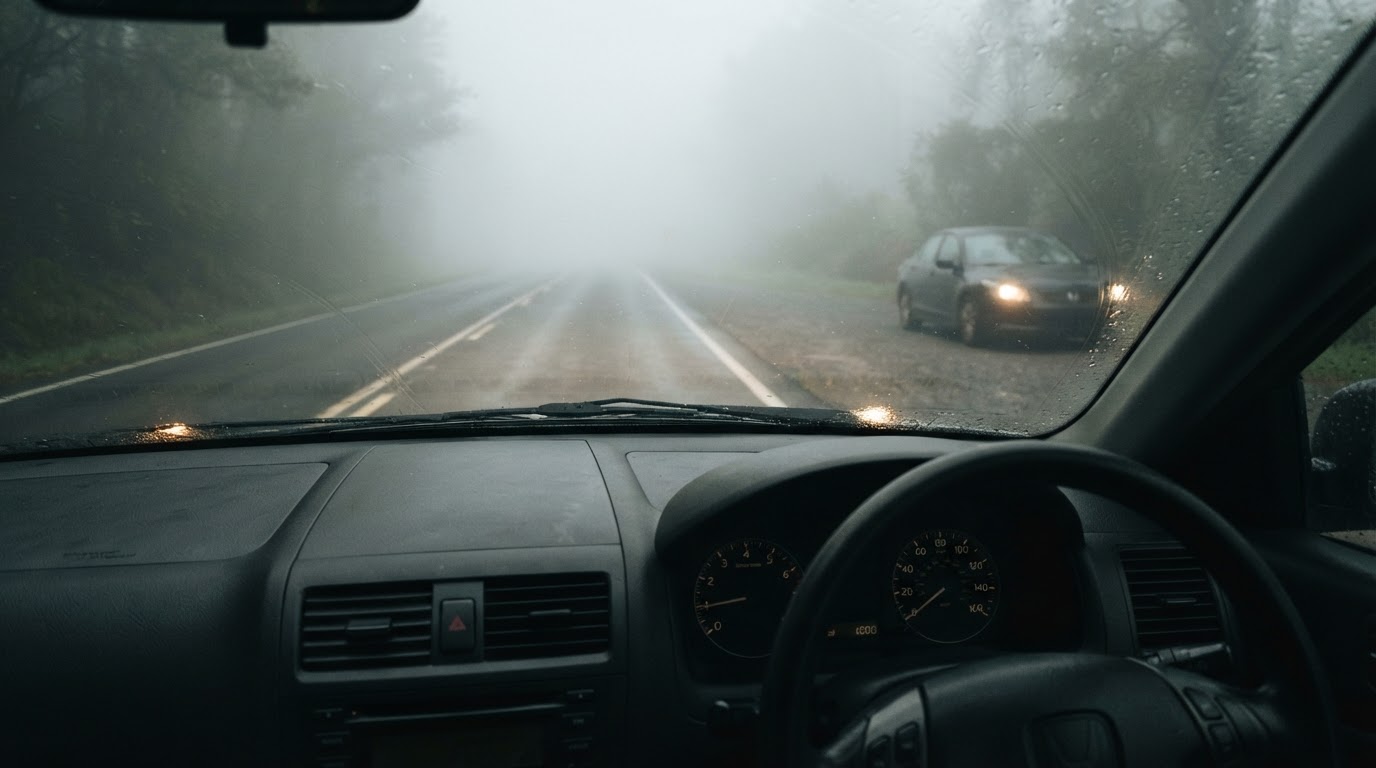
Dense fog means visibility under a quarter mile. Slow down, run low beams with fog lights, double your gap, and pull off before the road decides for you.
This article contains affiliate links. If you buy through these links, we may earn a small commission at no extra cost to you.
Fog takes a road you know and turns it strange. Signs appear late, brake lights bloom out of gray, and the car ahead is closer than it looked. Most fog pileups share one cause: somebody drove faster than they could see, per Army safety guidance. Fix speed first. The rest is details.
Quick answer: Slow down and check the speedometer, since fog hides your sense of speed. Low beams plus fog lights, never high beams. Gap past three seconds, track the right edge line. Near-zero visibility means hazards on and fully off the road; on a bare shoulder, kill every light but the hazards, set the brake, foot off the pedal.
The advisory is your go or no-go
The National Weather Service issues a Dense Fog Advisory when fog cuts visibility to a quarter mile or less across a wide area. Treat it like a storm warning: the trip can probably wait. Morning fog often lifts within an hour or two of sunrise, so check the forecast and shift the drive if you can. Already out when the wall arrives? The rest of this guide is the plan.
Lights: low beams on, high beams off
This is the one rule with no exceptions, and it comes straight from NWS fog guidance. Low beams stay low and light the road; high beams fire up into the droplets and reflect back at you, which is the glare wall that makes everything worse. Turn the headlight switch on by hand. Daytime running lights often leave the taillights dark, and in fog the drivers behind you need those red lights more than you need the road lit.
If your car has fog lights, use them with the low beams. They sit low and wide and fill the pavement just ahead of the bumper, where the low beams thin out. They do not reach far and they do not replace the headlights.
Speed and space: the two numbers that matter
Fog lies about speed. With no trees, signs, or lane edges streaming past, 55 feels like 40. Navy driving guidance says to fly the speedometer instead of your gut in thick fog, and that is the whole trick: pick a number that fits what you can see and hold it. Slow enough to stop inside your sight distance is the test. If you cannot stop inside what you can see, you are too fast for the fog, whatever the sign says.
Then buy space. Army guidance puts the normal gap at three seconds and says to add more in fog; doubling it is a sane floor when visibility is under a quarter mile. Count three seconds off the bumper ahead. Under three, fall back.
Track the right edge line with your eyes, not the center line. Both NWS and Navy guidance agree here: the white line on the right keeps you in your lane, while the center dashes pull your attention toward oncoming traffic that is having exactly as much trouble seeing as you are.
Switch cruise control off: a car holding speed reacts late, and late is the whole problem in fog. Our hydroplaning guide makes the same call for standing water.
When to get off the road
Near zero visibility is not a slower-driving problem. It is a stop-driving problem. NWS guidance says to turn the hazards on and pull into a safe spot like a business parking lot, somewhere fully clear of travel lanes.
If no lot or driveway exists, take the shoulder, but do it right. Pull as far off the pavement as you can get, then run the stopped protocol from the same NWS guidance: every light off except the hazard flashers, emergency brake set, foot off the brake pedal so the taillights go dark. Lit taillights on a shoulder read as a lane to a tired driver in fog, and more than one secondary crash started that way. Stay belted and off the traffic side, and wait it out.
Never stop in a travel lane: a stopped car in moving fog is how pileups start.
The two checks that cut the odds
Both take minutes in the driveway, and both pay off the next foggy morning.
Glass. Fog plus a dirty windshield is two visibility problems stacked. Top off with a winter fluid that beads water and clears light ice: a gallon like the Rain-X 2-in-1 All Season (-25°) Winter Washer Fluid (about $9.99, rated to -25°F) belongs in the trunk through the cold months. Then check the blades, since makers recommend a fresh set every six to twelve months. A beam blade like the Bosch ICON 24" Premium Beam Wiper Blade (about $32.00) takes five minutes to fit.
Be seen if you stop. A set of folding triangles like the CARTMAN Foldable Warning Triangles, DOT-Approved… (about $14.39 for three, DOT-approved with weighted bases) marks a stopped car from well back. If you step out on a shoulder, a hi-vis vest like the XIAKE Class 2 Hi-Vis Safety Vest (about $6.49, packs flat under a seat) is the cheapest life insurance in the catalog. Triangles out first, vest on before the door opens.
When it is not just fog
Fog rarely travels alone.
- Freezing fog. If the temperature sits near or below freezing, the droplets glaze the pavement into black ice. That is a traction problem wearing a visibility costume. Slow further, skip any braking on bridges and overpasses, and read the winter driving guide for the surface half.
- Wet road under the fog. Standing water plus speed is the hydroplane setup: ease off the gas, no hard braking, steer small. The hydroplaning guide walks through the recovery.
- Water over the road. If fog hides water deep enough to cover the markings, or moving across the lane, do not enter it. Twelve inches of rushing water can carry most cars, per NWS Turn Around Don't Drown guidance, and the flash flood warning guide covers what to do when the water wins.
After the scare
A fog drive that ends in contact with another car or a guardrail is a crash scene now. Work through the first steps after an accident before anything else. If you simply pulled off and waited, remember what worked: the exit, the lot, the speed that felt right. Next fog, that memory is the plan.
Source notes: NWS "Driving in Fog" safety page (low beams, fog lights, no high beams, lane lines, pull-off and stopped-vehicle protocol); NWS Dense Fog Advisory definition (visibility one-quarter mile or less); U.S. Army fog-driving guidance (speed as the fatality cause, beyond-three-seconds gap); Navy Region Southwest fog tips (speedometer as speed guide, right edge line).
Frequently asked questions
Should I use hazard lights while driving in fog?
Use low beams and fog lights while you drive, and save the hazards for when you pull off and stop, per NWS guidance. Rules on hazards in motion differ by state, and the stopped-only habit keeps you legal everywhere.
How slow should I drive in dense fog?
Slow enough to stop inside the road you can see. Fog masks your sense of speed, so check the speedometer instead of trusting feel, and stretch your following gap past three seconds, per Army and NWS guidance.
Are fog lights enough on their own in fog?
No. Fog lights widen the patch of road right ahead of you but do not replace low beams, which also light your taillights so drivers behind you can see the car. Run both together.