
How to Light Your Home Without Power: Emergency Lighting Guide 2026
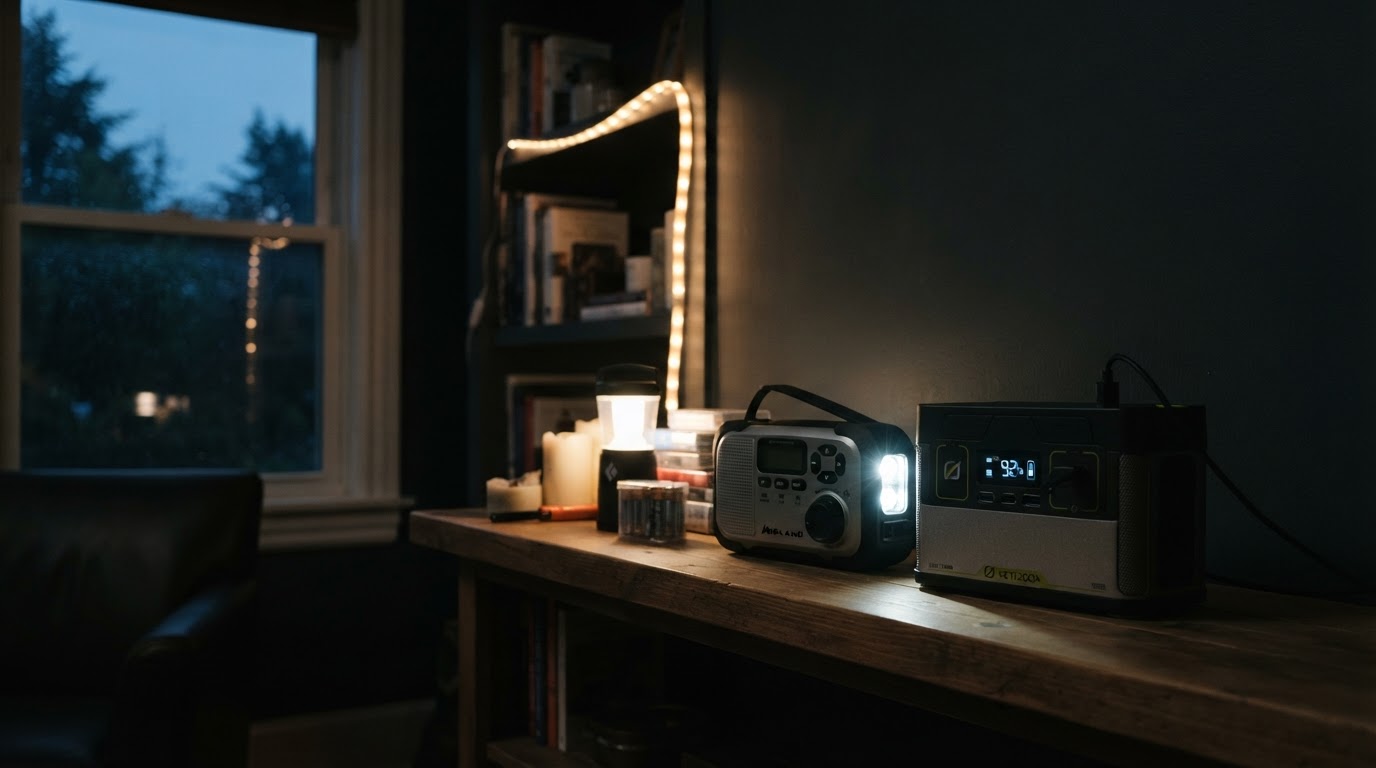
How to light your home without power: LED run-time math, why a battery station beats candles, and the radios with built-in lights that carry a 2026 outage.
This article contains affiliate links. If you buy through these links, we may earn a small commission at no extra cost to you.
The answer is LED, and the math is small enough to do in your head: 245Wh at 10W is 24 hours on paper, about 20 after the inverter's losses; a 5W USB strip stretches that to days; and a crank radio with a built-in reading light never stops as long as you'll turn the handle. Candles are how an inconvenience becomes a house fire. The setup worth building is three layers: a battery power station, radios with lights built in for the long haul, and a headlamp per person for everything between.
The One-Line Run-Time Math
Lighting is the cheapest emergency to solve because LEDs drink almost nothing compared with the rest of your outage load:
| What it runs on | Draw | Time from a 245Wh station | Verdict |
|---|---|---|---|
| 10W LED lamp | ~10W | ~20 hours | One per living room, the workhorse |
| 5W USB LED strip | ~5W | ~2 days | Halls and stairwells, cheap |
| Phone flashlight | 1–2W | Days, but it's your comms device | Last resort only |
| Crank radio lamp | Crank | Indefinite | The never-quits layer |
The 245Wh figure is the battery inside the EcoFlow RIVER 3 Portable Power Station, and it turns lighting from a consumable into a one-time purchase you can recharge from the wall, your car, or a fold-out solar panel.
Why LED, and Why Not Candles or Your Phone
Two shortcuts look appealing and both fail the test.
Candles. Open flames are how a contained outage turns into a fire call. The National Fire Protection Association's five-year averages count roughly 7,400 home structure fires a year started by candles, with about 90 deaths and 670 injuries, and December is the peak month — exactly when outages bring the strongest urge to light something. NFPA's review of fatal candle fires found the home had lost power in about a quarter of them. A knocked-over candle, a curtain, and a house already dark: the cost is not comparable to a $15 LED lamp.
Your phone. It's a flashlight, but it's also your contact with the outside world. Every hour as a torch is an hour the battery isn't there when you need to text someone or check a NOAA broadcast. A ten-dollar USB task light solves it: our pick is the GXILEE 5V COB LED Strip Lights 6ft with USB Dimmer…, a 6-foot strip on an inline dimmer that sticks along a hallway and sips from a power station for days.
LEDs use at least 75% less energy than incandescent bulbs for the same light, per the U.S. Department of Energy, so a 10W LED roughly matches the old 60W bulb's ~800 lumens. The math assumes a standard 60W-equivalent LED bulb, like the Philips LED 60W A19 Light Bulbs, Soft White, 4-Pack… (a four-pack runs about $12), so the lamp beside the station can be any lamp you already own. A 200–300 lumen headlamp per person covers moving around the house and keeps light where you're looking. The Energizer PRO-400 Rechargeable Headlamp hits that at 500 lumens on high with a red-light mode that preserves night vision.
The Setup: A Power Station and Radios with Built-in Lights
A big floodlight lantern is the one thing most houses don't need — light that throws everywhere isn't where an outage wants it. What earns a spot is an inflatable solar lantern that lights one room and packs flat, like the BioLite Luci Emergency Lantern: it charges from the sun or USB-C, floats if it ends up in a bucket, and its ~24-hour low setting is the "no dead batteries anywhere" room light. So the full setup is solar lantern + battery power + radios that already carry lights, three cheap, overlapping layers.
- EcoFlow RIVER 3 Portable Power Station, 245Wh, recharges from wall, car, or solar. Runs a 10W lamp ~20 hours, a CPAP or a modem for a night, and recharges your headlamps and phones. This is the backbone.
- Kaito KA500 Emergency Radio, five power inputs (AC, DC, batteries, solar, hand crank) and a built-in reading lamp. Crank power is slow, so this is the "no electricity left in the world" layer, not the living-room floodlight. A standalone option is Coghlan's Dynamo Flashlight, a rechargeable LED flashlight with a hand crank.
- Midland ER310 Emergency Radio, 72+ hour battery, a real flashlight, a flashing SOS beacon, and NOAA SAME alerts. The beacon turns "I'm out here" into something a search party can see for miles.
Both radios run on AA batteries, so the consumable layer is one purchase: a Energizer MAX AA Batteries, 24 Count 24-pack carries a 10-year shelf life.
| Piece | What it lights | How far it takes you | Best job |
|---|---|---|---|
| EcoFlow RIVER 3 | Any USB/AC LED lamp or strip | ~20 h on a 10W lamp | The backbone, recharges everything |
| Kaito KA500 | Built-in reading lamp | Indefinite via crank | The never-quits fallback layer |
| Midland ER310 | Built-in flashlight + SOS | 72+ h on internal battery | Carry-outside and signal |
Put the power station on a shelf you can reach in the dark, keep a lamp plugged in next to it, and hang a headlamp on each bedroom door — the Petzl Tikkina Headlamp (300 Lumens) is the per-person pick at about $20.
Match the light to the job
One of each beats a bigger version of any:
- Flashlight: one per adult, staged on the nightstand — not your phone.
- Headlamp: one per person, hung where you can find it by feel.
- Lantern: a dimmable low mode lights a room without glare; the solar BioLite Luci Emergency Lantern runs ~24 hours on low and never needs batteries.
- USB strip: draws ~5W, so it runs for days off the station — right for halls, stairs, and the counter.
- Candles: skip them; open flames are how outages become fires.
Route cords along walls and tape them down, keep floor-level lights out of walkways, and stage the bedroom-to-bathroom path before dark.
The $0 version: gather the flashlights and camping headlamps you already own, load fresh batteries, and stage them where this list says.
The Fire and Carbon Monoxide Rules
Lighting appliances inside a closed house come with two hard rules:
Generators go outside, 20+ feet from doors and windows, never in a garage. Carbon monoxide is invisible and kills in minutes; the power outage survival guide for 2026 covers the full rule set. A battery station sidesteps all of it: silent, indoor-safe, no fuel to store.
Don't lean on gas stoves or ovens for light or heat. It's a CO risk, and our winter storm survival guide hammers the same point.
If you reach for candles anyway, they belong in deep, stable holders on a hard surface, out of reach of curtains and pets, and never left burning in an empty room.
Your Lighting Checklist
- 10W LED lamp + dedicated outlet strip beside the power station
- Headlamp per person, hung where you can find it by feel (Energizer PRO-400 Rechargeable Headlamp, rechargeable, red-light mode, IPX4)
- Radio with built-in light: Kaito KA500 Emergency Radio (crank) and Midland ER310 Emergency Radio (flashlight + SOS)
- USB strip for halls and stairs (no open flame)
- Battery station charged and stored dry (EcoFlow RIVER 3 Portable Power Station is our pick)
- Spare batteries beside each radio — Energizer MAX AA Batteries, 24 Count covers both (AA)
- Assign one lamp to the kitchen — cooking in the dark invites burns
The fridge stays closed longer when you're not spelunking in the dark: see how long food lasts without power for the 4-hour and 48-hour clocks.
Ten minutes of prep covers this one. Buy the lamp, hang the headlamps, charge the station, and an outage stops being a reason to stumble around gripping a candle.
Frequently asked questions
What is the best light source during a power outage?
Battery LED lanterns for rooms, a headlamp per person for hands-free tasks, and a magnetic flashlight that sticks to the fridge or breaker panel. Candles are the last choice: fire agencies say use flashlights, not candles, during an outage.
How many lumens do I need during a power outage?
A 200 to 300 lumen headlamp per person covers moving around safely; a 500 to 1,000 lumen lantern lights a shared room. More is not better; glare destroys the night vision you need for the unlit parts of the house.
What do I do if the power outage lasts several days?
Rotate light sources to conserve batteries: one room lantern in the evening, headlamps for tasks, red-light mode at night to preserve sleep cycles. Recharge from a power station or car, and stage lights where you will need them before dark.