
What Size Generator to Run a Well Pump (2026)
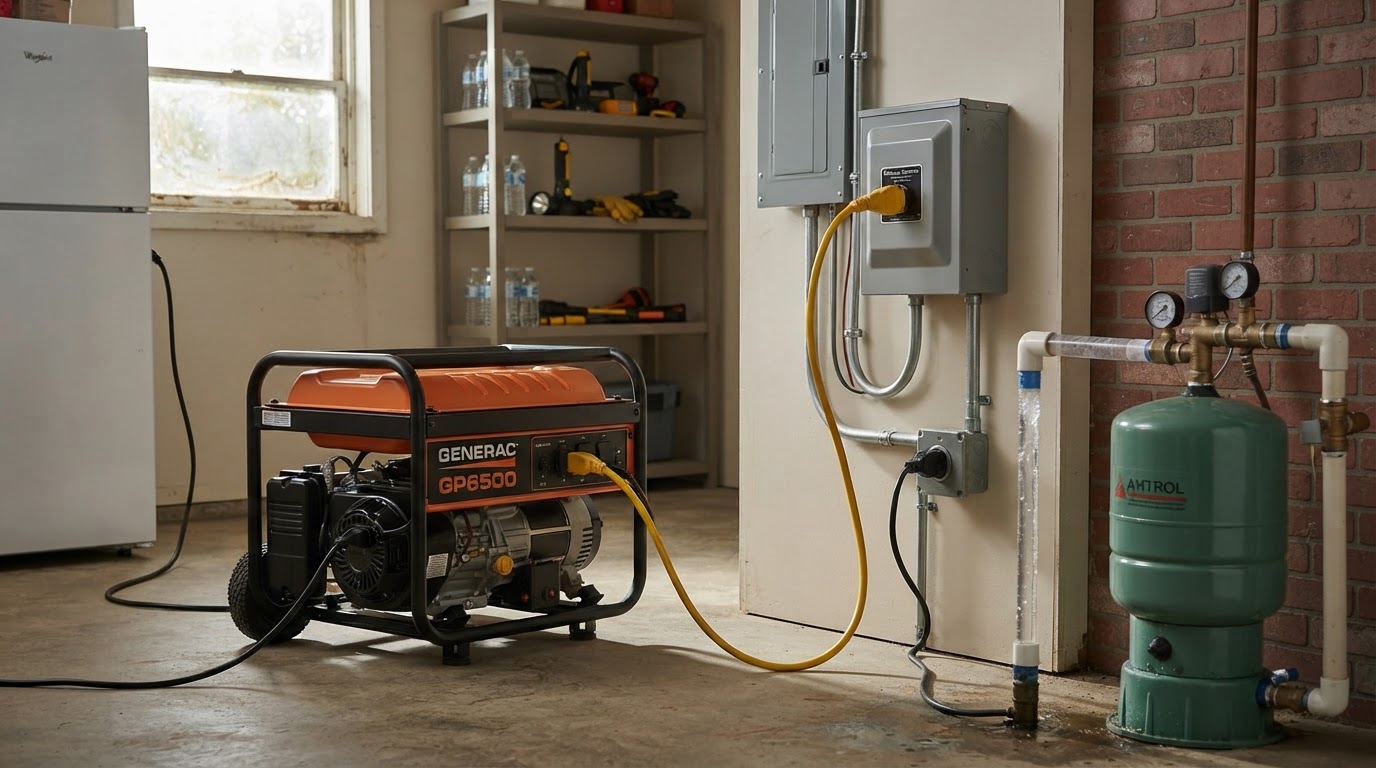
What size generator runs a well pump? Horsepower sizing table, the 240-volt rule, transfer-switch setup, and a worked pump-plus-fridge example for 2026.
This article contains affiliate links. If you buy through these links, we may earn a small commission at no extra cost to you.
With November storms already cutting power on both coasts, well owners face a quiet second outage: no power means no water. A 1/2 HP well pump needs a 3,500 to 4,000 watt generator with a 240-volt outlet, and a 1 HP pump needs 5,000 to 7,500 watts. Size by starting watts, not running watts, because the motor surges to two or three times its running draw for a second at startup.
- A pump motor surge sets the generator size, not the running watts
- Most deep-well pumps need 240 volts, which rules out 120-volt-only portables
- Find horsepower and voltage on the nameplate, control box, or breaker panel
- Well pumps are hardwired, so power must come through a transfer switch
- A half-horse pump plus a fridge fits a 5,000-watt running class generator
What size generator for a well pump: the horsepower table
Running watts keep the pump spinning. Starting watts get it moving, and they run roughly two to three times higher for a second or two each time the pressure switch calls for water. Figures below are planning ranges drawn from pump-maker sizing tables and generator-maker wattage charts. Your pump nameplate has the final word.
| Pump motor | Running watts | Starting watts | Generator for the pump alone |
|---|---|---|---|
| 1/3 HP | ~750 to 1,000 | ~2,000 to 3,000 | 3,000 to 3,500W |
| 1/2 HP | ~1,000 | ~2,000 to 3,000 | 3,500 to 4,000W |
| 3/4 HP | ~1,500 | ~3,000 to 4,500 | 5,000 to 6,500W |
| 1 HP | ~2,000 | ~4,000 to 5,500 | 5,000 to 7,500W |
| 1-1/2 HP | ~2,500 to 3,000 | ~5,000 to 7,500 | 10,000W or standby |
The table covers the pump only. Add running watts for the fridge, furnace fan, and lights, then add the single largest starting surge (usually the pump) once. For the full worksheet, see our home generator wattage math. For what the pump outage means in gallons, see well water when the power goes out.
Find your pump horsepower and voltage first
The pump sits down the borehole where you cannot read it, so follow the paperwork trail. A separate control box between the pressure switch and the well means a 3-wire pump, and its label lists horsepower and voltage. No box usually means a 2-wire pump, which needs the larger generator column above. A double-pole breaker labeled well or pump means 240 volts. If a label gives volts and amps, multiply them for watts.
The 240-volt outlet and the transfer switch
Voltage decides before wattage does. Most submersible pumps run on 240 volts, reachable only through a 240-volt outlet such as an L14-30R or 14-50R. A 120-volt-only generator cannot run a 240-volt pump at any wattage. The connection is never a plug: well pumps are hardwired, so power must come through a transfer switch or inlet installed by a licensed electrician, joined with a cord like the Reliance Controls PC3010M 30-Amp Generator Cord (about $55, rated 4.8 stars). Never backfeed through a dryer outlet. Place the generator outside, 20 feet from the house, per our generator CO safety guide.
Worked example: half-horse pump plus the fridge
Take a rural home with a 1/2 HP pump that wants water, cold food, and lights: 1,000 pump watts plus 700 for the fridge plus 300 for lights and chargers is 2,000 running watts, and the pump's 2,100-watt surge is the largest single spike, so plan for about 4,100 watts peak. A generator with roughly 5,000 running watts covers this house with margin. The Westinghouse WGen5300DFc 6600W Dual Fuel Generator (about $649, rated 4.0 stars, 6,600 peak and 5,300 running watts on gasoline, dual fuel so propane stores for years) fits this exact job. Keep its fuel fresh with stabilized stored gasoline.
Quick recommendations
Pump plus essentials on a budget: Westinghouse WGen5300DFc (about $649). The Westinghouse WGen5300DFc 6600W Dual Fuel Generator covers a 1/2 HP pump plus fridge and lights per the math above, with remote electric start and CO shutdown. Who it is for: well owners whose pump is 1/2 HP or smaller with transfer equipment already planned. Why it wins: dual fuel at a portable price with a 14.5-hour tank.
One-horse pump or whole house: Westinghouse WGen9500DFc (about $1,049). The Westinghouse WGen9500DFc 12500W Dual Fuel Generator (rated 4.6 stars, 9,500 running and 12,500 peak watts, transfer-switch ready) absorbs a 1 HP pump surge with a fridge, freezer, and furnace fan beside it. Who it is for: 3/4 HP and larger pumps, or households that want the pump plus real house loads at once.
Hands-off answer: Generac Guardian 14kW standby (about $5,499 hardware). The Generac Guardian 14kW Home Standby Generator with… (rated 4.9 stars) starts itself within seconds and runs on natural gas or propane. Who it is for: wells as the sole water source, medical equipment in the house, or anyone away from home often. Installation, gas, pad, and permit add thousands more.
Disqualified: small 120-volt inverter portables for the pump itself. Fine for the fridge and electronics, but they cannot start a 240-volt submersible pump at any load. Keep the small inverter for the kitchen and size a 240-volt machine for the well.
Well pump generator checklist
- Read the pump nameplate or control box for HP and voltage
- Size by starting watts, with headroom above your peak
- Pick a 240-volt model; hire an electrician for the transfer switch
- Stock stabilized fuel or propane, and test-run quarterly under load
Frequently asked questions
What size generator do I need for a 1/2 HP well pump?
Plan for a 3,500 to 4,000 watt generator with a 240-volt outlet. A 1/2 HP pump draws about 1,000 running watts but surges to roughly 2,000 to 3,000 watts for a second at startup, so starting watts set the size. Confirm your pump voltage and horsepower on the nameplate first.
Can a portable generator run a well pump?
Yes, if it has a 240-volt outlet, covers the pump starting watts, and feeds the pump through an electrician-wired transfer switch or inlet. A standard 120-volt-only portable cannot run a 240-volt submersible pump at any wattage, and a well pump must never run off an extension cord.
Can I plug my well pump into a generator with an extension cord?
No. Well pumps are hardwired to a breaker, so there is nothing to plug in. Generator power must reach the pump through a transfer switch or a dedicated inlet installed by a licensed electrician. Backfeeding through a wall or dryer outlet can energize utility lines and injure line workers.