
Well Water When the Power Goes Out: What You Have and How to Get More
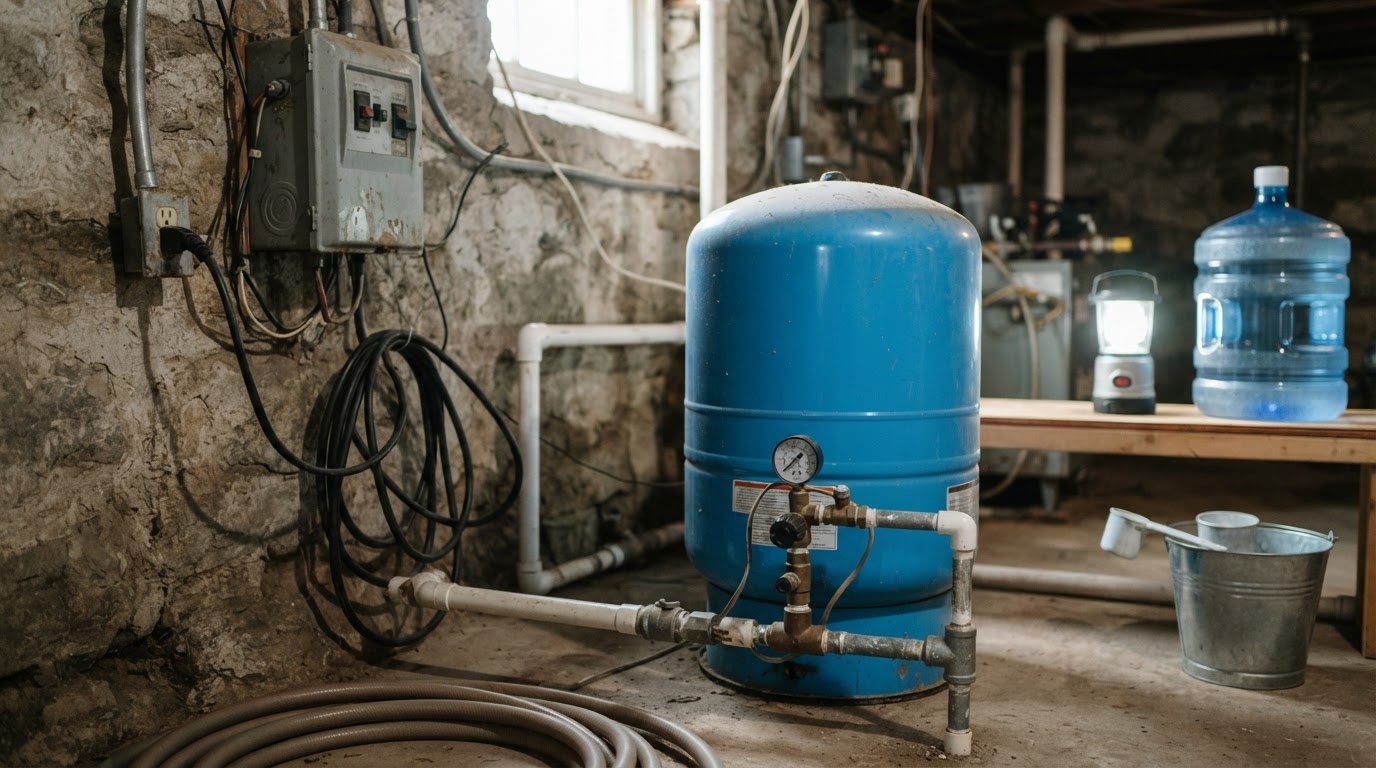
When the power goes out, a private well goes quiet with it. Here is what your pressure tank still holds, what it takes to run the pump, and how to refill.
This article contains affiliate links. If you buy through these links, we may earn a small commission at no extra cost to you.
If your home runs on a private well, a power outage is a water outage. The pump sits down the borehole, the power comes from the pole, and when one stops, so does the other. No utility crew is coming to restore your water; the fix is a generator, a store of water, or both. This guide is for well owners; on a utility main, start with what to do when the water goes off.
Quick answer: When the lights go out, fill your largest containers first. A pressure tank holds only about a quarter to a third of its nominal size as usable water (drawdown tables from tank makers such as Amtrol put a 32- to 44-gallon tank at roughly 8 to 13 gallons), and the taps go quiet once it drains. After that you are on stored water, and FEMA and the American Red Cross both set the floor at one gallon per person per day. Getting more means either a generator with 240-volt output sized for the pump's starting watts, or hauled water treated before it is drunk.
The first ten minutes: drain the reserve into containers
When the power dies, the pump stops but the tank does not empty itself. That reserve flows from your taps until the pressure is gone, and it is the only water you get without power. Fill drinking containers first (jugs, bottles, the kettle), then cooking pots, then the bathtub for flushing water. A full 5-gallon bucket weighs about 40 pounds; keep the heavy ones on the floor.
Leave the tank itself alone. A bladder tank is a sealed, pressurized vessel, and its fittings are not a tap. Draw from the faucets.
Two other reservoirs come with the house: the water heater holds 40 to 80 gallons, and each toilet tank a few more. Our guide to water sources already in the house covers how to get at both safely.
One switch to check: if the well house flooded or pump equipment went underwater, turn the pump breaker off and leave it off until it is inspected. Restarting a submerged pump can wreck it, and CDC guidance for flooded wells is to treat the water as contaminated until the system is disinfected and tested.
Why the pump needs more than a small generator
Submersible well pumps are not like a fridge. Most deep-well pumps run on 240 volts, and the motor pulls two to three times its running wattage for a second or two at startup. A half-horsepower pump draws about 1,000 running watts, so plan for 2,000 to 3,000 watts to start it, per pump and generator sizing guidance. A typical 120-volt portable generator cannot run one at all.
Even a big enough generator cannot simply be plugged in. Well pumps are hardwired to a breaker, so generator power has to come through a transfer switch or a generator inlet wired in by an electrician, not an extension cord. The home generator guide walks through the wattage math and what the install costs; the short version is that well owners end up in the 9,500-watt class, like the Westinghouse WGen9500DFc 12500W Dual Fuel Generator (about $1,049, 9,500 running and 12,500 peak watts, dual fuel so a propane tank stores for years).
The generator rules do not change because you are rural: outside only, at least 20 feet from the house, never in a garage, with a working CO alarm inside (CPSC guidance). The power outage survival guide has the full setup, and if you are burning gasoline, store it stabilized.
What to store, and how much
FEMA's baseline is one gallon per person per day for at least three days. On a well, treat that as a starting point rather than a target: nothing comes back on until the power does, and a storm that takes the grid for a week takes your water for the same week. Two weeks of drinking and cooking water is the number most well owners settle on, and the two-week water budget runs the full math, pets and flushing included.
The containers matter as much as the gallons. You want a stack you can carry, pour from, and rotate. Two 7-gallon jugs with spigots, like the Reliance Aqua-Tainer 7 Gallon Water Container… (about $52 for the pair), cover drinking and cooking for one person for two weeks and stack in a closet corner. Store them out of sunlight and replace the water every six months, per CDC storage guidance; that also keeps the plastic from taking on a taste.
Hauling water, and treating it
If the outage runs long, refill where water still flows: a friend or relative on city water, a community water station your county opens, or a store once it reopens. Five-gallon jugs are the practical unit, and only labeled food-grade containers should touch drinking water.
Treat anything from an unknown source before drinking it. The CDC rule for questionable water is a rolling boil for one minute, or three minutes above 6,500 feet, and a certified filter or disinfectant works when boiling is not practical. For hauling, Aquatabs 49mg Water Purification Tablets (30 Pack) (about $12) are EPA- and NSF-certified: one tablet per one to two liters, 30 minutes, no fuel or stove needed. If the water is cloudy, filter the sediment out first; our filter and purifier guide has the flow rates and capacities.
If the well itself flooded, stop. CDC guidance is blunt: do not drink or use the water until the well has been inspected, disinfected, flushed, and tested, a job usually handled by a well contractor. That is a multi-day process, and it is exactly what stored water is for.
When the power comes back
The pump restarts on its own once the breaker is on and power returns. Expect sputtering and air at the taps for a minute; run a cold tap until the flow is steady, then refill your containers before the next storm.
If winter did the damage instead, a frozen line between the well and the house is the usual culprit. Thawing frozen pipes covers what to warm and what to leave alone.
Quick recommendations
- Store it: Reliance Aqua-Tainer 7 Gallon Water Container…, two 7-gallon jugs with spigots, about $52
- Treat hauled water: Aquatabs 49mg Water Purification Tablets (30 Pack), about $12, EPA- and NSF-certified
- Run the pump: Westinghouse WGen9500DFc 12500W Dual Fuel Generator, about $1,049, transfer-switch ready and dual fuel
Sources: CDC guidance on emergency water supply and disinfecting wells, EPA's page on private wells after a flood, FEMA and American Red Cross water-storage minimums, CPSC generator placement guidance, and manufacturer drawdown tables (Amtrol).